Health
Trump orders a new NIH women’s health division. Here is what changes next
The October 19 order sets a 90-day deadline and creates a White House task force. Research funding and practical results still depend on implementation.
What to know
- HHS and NIH are directed to establish the new division within 90 days of the October 19 order.
- The division is to coordinate with the existing NIH Office of Research on Women's Health.
- A White House task force will work on research, prevention, diagnosis, treatment and care across stages of life.
- Implementation is subject to applicable law and available appropriations; the order does not specify a new total research appropriation.
President Donald Trump signed an executive order Monday directing federal health officials to establish a Women's Health Division within the National Institutes of Health. The order gives officials 90 days to create the division inside an appropriate NIH institute or center and sets up a White House task force to coordinate work across the government.
For patients, the immediate development is a change in federal research organization and priorities. The document does not announce an approved treatment or guarantee that a particular test, appointment or medicine will become available on a set date.
What the new division would do
The signed executive order directs the division to strengthen research into conditions that remain understudied, coordinate work across disciplines and help move scientific discoveries into clinical practice. Its duties include replication studies, better research and data-collection methods, and greater inclusion of women and girls in clinical trials.
It also calls for accountability among grant recipients under NIH's policy on considering sex as a biological variable. That is a specific research requirement named in the order; it is not a claim that the new division has already changed current clinical-trial results.
The document identifies a broad range of research needs, including heart disease, cancer, stroke, autoimmune conditions, chronic pain, endometriosis, fibroids, infertility, maternal health, menopause and aging. The administration's stated aim is to connect research with prevention, diagnosis and care throughout life.
How the task force fits in
The new task force is co-chaired by the health and human services secretary and the president's chief of staff. Its membership spans federal health agencies and other departments. HHS is assigned to cover its administrative costs.
The order allows the co-chairs to seek expert input through hearings, meetings and other events. Its functions include advising on evidence-based practices, research priorities and opportunities for pilot programs. It also calls for consultation with states, tribal nations, local organizations, researchers and the private sector.
In its October 19 fact sheet, the White House presents the action as a way to improve coordination and bring discoveries into care faster. Those are the administration's goals; whether the structure achieves them will depend on the work that follows.
What the order does—and does not—settle
The order explicitly revokes a March 2024 executive order on women's health research and a November 2023 presidential memorandum establishing a White House initiative. Readers should therefore understand this as a new organizational framework that replaces earlier presidential directives, rather than a statement that federal women's health research began today.
The document leaves important implementation questions open, including which NIH institute or center will house the division and how its work will be staffed and funded. It also preserves existing legal authorities and makes implementation conditional on available appropriations.
The first concrete milestone to watch is the 90-day establishment deadline. After that, published research priorities, funding decisions, trial design and measurable patient outcomes will provide more useful tests of progress than the announcement alone.
Photograph and reuse notes
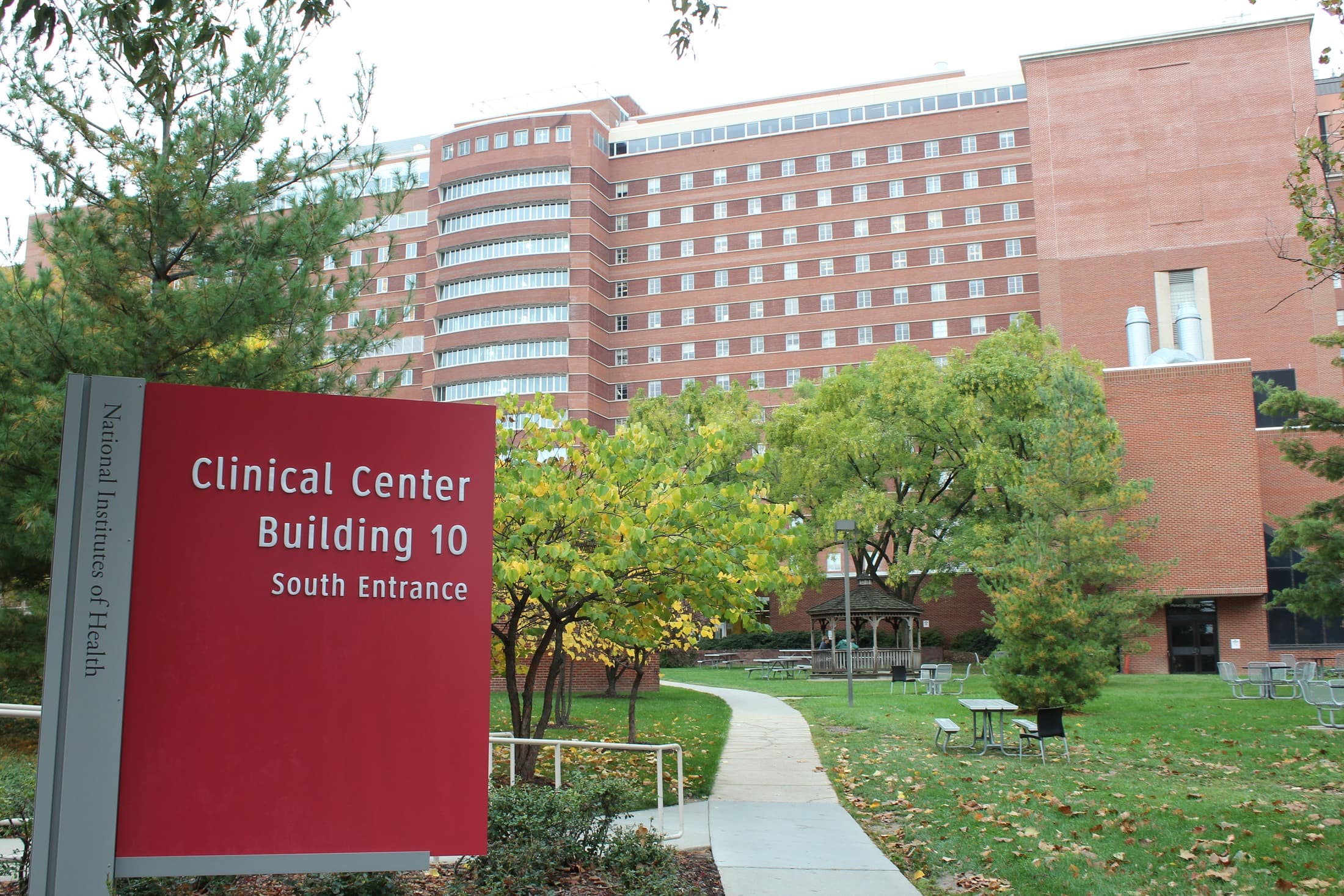
The NIH Clinical Center south entrance in Bethesda, Maryland, in an archive photograph dated October 16, 2014. The new division’s host institute or center has not been announced in the order. Photo: Masm2016 / Wikimedia Commons, CC BY-SA 4.0. The website photograph is resized/compressed with responsive display cropping. Social adaptations add a crop, contrast gradient, NewsCubby branding and translated headline. The photograph and adapted cards retain CC BY-SA 4.0; no additional restrictions are imposed. Original photograph and rights record; license.