World
Breaking: Florida arrest warrant targets Raúl Castro over 1996 downing of two planes, renewing scrutiny of repression and exile
The newly reported state case is separate from May’s federal indictment. Four deaths anchor a wider reckoning with the Castro system and the Cubans who have lived under it.
What to know
- The newly reported warrant is a Florida state action, separate from the federal indictment announced on May 20.
- The case concerns the destruction of two civilian planes on February 24, 1996, killing Carlos Costa, Armando Alejandre Jr., Mario de la Peña and Pablo Morales.
- A warrant is not a conviction. No arrest of Castro was established in the reporting reviewed for this article.
- The Castro brothers led Cuba’s government consecutively from 1959 to 2018; Raúl retained the Communist Party’s top position until 2021.
A Miami judge has signed a Florida arrest warrant for Raúl Castro over the 1996 destruction of two Brothers to the Rescue aircraft, according to reporting by the Miami Herald and Fox News, both of which say they obtained court documents. The development adds a state case to an existing federal prosecution of Cuba’s former leader. Miami Herald, reported by Liv Caputo, Fox News, Landon Mion and Lorraine Taylor.
The allegations concern four men killed while flying with an organization that searched for Cuban migrants at sea. They also renew scrutiny of the authoritarian system Fidel and Raúl Castro built, the repression that survived their departures from formal leadership, and the generations of Cubans who have sought safety and opportunity abroad.
What the new warrant alleges
The Herald reports that Chief Judge Ariana Fajardo Orshan of Florida’s 11th Judicial Circuit signed the warrant Friday, October 16, following a Florida Department of Law Enforcement investigation. The alleged offense is conspiracy to commit first-degree murder. The state’s jurisdictional argument centers on Cuban intelligence activity inside Florida: investigators allege that agents infiltrated Brothers to the Rescue and transmitted information about its flights. Those remain allegations to be tested in court. Herald/Times reporting.
Fox News reports that the warrant provides for no bond and seeks Castro’s return to Florida if he is arrested in another U.S. jurisdiction. It quotes the document as saying: “The investigation revealed evidence of a conspiracy to kill persons aboard BTTR aircraft.” NewsCubby has reviewed the outlets’ reporting but has not independently obtained the new state warrant. Fox News.
That distinction matters: this is a reported judicial action in Florida, not a newly announced federal indictment, and it does not establish that Castro is in American custody.
Four lives at the center of the case
On May 20, the Justice Department announced a superseding indictment charging Castro and five co-defendants over the attack. Federal prosecutors allege that Cuban fighter jets destroyed two unarmed civilian Cessnas outside Cuban territory, killing three U.S. citizens and one lawful permanent resident. The charges include conspiracy to kill U.S. nationals, destruction of aircraft and murder. Justice Department announcement.
The victims were Costa, Alejandre, de la Peña and Morales. Their names are essential to understanding a case often discussed through the language of diplomacy and regime change: four people died, and their families have waited three decades for accountability.
“For 30 years, the families of these men have waited,” U.S. Attorney Jason A. Reding Quiñones said when the federal charges were announced in May. The Justice Department also emphasized that defendants are presumed innocent unless proven guilty beyond a reasonable doubt. Justice Department.
Cuba has disputed the American case. In a statement reported by The National in May, its government called the federal prosecution a “despicable and infamous act of political provocation” and rejected U.S. jurisdiction. That was Havana’s response to the earlier federal case, not a newly verified response to Friday’s state warrant. The National, Sara Ruthven.
Nearly seven decades of a system the Castros built
Fidel Castro’s rise to power followed the 1959 revolution. By October 2026, almost 68 years have passed since that transformation. But saying the brothers still hold the same offices would obscure the actual succession. U.S. Office of the Historian.
Fidel transferred provisional control to Raúl in July 2006 because of ill health. Raúl formally became president in February 2008. Miguel Díaz-Canel succeeded him as president in 2018 and as Communist Party leader in April 2021. Together, the brothers headed the government for roughly 59 years; Raúl continued leading the Communist Party for another three years after leaving the presidency. Congressional Research Service’s succession history, CRS policy overview.
The change in personnel did not produce competitive democracy. Freedom House’s 2026 assessment gives Cuba 9 points out of 100 and classifies it as “Not Free.” Its assessment describes a one-party state that suppresses dissent, restricts civil liberties and prohibits political pluralism. The central issue is therefore the survival of institutions that deny Cubans a meaningful electoral choice, beyond the question of which leader occupies a particular office. Freedom House.
Repression documented across generations
The record of abuse is supported by investigations independent of today’s prosecutors. Human Rights Watch’s 2009 report, New Castro, Same Cuba, documented more than 40 cases in which Raúl’s government imprisoned people under the then-existing offense of “dangerousness” for exercising basic rights. Activities included peaceful marches, critical journalism and efforts to organize independent unions. The finding was historical and specific: succession from Fidel to Raúl had preserved machinery used to punish dissent. Human Rights Watch’s 2009 investigation.
More recent reporting shows the consequences continuing under Díaz-Canel. Human Rights Watch’s World Report 2026, covering events in 2025, describes arbitrary detention, intimidation of activists and journalists, harassment of prisoners’ relatives, and courts subordinate to the executive. It cites Justicia 11J’s finding that 359 people connected with the July 2021 protests remained imprisoned in October 2025, with sentences reaching 22 years. Those are dated findings, not an October 2026 prison census. Human Rights Watch’s 2026 report.
A current case brings that history into the present. On October 15, Amnesty International reported that Roberto Pérez Fonseca was serving a ten-year sentence for participating in the July 2021 protests. His family described repeated punishment-cell confinement, restricted contact and deteriorating health. Amnesty called for his unconditional release. Amnesty’s October 15 urgent action.
“The Cuban authorities continue to administer freedom as if it were a discretionary concession and not an obligation of the state,” Amnesty’s Americas director, Ana Piquer, said in April. The organization warned that announced releases could leave people facing surveillance, restrictions and the threat of reimprisonment. Amnesty International.
Exile is part of the human cost
Cuba’s diaspora provides powerful evidence of the scale of departure, but numbers alone cannot establish each person’s motivation. Political persecution, economic deprivation, family reunification and hopes for a different future can overlap. A Congressional Research Service overview explicitly identified both political repression and difficult economic conditions as drivers of the migration surge it examined. CRS.
The Migration Policy Institute’s 2023 analysis, using 2021 census data, counted nearly 1.3 million Cuban immigrants in the United States. Its pooled 2017–2021 data placed 76 percent in Florida. These figures describe an earlier baseline, not today’s total, and exclude U.S.-born descendants from the immigrant count. They nevertheless show how deeply Cuban displacement has shaped American communities. Migration Policy Institute.
Individual cases show the connection between repression and exile more directly. In July 2026, Amnesty reported the arrival in the United States of artist Luis Manuel Otero Alcántara after nearly five years of imprisonment. The organization said his prosecution punished artistic expression and dissent, and described his exile as a continuation of that punishment. Release from prison, in that account, did not restore the freedom to live and speak safely in his own country.
Ordinary Cubans bear the consequences
The political crisis is inseparable from daily hardship. In a July 2026 policy brief, Freedom House described shortages of food, medicines, fuel and electricity alongside decades of centralized control and economic mismanagement. It also acknowledged that intensified U.S. measures were worsening shortages. An honest account must recognize those external pressures while examining the Cuban authorities’ responsibility for governance and repression. Freedom House policy brief.
For families seeking medicine, reliable power or enough food, accountability has a practical meaning. So does the ability to criticize officials, organize peacefully and demand better services without facing punishment. Those needs should remain central as governments argue over sovereignty, sanctions and criminal jurisdiction.
What happens next
The immediate questions are whether the new state documents become publicly available, what additional evidence Florida presents, and whether authorities can bring Castro before a court. The reporting reviewed does not establish an arrest or a trial date.
The warrant may advance a specific criminal case. It cannot, by itself, release political prisoners, repair living conditions or restore the choices denied to generations of Cubans. The measure of change will be whether people can live safely, speak freely and build a future at home—without imprisonment or exile being the price of disagreement.
Photo and reporting notes
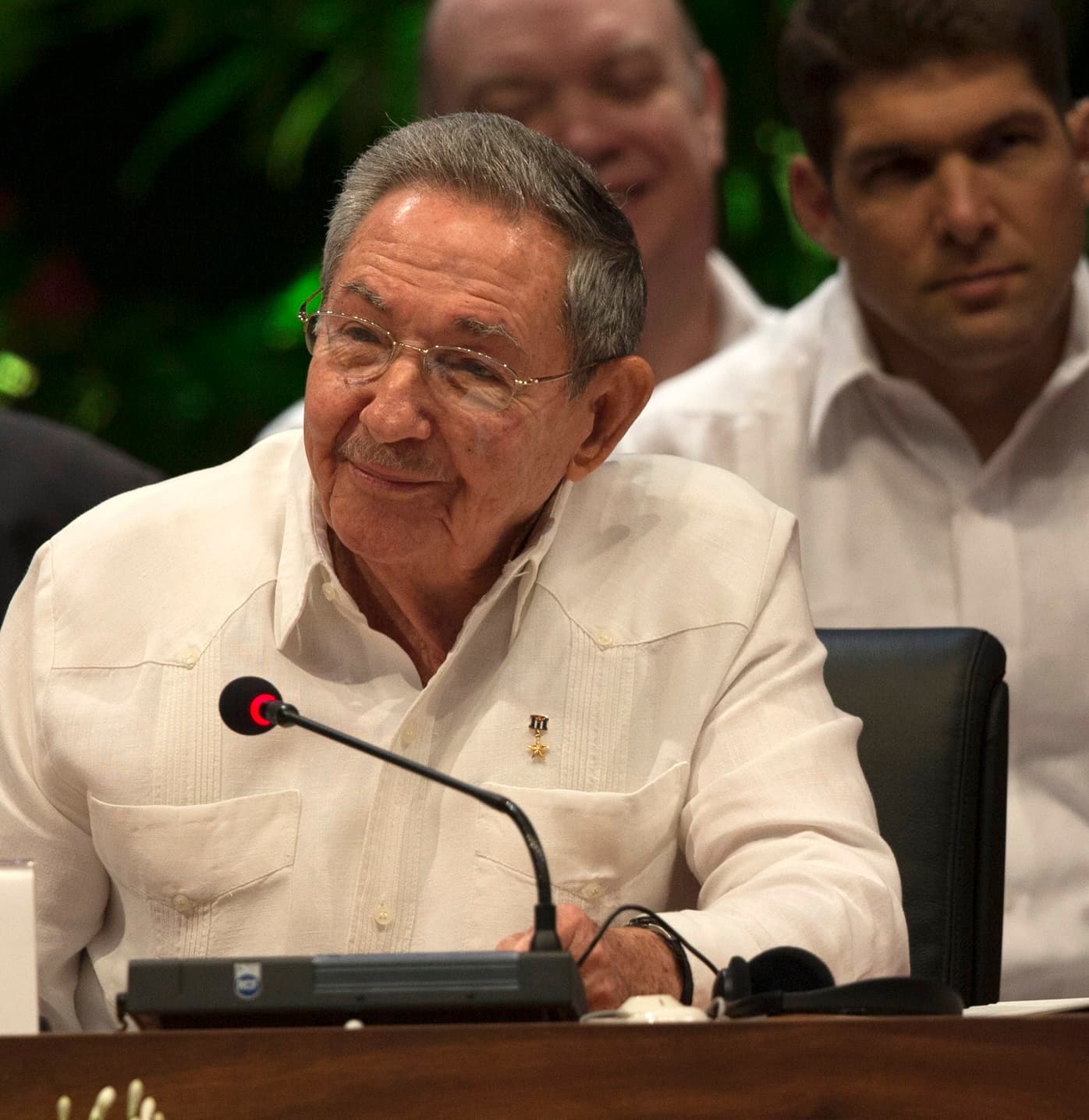
Archive photograph: Raúl Castro at the Association of Caribbean States summit, June 4, 2016. Photo: Presidencia de El Salvador / Wikimedia Commons, CC0 1.0. The photograph does not depict an arrest or the current proceedings. Social cards add a crop, gradient, headlines and NewsCubby branding. Reporting is based on the named linked sources; NewsCubby did not conduct the quoted interviews.
Sources, credits & editorial notes
- Herald/Times reporting
- Fox News
- Justice Department
- The National, Sara Ruthven
- U.S. Office of the Historian
- Congressional Research Service’s succession history
- CRS
- Freedom House
- Human Rights Watch’s 2009 investigation
- Human Rights Watch’s 2026 report
- Amnesty’s October 15 urgent action
- Amnesty International
- Migration Policy Institute
- Amnesty’s July statement
- Freedom House policy brief
- Photo: Presidencia de El Salvador, Raúl Castro, June 4, 2016, CC0 1.0
- Photo license: CC0 1.0 Universal Public Domain Dedication