Technology
EU Challenges TikTok’s ‘For You’ Feed Over Harmful Loops
The European Commission says TikTok failed to assess and reduce risks from repeated recommendations. TikTok disputes the preliminary finding.
What to know
- On November 6, the European Commission said TikTok’s feed may repeatedly steer users toward potentially harmful content.
- Regulators question both TikTok’s assessment of risks and the effectiveness of measures meant to reduce them.
- TikTok disputes the assessment and says it gives users control over their experience.
- A confirmed violation could result in penalties of up to 6% of the provider’s worldwide annual turnover, subject to the applicable decision and law.
- The proceeding concerns TikTok’s obligations under European Union law.
The European Commission has provisionally found that TikTok breached the European Union’s Digital Services Act by failing to adequately assess and reduce risks associated with its personalized “For You” feed.
The Commission said repeated recommendations can draw users into what regulators call “rabbit holes”: streams of similar material that may become harmful when they repeatedly concern subjects such as sadness, isolation, body image or mental health. Its November 6 announcement says children and vulnerable adults can be particularly affected.
TikTok rejects the assessment. The company told The Associated Press that the Commission’s findings misrepresent the platform’s design and its commitment to user safety. The company will have an opportunity to respond before regulators decide whether to issue a final decision.
What is the Commission challenging?
TikTok’s For You feed presents a stream of recommended videos tailored to the viewer. The Commission says a person’s interaction with one kind of material can lead the system to suggest more of the same, increasing repeated exposure to a subject.
Its concern is not that every video about a difficult subject is prohibited, or that every person who encounters such content will experience harm. Regulators are examining the way a recommendation system can repeatedly deliver related material and whether the company has adequately assessed and mitigated the resulting risks.
The Commission’s examples include videos related to sadness, isolation and body image. It says repeated exposure can have a detrimental effect on mental well-being, especially for minors and adults who are vulnerable. Those are the regulator’s findings at this stage, rather than an independent conclusion that the feed causes a particular outcome in every user.
A recommendation system is a set of processes that selects or ranks items for a user. On a video app, a feed can respond to signals from earlier activity. Reuters reported that the Commission wants TikTok to put greater weight on users’ explicit preferences, improve the accessibility of controls and regularly test its algorithm. These are changes regulators say are needed, not completed changes that TikTok has already agreed to make.
Why does the finding remain preliminary?
The Digital Services Act provides for an investigation before a final noncompliance decision. Preliminary findings tell the company how the Commission currently views the evidence and give it a chance to examine the case and respond.
TikTok can contest the Commission’s interpretation and provide its own arguments. The regulator must consider the response and the remaining procedural steps before deciding whether its initial conclusions should become final.
The November 6 notice gives TikTok an opportunity to challenge the findings. The Commission would determine any remedies or penalty in a final decision. The 6% figure sets the maximum possible fine under the law.
The Commission’s description of DSA supervision tracks its actions involving designated very large platforms. Its public record separates opened proceedings, preliminary findings, commitments and decisions. Each label reflects a different point in the process.
What does TikTok say about the feed?
TikTok told AP that it considers the findings inaccurate and said it has tools to help users influence their experience. The company also described protecting its community as part of its approach to safety.
TikTok offers a “not interested” control, but the Commission says viewing-time signals can outweigh a user’s choice to see less of a subject. Its November 6 release says that repeatedly watching weight-loss or body-image videos can be interpreted as interest, bringing more of the same material into the feed. The regulator proposes removing viewing time as a recommendation signal, giving more weight to explicit preferences and making controls easier to find and use. These are preliminary findings and proposed changes. TikTok disputes the assessment.
The Commission also calls for regular tests of the algorithm. It says the existing measures to diversify recommendations do not sufficiently reduce how often similar material is shown. Those findings connect the design of the controls with what the feed actually recommends.
The company’s response is an important part of the process. An allegation in a preliminary finding is not a finding that TikTok accepts the regulator’s account, and a company statement does not settle whether its measures satisfy EU law. The next formal submissions and the Commission’s eventual decision will show how those competing positions are resolved.
What does the Digital Services Act require?
The DSA establishes EU-wide rules for online services, with additional obligations for services designated as very large platforms or search engines. The Commission’s overview of the law describes responsibilities involving systemic risks, transparency and oversight.
For the largest services, the framework includes assessing certain risks connected to their design and operation and taking proportionate measures to address them. The present finding focuses on the adequacy of TikTok’s risk assessment and mitigation concerning repeated recommendations.
That structure matters because a regulatory concern can involve the system around content as well as individual posts. A video may remain available while regulators ask how a platform evaluates repeated exposure, offers meaningful controls or tests whether a mitigation measure works.
The Commission is the EU executive responsible for supervising designated very large platforms under the relevant provisions. National authorities also have roles in the broader DSA system. The November finding is part of the Commission’s oversight of TikTok, rather than a ruling by a U.S. court or a new act of Congress.
How does this fit the earlier TikTok investigation?
The Commission opened formal proceedings against TikTok in February 2024. The November 2026 notice is one part of a wider investigation, not the start of an entirely separate assessment of every feature on the service.
In February 2026 preliminary findings, the Commission focused on design features it considered potentially addictive, including infinite scrolling, autoplay, notifications and personalization. Those findings were also preliminary, and TikTok had a right to respond.
In July 2026, the Commission separately announced preliminary concerns about settings for minors’ accounts and the visibility and recommendation of their content. That matter is related to child protection but is not identical to the November finding about repeated exposure in the For You feed.
The sequence shows why a date and a specific issue matter. A headline about “TikTok and the DSA” may refer to addictive design, minors’ account settings or the latest recommendation-system finding. A preliminary notice in one area does not automatically mean a final decision in another.
What could the decision mean for users?
The immediate effect is procedural: TikTok can respond and regulators continue their work. The announcement does not set out a finished rollout that users should expect to see on a particular day.
If the process results in a confirmed violation, the Commission can adopt a noncompliance decision and impose a proportionate fine within the legal ceiling. The outcome could also involve steps intended to address the identified problems. The actual decision, any measures and their timing remain to be determined.
For users, the practical questions concern how easily they can express a preference, find controls and change the stream they see. For parents and guardians, the finding also raises questions about how settings operate for younger users. The Commission’s concern includes vulnerable adults as well as minors, so its assessment is not limited to children’s accounts.
Google’s planned default-off Search and AI settings for school accounts illustrate why a default setting matters to students who never open a settings menu. A separate New Mexico case over Facebook privacy examined a related question about how a platform’s actual practices compare with the controls users see. The TikTok inquiry tests that relationship in recommendations.
What should readers watch next?
The next substantive development will be TikTok’s formal response and the Commission’s assessment of it. A final decision would need to distinguish any confirmed violations from the preliminary allegations and identify any remedies or penalty actually imposed.
Readers can also watch for specific information about the feed: which controls are offered, how recommendations change after a user expresses a preference, and whether the Commission explains how it evaluates the effectiveness of safeguards. Those details matter more than treating the current notice as a completed order to redesign the service.
The Commission’s case concerns services operating under EU rules. Any changes the company makes elsewhere, or any separate enforcement in another jurisdiction, would need its own announcement and evidence.
Want more? Explore today's headlines on NewsCubby and join My Day free to make NewsCubby part of your day.
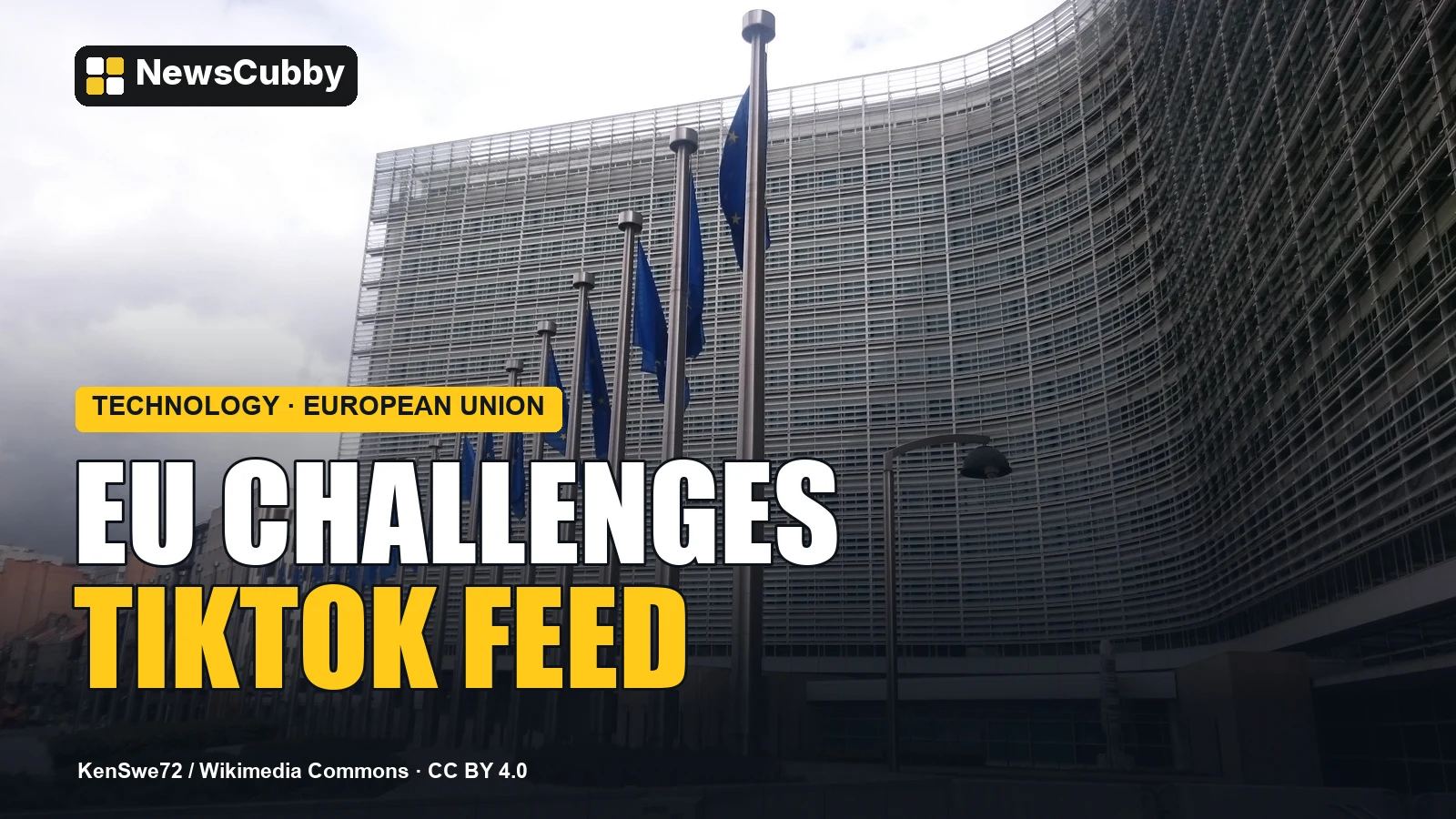
ARCHIVE PHOTO: The European Commission’s Berlaymont building in Brussels, May 14, 2017. Photo: KenSwe72 / Wikimedia Commons, CC BY 4.0. The NewsCubby cover resizes the image and adds a gradient, headline, credit and logo.
NewsCubby articles are produced with AI assistance.
Reporting Sources
- November 6 announcement
- The Associated Press
- Reuters reported
- description of DSA supervision
- overview of the law
- February 2026 preliminary findings
- July 2026
- Google’s planned default-off Search and AI settings for school accounts
- New Mexico case over Facebook privacy
- NewsCubby
- join My Day free
- Associated Press — November 6 reporting and TikTok’s response
- https://ec.europa.eu/commission/presscorner/api/files/document/print/en/ip_26_2361/IP_26_2361_EN.pdf
- https://commission.europa.eu/legal-notice_en
Editorial notes
Sources
- European Commission — November 6 preliminary TikTok feed findings
- Associated Press — November 6 reporting and TikTok’s response
- Reuters — EU findings and requested changes
- European Commission — Digital Services Act overview
- European Commission — DSA supervision of very large platforms
- European Commission — February 2026 preliminary findings on addictive design
- European Commission — July 2026 preliminary findings on minors’ accounts
Photo: KenSwe72 / Wikimedia Commons, CC BY 4.
Video image credits
Berlaymont building, Brussels — KenSwe72. 2017-05-14. CC BY 4.0.
https://commons.wikimedia.org/wiki/File:Berlaymont_building_Brussels.jpg
https://creativecommons.org/licenses/by/4.0/
Henna Virkkunen visiting Greece — © European Union, 2025; Yorgos Karahalis / FACTSTORY / EC Audiovisual. 2025-10-02. CC BY 4.0.
https://creativecommons.org/licenses/by/4.0/
Former TikTok office in California — Coolcaesar. 2024-06-26. CC BY 4.0.
https://commons.wikimedia.org/wiki/File:TikTok_Headquarters.jpg
https://creativecommons.org/licenses/by/4.0/
14 EU Member Flags in front of European Parliament in Brussels — Marek Ślusarczyk (Tupungato). 2009-08-31. CC BY 3.0 Unported.
https://creativecommons.org/licenses/by/3.0/
European Commission preliminary findings, November 6, 2026 — European Commission. 2026-11-06. CC BY 4.0, retained Commission text.
https://ec.europa.eu/commission/presscorner/api/files/document/print/en/ip_26_2361/IP_26_2361_EN.pdf
https://commission.europa.eu/legal-notice_en
Video and cover changes include cropping, motion, resizing, gradient, wording, subtitles and logo.
Original explanatory graphics by NewsCubby, based on the European Commission’s November 6, 2026 preliminary findings.