Science
Why astronauts are preparing to print blood vessels in space
NASA says this week’s work will use patient cells in an orbiting bioprinter. Microgravity offers a research advantage, but the experiment is not a treatment or a proven cure.
What to know
- Watkins prepared the BioFabrication Facility in the station's Columbus laboratory module.
- NASA described blood-vessel printing as planned work for the week; Monday's report did not announce completed results.
- Microgravity can help delicate tissue structures retain their shape during printing.
- Printed research tissue and an approved treatment for a patient are different milestones.
A printer aboard the International Space Station is being prepared to work with something more delicate than plastic or metal: living cells. NASA said Monday that astronaut Jessica Watkins set up the BioFabrication Facility for blood-vessel printing planned during the week.
The work will use cells from patients with a rare genetic disorder that causes rapid aging, according to the agency's October 19 mission update. It is an experiment in building and studying biological tissue, not an announcement that scientists have made a replacement organ or cured a disease.
Why put a biological printer in orbit?
Ordinary 3D printing builds an object in layers. Bioprinting applies a related idea using living cells and materials that support them. The challenge is that soft biological structures do not behave like rigid plastic.
In its background explanation of 3D bioprinting, NASA describes the advantage of the station's near-weightless environment: tissues can grow in three dimensions without the same supporting structures needed under Earth's gravity. The BioFabrication Facility, developed by Redwire, allows researchers to test that possibility in orbit.
This is why location matters to the science. The station is not simply a distant room for a familiar laboratory procedure; its environment changes a physical constraint that makes delicate tissue difficult to build on the ground.
Why blood vessels matter
Blood vessels are central to the longer-term challenge of making useful tissue. Cells need a way to receive the materials that keep them alive. NASA's vascular-tissue research explanation describes blood vessels supplying nutrients to tissue and the potential use of tissue models for disease research and drug testing.
Those potential uses do not establish what this week's experiment will achieve. The current mission report identifies the planned material and preparation; it does not publish a finished study, compare outcomes or announce a clinical application. Those are questions for subsequent research and evaluation.
A project with a longer history
NASA's earlier overview describes successful space-station bioprinting of a human knee meniscus and research on cardiac tissue. Those are distinct investigations, not proof that the current blood-vessel work has succeeded.
The goal of eventually making more useful tissues gives the experiment its importance, but the sequence matters: prepare the equipment, conduct the work, examine what was produced and report the findings. A promising technique should not be described as a ready medical service before those steps establish its capabilities.
What happens next
The next relevant update is whether the planned printing is carried out and what researchers learn from the material. Monday's NASA report placed biomedical research alongside routine station work and preparations for separate spacewalks later this month.
For people reading about medical progress, the useful distinction is between a new research opportunity and a treatment available now. This week's work belongs in the first category.
Sources and photo
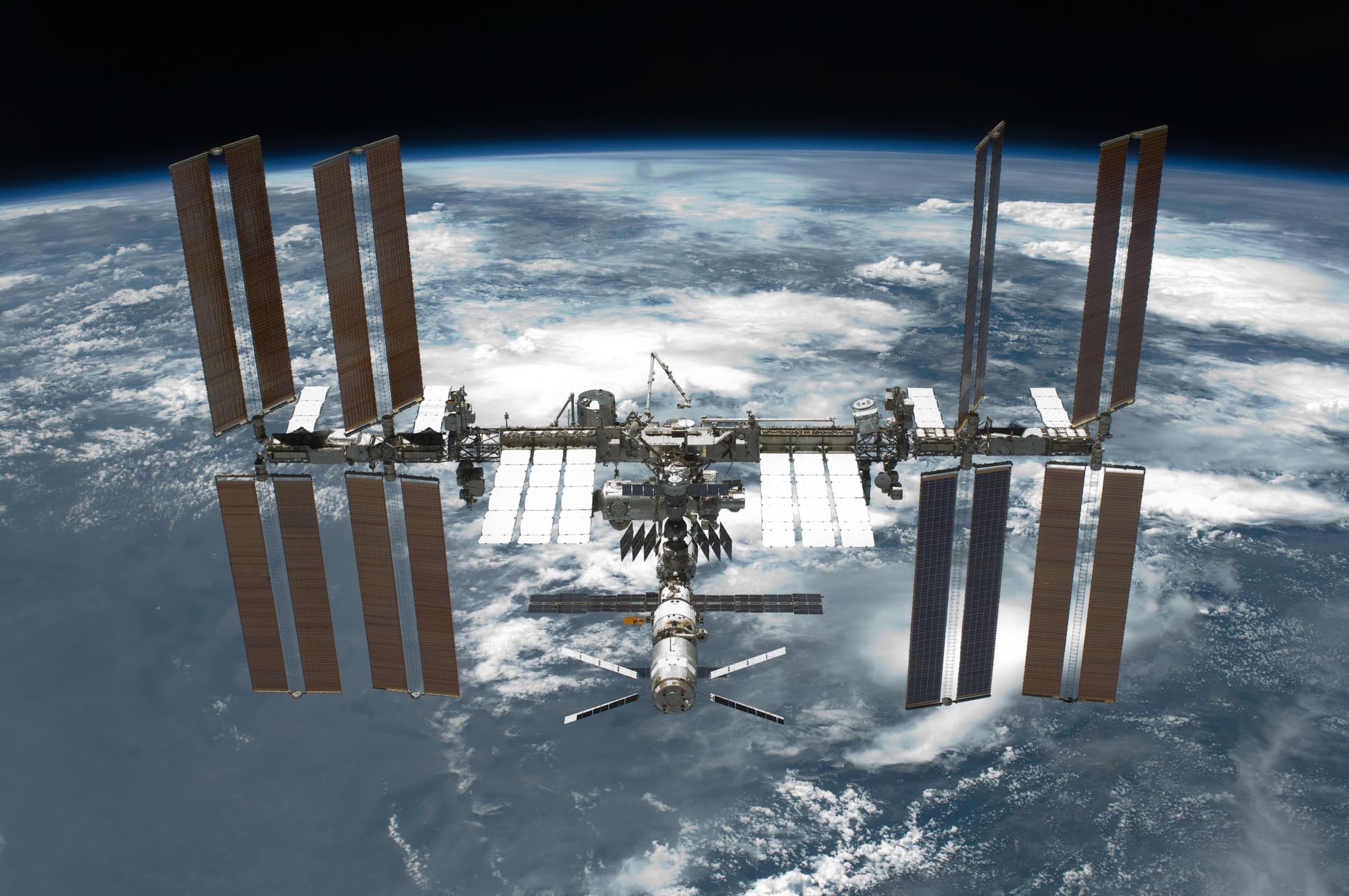
NASA's October 19 mission report and its background materials on bioprinting and vascular tissue. Archive photograph: International Space Station viewed from Endeavour on May 30, 2011, NASA, public domain. It shows an earlier station configuration, not this week's experiment.
Photograph and reuse notes
The International Space Station photographed from Endeavour on May 30, 2011. NASA, public domain. Archive image showing an earlier station configuration, not the current experiment. The website photograph is resized/compressed with responsive display cropping. Social adaptations add a crop, contrast gradient, NewsCubby branding and translated headline. No endorsement by the photographer, subject or organization is implied. Original photograph and rights record; license.