World
Tanker hit mine and caught fire east of Hormuz, Iran’s army says
Iran’s army says the ship entered a restricted area; UKMTO separately reported a tanker incident in the Strait without citing a mine.
What to know
- Wednesday, Nov. 11, 2026: Iran’s Army Navy said a tanker struck a sea mine and caught fire in an “unsafe and restricted” area east of the Strait of Hormuz; this characterization and the mine claim come from Iran’s army.
- UKMTO posted Warning 202-26 about a tanker incident in the Strait, with crew status, damage assessment, and environmental impact unknown; it did not say a mine was involved and listed time and position as to be confirmed.
- Arab News and Arab Times reported it was unclear if the UKMTO advisory and Iran’s army statement covered the same vessel.
- The vessel’s name, flag, owner, cargo, crew condition, injuries, and spill impact were not identified in the reports reviewed and remain unknown.
- Iran International reported Iranian forces said they monitor and control the eastern part of the strait and urged shipowners to coordinate with Iran’s armed forces for safe passage.
An oil tanker caught fire after striking a sea mine in waters east of the Strait of Hormuz, Iran’s Army Navy said Wednesday. The force described the area as unsafe and restricted and urged shipowners to coordinate with Iranian armed forces for safe passage, according to Iran International and Arab News.
Separately, the United Kingdom Maritime Trade Operations issued a “Suspicious Activity” warning about an incident involving a tanker in the Strait of Hormuz, without attributing a cause or naming a vessel. It was not immediately clear whether the two reports refer to the same ship, Arab News and Arab Times noted.
Where did Iran place the incident, and what did it claim?
Iran’s Army Navy public-relations office said a tanker caught fire after hitting a sea mine in an area east of the Strait of Hormuz. The force described that area as “unsafe and restricted” and, in some accounts, a prohibited or unauthorized route. Arab News reported that Iran’s army said the tanker “entered a prohibited area,” while Iran International cited the army’s characterization of the zone and its call for coordination.
Those details—including the claim that a mine caused the fire, the assertion that the tanker entered a prohibited area, and the location east of the strait—are the Iranian army’s account. As of Wednesday, independent confirmation of the cause and exact position had not been provided in the sources reviewed for this report.
The Army Navy is part of Iran’s regular military forces and is distinct from the naval arm of the Islamic Revolutionary Guard Corps (IRGC). The statement aligns with Tehran’s message in recent months that foreign-flagged commercial vessels should coordinate with Iranian authorities when approaching or transiting the narrow waterway.
What did UKMTO say, and what remains unclear?
The United Kingdom Maritime Trade Operations—an information-sharing body that relays security alerts for merchant shipping—issued Warning 202-26 on Wednesday labeled “Suspicious Activity.” UKMTO said it had received a report of an “incident involving a tanker in the Strait of Hormuz.” At the time of the notice, the status of the crew, any damage assessment, and any environmental impact were unknown. UKMTO advised vessels to transit with caution and report suspicious activity while authorities investigate. The advisory did not identify the vessel, did not provide a precise position beyond the reference to the Strait of Hormuz, and did not state that a mine was involved. The incident date and time were marked as to be confirmed.
Arab News and Arab Times both reported that it was not immediately clear whether UKMTO’s report and Iran’s army statement referred to the same ship. That uncertainty is significant because the two reports differ in attribution and detail: Iran’s Army Navy cited a mine and a restricted zone east of the strait, while UKMTO avoided assigning a cause and did not pinpoint a location inside the Strait of Hormuz beyond the general area.
What do we know—and not know—about the vessel and any impact?
As of publication time, the name, flag, and owner of the tanker involved in Iran’s account had not been released in the sources reviewed. The type and volume of cargo, the number and condition of crew, and the extent of any damage or pollution were not specified by Iran’s army, UKMTO, or other publicly available reporting cited here. Arab News and Iran International did not identify the ship.
Given those gaps, key facts remain unknown: whether the fire was extinguished, whether the vessel required or received assistance, whether there were injuries, and whether oil or other substances entered the sea. UKMTO’s notice underscored that those assessments were not available at the time of its warning.
Why does the Strait of Hormuz matter so much?
The Strait of Hormuz is one of the world’s most critical maritime chokepoints. Roughly a fifth of the world’s oil supply moves through this narrow passage between Iran and Oman, according to Arab News. Disruptions or perceived risks in and around the strait can quickly reverberate through global energy markets and shipping routes.
In the months since a wider Middle East war erupted in late February 2026, Arab News reported that Iran has restricted traffic through the strait and targeted vessels it says are transiting without its authorization. The United States, for its part, has imposed a naval blockade of Iranian ports and has been helping tankers navigate the corridor. Arab News reported that U.S. Central Command (CENTCOM) says about 1.5 billion barrels have passed through the waterway since the summer under U.S.-facilitated movements. Those numbers and claims are attributed to Arab News and CENTCOM.
For market context on how oil traders are watching the region, see our recent analysis: NewsCubby.
How does Wednesday’s account fit recent patterns and claims?
Arab News reported that Iran’s Islamic Revolutionary Guard Corps has said three oil tankers caught fire in the strait recently. In one earlier case, Arab News said a Liberia-flagged tanker was hit by a projectile, injuring several people, including an Indian national who was taken ashore safely. Those are prior episodes and are not part of Wednesday’s Army Navy mine claim.
Tehran has, at times, attributed shipboard fires to naval mines, Arab News added, even as U.S. officials have stated that all mines in the area have been cleared. Both of those assertions—the Iranian blame of mines and the U.S. claim of cleared mines—are reported positions and are presented here as claims by the respective sides, without adjudication.
For a prior NewsCubby report on a separate late-October incident involving claims of explosives and a fire aboard a tanker—with the crew reportedly safe—see: NewsCubby. That article covers a different event and should not be conflated with Wednesday’s Iranian Army Navy statement.
What are Iranian forces saying about control and coordination?
Iran International reported that Iranian forces said they were “monitoring and controlling” the eastern part of the Strait of Hormuz and urged shipowners to coordinate with Iran’s armed forces for safe passage. That message echoes Iran’s broader posture during the current period of heightened tensions, in which it has asserted authority over certain lanes and challenged transits it deems unauthorized.
Arab News characterized Iran’s description of the location as a prohibited or unauthorized route. The Army Navy’s use of terms such as “unsafe,” “restricted,” or “prohibited” signals an effort to enforce de facto traffic management in areas Tehran views as sensitive. However, those characterizations do not carry the force of international consensus absent multilateral agreement, and the UKMTO warning did not echo any such designation in its neutral advisory.
What are shipping and security protocols when reports are still unverified?
When an incident is reported but details are pending, maritime security guidance typically stresses caution, communication, and verification. UKMTO’s standard practice is to circulate initial notices based on reports received from vessels or regional authorities, then update with confirmations, locations, and any safety recommendations. In its Warning 202-26, UKMTO advised merchant ships transiting the Strait of Hormuz to proceed with caution, report suspicious activity, and monitor for further updates while authorities investigate.
In parallel, ship operators often seek direct confirmation from their security managers, flag states, insurers, and charterers, and may adjust speed, spacing, or routing if credible threats are identified. None of those specific steps have been described in the sources cited for this incident; they are noted here to explain why initial reporting can appear limited while maritime stakeholders compile verifiable facts.
What’s the diplomatic and military backdrop?
The episode unfolds against an already tense regional setting. Arab News has reported that the U.S. is enforcing a naval blockade of Iranian ports while facilitating energy exports from allied Gulf states through the Strait of Hormuz, with CENTCOM providing escorts and coordination. This is occurring alongside diplomatic efforts and military signaling elsewhere in the region that could bear on maritime security.
For developments in U.S.–Iran dynamics and talks involving regional actors, see our coverage: NewsCubby. For broader geopolitical threads that may shape energy markets and security postures, see: NewsCubby.
Are the reports definitely about the same ship?
As noted, Arab News and Arab Times said it was not immediately clear whether the UKMTO advisory and Iran’s army report involved the same vessel. That means two possibilities remain open based on current public reporting: either one incident is being described differently by different parties (with or without full overlap in location and cause), or two separate but possibly related events occurred in or near the strait on Wednesday.
Without a named vessel, coordinates, or imagery from either account, it is premature to conclude they are the same. UKMTO generally updates its bulletins when additional details are confirmed by ships in the area or by regional authorities. Iran’s Army Navy could also release clarifications or additional imagery, though none were cited in the reports reviewed.
What’s at stake for energy flows and insurers?
Any indication of mines or projectile threats in the Strait of Hormuz can affect risk calculations for shipowners, charterers, and insurers. War-risk premiums and routing decisions can change quickly during periods of uncertainty, particularly if reports suggest hazards near typical traffic separation schemes or in approach lanes east of the strait.
Market participants also watch for potential spill impacts when a tanker fire is reported. In this case, UKMTO said environmental impact was unknown at the time of its warning, and Iran’s army did not provide details about cargo or leakage in its account. The absence of those details explains why shipping advisories emphasize vigilance while avoiding assumptions about the scale or nature of any hazard.
For a sense of how traders were pricing escalation risks around Iran and the Gulf earlier this week, see: NewsCubby.
What’s next
Maritime authorities and industry stakeholders will seek clarity from several sources:
- UKMTO updates: If and when a vessel master files a detailed report, UKMTO typically issues a follow-up with coordinates, vessel type, and a narrative of events.
- Owner/flag statements: Shipowners or flag states often confirm identities, cargo status, crew condition, and damage once they have verified information and notified families and insurers.
- Satellite and AIS data: Commercial satellite imagery and Automatic Identification System (AIS) transmissions can narrow locations and timelines if a vessel’s identity becomes known; caution is warranted because ships in sensitive zones sometimes turn off AIS for security.
- Iranian statements: Iran’s Army Navy or other agencies may release additional details, imagery, or navigational advisories. As of now, the cause and location are the Iranian army’s claims.
- Regional coordination: CENTCOM and regional navies monitoring the corridor may issue advisories to shippers if they detect confirmed hazards.
NewsCubby will update this report if UKMTO issues a new warning or if shipowners, flag states, or regional authorities provide verified information clarifying the vessel’s identity, location, cause of the fire, crew status, or any environmental impact.
For background on a separate late-October incident involving a tanker and reported explosives—distinct from Wednesday’s report—see: NewsCubby.
*Want more? Explore today’s headlines on NewsCubby and join My Day free to make NewsCubby part of your day.*
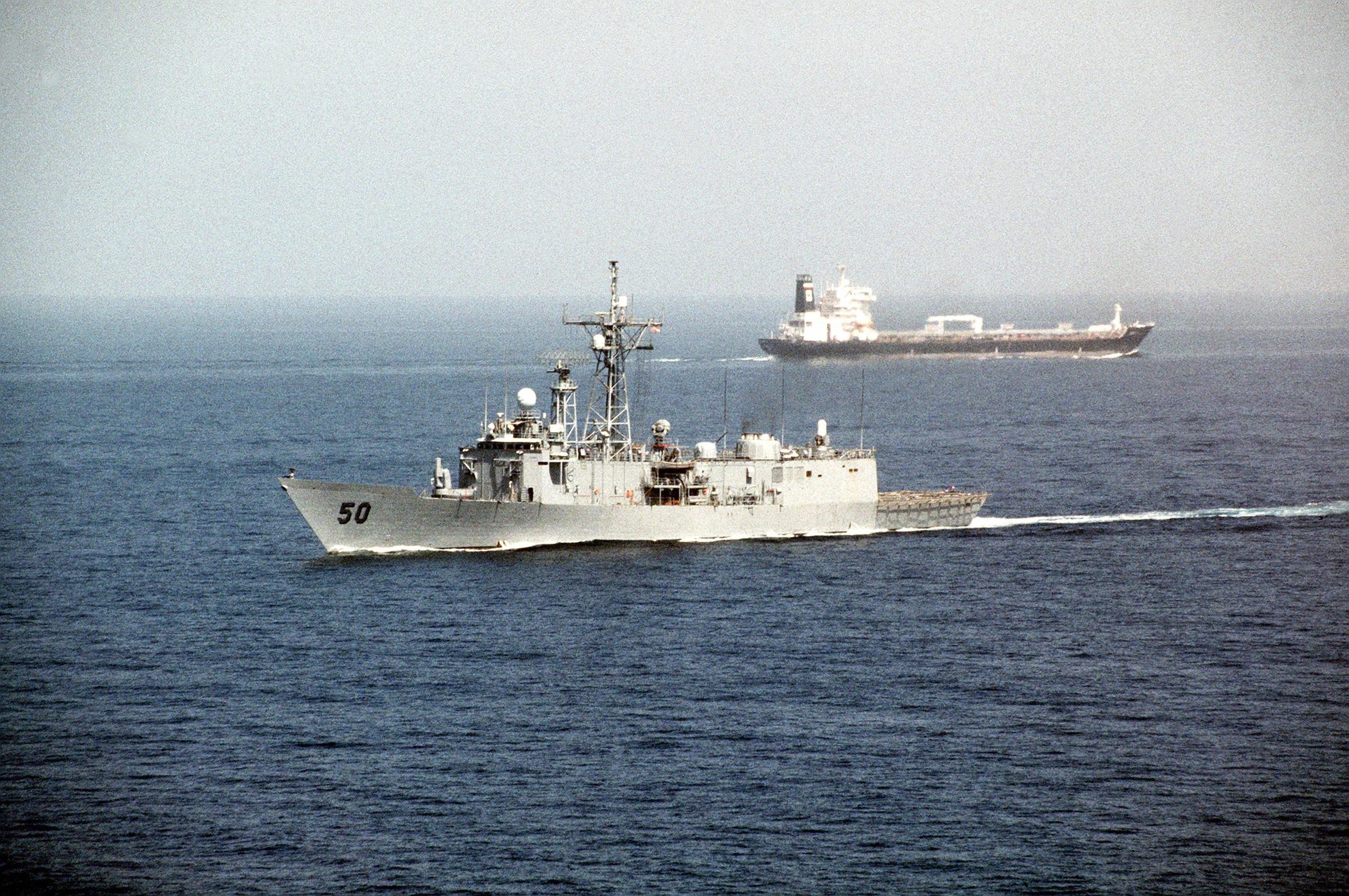
*ARCHIVE PHOTO: A U.S. Navy frigate passes a tanker after transiting the Strait of Hormuz in 1992, during Operation Desert Shield. This image does not show Wednesday’s incident. Photo: U.S. Department of Defense / National Archives / Public domain.*
*NewsCubby articles are produced with AI assistance and reviewed by humans.*
Photo & Video Credits
Credit: U.S. Department of Defense / National Archives (public domain), 1992 archival photo. License: Public domain. Source: file page.