World
Europe flight bomb threats trigger diversions and searches
Bomb threats disrupted European flights Thursday. Several searches found nothing suspicious; airlines and police were still updating individual cases.
What to know
- Bomb threats affected multiple European flights on Thursday, November 5, with some diverted and others checked after reaching their destinations.
- Aer Lingus flight EI402 from Dublin to Rome landed at Évreux in France as a security precaution, the airline said.
- Finnair said its Helsinki–Rome and Helsinki–Vienna flights landed safely and nothing suspicious was found. Czech police also reported negative searches of four planes in Prague.
- Travelers should check their own flight, connection and rebooking instructions. A security alert does not automatically mean every flight at the airport is canceled.
Multiple passenger flights across Europe were diverted or inspected after bomb threats on Thursday, November 5, two days after a separate series of alerts disrupted air travel. Aer Lingus, Finnair, LOT and Wizz Air were among the airlines affected, according to Reuters.
Authorities and airlines reported negative searches in several cases. That is reassuring information about those aircraft, but it is not a continent-wide all-clear. The reports describe individual flights and security responses, not a shutdown of European aviation.
Which flights were diverted or searched?
Aer Lingus's Dublin–Rome service was sent to Évreux, west of Paris. The French prime minister's office said 151 passengers and six crew members were moved to safety while specialists examined the aircraft, Reuters reported. The airline separately confirmed to The Sun that EI402 had diverted as a security precaution.
The Associated Press live report identified the Finnair services as AY1761 to Rome and AY1471 to Vienna. Passengers disembarked after safe landings. Finnair described the threats affecting those services as unfounded. Czech police said searches of four aircraft that landed in Prague found nothing suspicious.
Wizz Air said its Milan–Warsaw service diverted to Vienna after receiving a threat during the flight. LOT said checks of its Warsaw–Brussels service revealed no suspicious items, according to Business Insider's reporting.
These accounts describe different operational outcomes. An aircraft landing at its intended destination for a security inspection has not necessarily diverted. A flight sent to another airport has changed its route, but that alone does not establish that an explosive device was found. Keeping those distinctions clear matters when checking whether a particular passenger has reached their destination.
How does this differ from the earlier alerts?
Thursday's disruption follows a separate wave on Tuesday, November 3. Euronews reported alerts involving flights arriving in Rome, Warsaw and Murcia, with security checks and, in one case, a military escort. Those earlier searches did not establish the presence of explosives.
The dates are important because the same airlines and some of the same destinations appear in both rounds of reporting. A photograph of police searching a plane on Tuesday is not evidence of what happened aboard a different flight on Thursday. Nor does the earlier outcome settle whether every newer threat is false.
The information reviewed for this report does not establish who issued Thursday's threats or whether all the messages came from a single source. Similar timing and wording can raise questions for investigators, but they do not identify a perpetrator, an organization or a motive. A finding that one aircraft is clear is an operational result, not the conclusion of the wider investigation.
What should passengers check before changing plans?
Start with the airline, flight number and scheduled departure date on the booking. Then check the carrier's own status service and any messages sent to the person who made the reservation. Aer Lingus's disruption guidance says individual options are communicated by email or text to the lead booker and directs travelers to live flight information.
If a connection may be missed, ask the airline or airport staff how the remaining itinerary will be handled. Keep the original booking, any replacement itinerary and the latest written instructions together. A new estimated arrival time is useful, but it does not by itself confirm that a connecting seat has been reserved or that checked baggage will travel on the same route.
Passengers should also distinguish an airport's overall operating status from an individual flight's status. An airport can be accepting aircraft while a particular service remains delayed, under inspection or awaiting a replacement. NewsCubby's flight-delay checklist explains how to record the flight, both airports and the time of each update.
Before buying a separate ticket or arranging an expensive transfer, ask what the operating airline is offering and what costs it will cover. Keep receipts for necessary expenses. Aer Lingus's guidance provides for claims involving eligible reasonable meals, accommodation and transport, but eligibility depends on the circumstances; retaining a receipt is not a promise that every purchase will be reimbursed.
Does a bomb threat automatically mean compensation is owed?
No. The immediate questions of assistance and onward travel are separate from a claim for additional cash compensation. The European Union's passenger-rights guidance identifies security risks among circumstances that may qualify as extraordinary. The particular disruption, route and operating carrier still matter.
The EU guidance covers flights within the EU regardless of the airline, as well as departures from the EU. For arrivals from outside the EU, carrier nationality is relevant. Those coverage rules are one reason passengers should identify the operating airline rather than rely only on the company that sold the ticket.
An extraordinary-circumstances exception should not be read as a blanket statement that passengers have no rights. Airlines must substantiate the circumstances they rely on when refusing compensation. Travelers should ask for the explanation in writing and use the airline's complaint process first. The UK Civil Aviation Authority likewise says security risks may qualify as extraordinary circumstances; a compensation decision depends on the cause and relevant conditions.
For a qualifying cancellation, the Irish Aviation Authority explains that a passenger choosing rerouting at the earliest opportunity can be entitled to care while waiting. This can include reasonable meals and refreshments, necessary overnight accommodation and transport between the hotel and airport. If required assistance is not provided, receipts can support a later claim.
A diversion should not automatically be classified as a cancellation. Establish what happened to the booked service and what replacement was offered before applying a cancellation rule. This is general travel information, not a determination of any passenger's individual claim.
What should people do during a security response?
Follow cabin crew and airport security instructions rather than assumptions drawn from social media. The European Union Aviation Safety Agency's general evacuation guidance emphasizes listening to the safety briefing, reading the safety card and following the trained crew's directions.
If an emergency evacuation is ordered, EASA says passengers should leave luggage behind. Retrieving belongings can obstruct other people and damage evacuation equipment. That guidance is included as general preparedness advice; it is not a report that Thursday's passengers used emergency slides or faced identical procedures at every airport.
EASA also explains that flight and cabin crew receive recurring theoretical and practical training for emergencies. Passengers do not need to decide for themselves whether a threat is credible before following instructions. An instruction to remain seated, disembark or move to a designated area should be understood in the context of that aircraft and the directions being given at the time.
What is still unknown, and what happens next?
The next useful updates are flight-specific: whether an inspection has concluded, whether passengers have an onward service, and whether police have established who sent a threat. No single result should be extended to every aircraft involved. For those waiting for someone, the airline's confirmed arrival and passenger arrangements are more useful than an unverified running total of alerts.
Related NewsCubby coverage examines the distinction between reopening an airport and restoring an itinerary in the Saudi airport travel disruption, and the importance of confirmed replacement transport after Spain's rail disruption. Those are separate events, not evidence of a connection to these threats.
*Want more? Explore today's headlines on NewsCubby and join My Day free to make NewsCubby part of your day.*
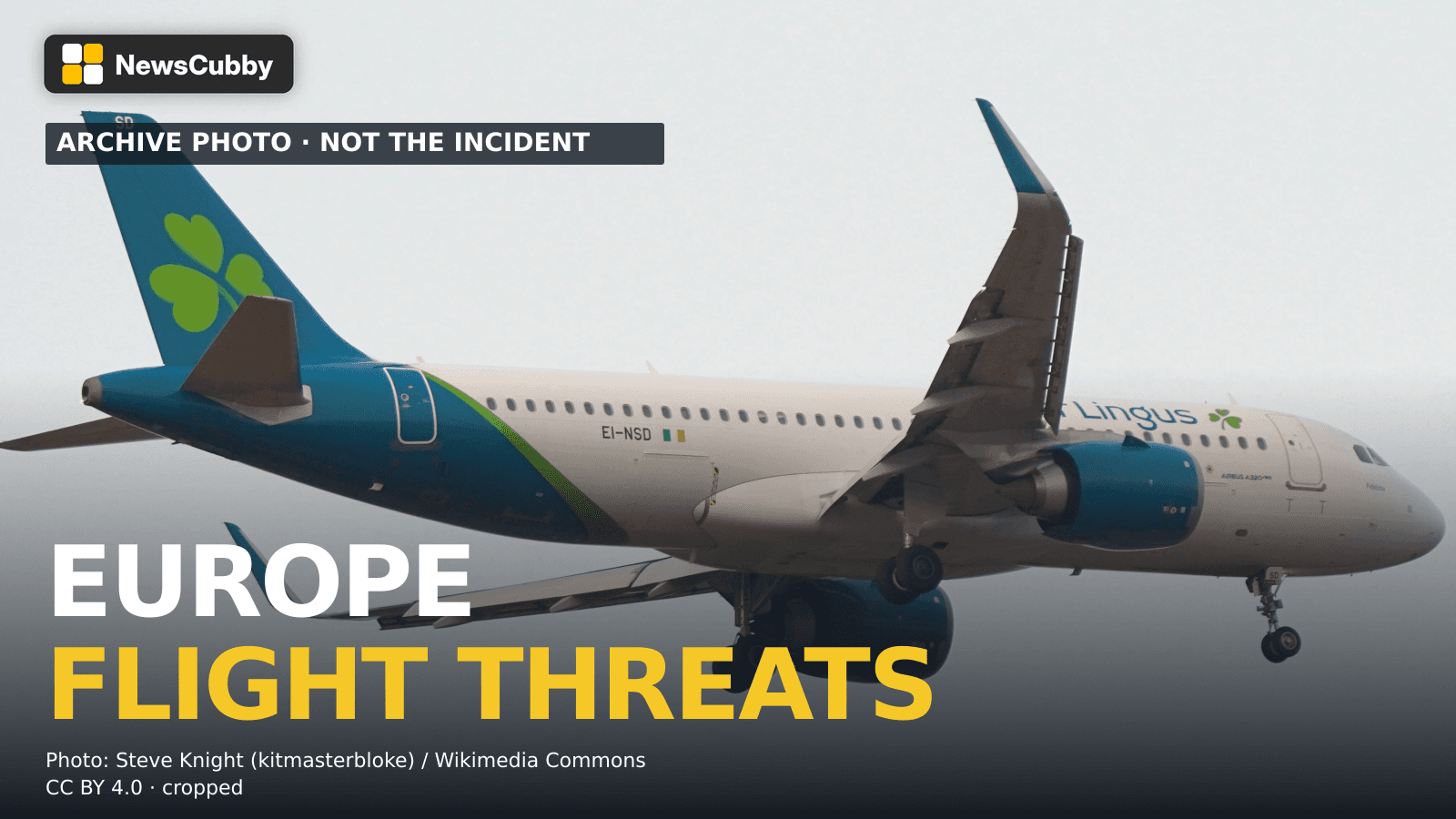
*ARCHIVE PHOTO: An Aer Lingus Airbus A320neo approaches London Heathrow in March 2026. Not the current incident or an image of flight EI402. Photo: Steve Knight (kitmasterbloke) / Wikimedia Commons / CC BY 4.0. Cropped for thumbnail.*
*NewsCubby articles are produced with AI assistance.*