Politics
Judge temporarily bars federal pressure on election workers over disputed voter lists
The October 30 order restricts DOJ and DHS demands and prosecution threats. The government has notified the court that it intends to seek relief.
What to know
- The order restricts DOJ and DHS pressure on election workers when it rests solely on the government's allegation that a registered voter is ineligible.
- It also requires corrective notices to governments that received relevant letters and disclosure to the court of pending demands for election materials.
- The restraining order is set to expire at 5 p.m. November 16; a preliminary-injunction hearing is scheduled for November 13.
- The government filed a notice of its intention to challenge the order. That notice does not itself change or suspend the restrictions.
A federal judge has temporarily barred the Justice Department and Department of Homeland Security from using prosecution threats and certain demands to pressure state and local election workers over voters the government alleges are ineligible. The October 30 order arrives while ballots are already being processed for the November 3 midterm election, and extends beyond the separate dispute over California's voter list.
U.S. District Judge Trina L. Thompson issued the eight-page restraining order in a lawsuit brought by labor unions and civil-rights organizations in the Northern District of California. The government responded with a notice saying it intended to seek modification, dissolution or appellate review. The signed order is temporary relief, not a final judgment resolving every allegation or the eligibility of individual voters.
What the judge ordered
The operative provisions appear on pages six and seven of the signed October 30 order. They prohibit the defendants from threatening, intimidating or coercing election officials to stop processing a registered voter's ballot solely because the federal government alleges that the person is ineligible. That limiting condition is part of the ruling's scope.
A second provision addresses demands directed at voter registration and ballot handling. On that same basis alone, defendants may not demand removal of specific registered voters, refusal to issue their ballots, or segregation or noncounting of their November 3 ballots. The order therefore reaches the chain of election administration rather than only the final act of counting a vote.
Two further provisions concern threatened criminal prosecution. The defendants may not threaten workers for refusing the specified demands or for processing and counting ballots in compliance with applicable state and federal election law on the basis of alleged voter ineligibility. The judge's protection concerns workers carrying out the lawful procedures of their jobs; it is not a finding that every person on any disputed list is eligible.
The injunction binds the named departments and officials, their officers, employees, lawyers and other covered people acting in concert with them under the rule identified in the order. The language refers to state and local election officials without limiting those operative provisions to California counties. Its practical significance therefore extends beyond the particular California letters described in the case.
The letters that brought the dispute to court
The lawsuit was filed by the Service Employees International Union, the American Federation of State, County and Municipal Employees, the League of United Latin American Citizens and the NAACP. They alleged that federal officials were intimidating people responsible for administering the election. The judge's background section identifies those accounts as drawn from the plaintiffs' complaint and emergency motion.
That section describes October 13 demands that California and Los Angeles County set aside ballots associated with roughly 20,000 registered voters whom federal officials believed were likely noncitizens. It then describes October 23 letters to county election officials threatening prosecution, and an October 26 letter to Washington concerning potentially ineligible voters. These are the chronology and allegations the court considered; the list itself is not a verified count of unlawful votes.
The administration's stated purpose was to prevent unlawful voting by noncitizens. Thompson concluded, at this preliminary stage, that the challenged conduct was likely to interfere with election administration and disenfranchise lawful voters. Those competing positions explain the issue before the court: whether the federal government's methods unlawfully pressure officials, not whether a newspaper or a political party can decide an individual's ballot eligibility.
The immediate concern for workers was a conflict between the federal demands and their existing obligations. The judge found that the pressure put election staff at risk of choosing between following election procedures and facing threatened investigation or prosecution. She also found a potential effect on registered voters whose ballots could be held back because of the government's allegations.
Why temporary relief was granted
Thompson applied the emergency-relief framework set out in her order: likely success on the merits, likely irreparable injury without relief, the balance of hardships and the public interest. She found the unions and civil-rights groups had met that threshold. Her reasoning specifically addressed the Voting Rights Act's prohibition on intimidation and the constitutional allocation of responsibility for administering congressional elections.
The election's timing was central to the decision. Ballots had been issued, people had begun voting and officials had begun processing them. The court found that waiting could cause harm before the government could be heard in opposition. The order expressly discusses the rule for granting a temporary restraining order without the ordinary advance notice and explains why the judge considered immediate action necessary.
That procedure leaves further argument ahead. A temporary restraining order preserves conditions while the court receives more briefing and considers a longer preliminary injunction. It does not complete a trial, determine damages or make a permanent judgment on every legal theory in the complaint. In the discussion, Thompson said the urgency meant a full analysis of the Fifth Amendment and Administrative Procedure Act questions was unnecessary at that point.
Two requirements beyond stopping the demands
The judge also ordered the defendants to inform state, county or other local governments that had received the relevant letters that the demands and prosecution threats had been enjoined. This affirmative notice requirement matters because simply issuing an order in a federal case would not necessarily tell every recipient how an earlier demand had changed.
Separately, DOJ must tell the court about pending search-warrant applications, grand-jury subpoenas or other demands for election materials, ballots or related testimony concerning its lists of allegedly ineligible voters. That disclosure requirement is directed to the court. It does not announce that every underlying investigative document must immediately be released to the public.
Both measures connect the written ruling with actions already underway. One concerns communications to officials who had received the demands; the other gives the judge information about pending investigative requests. Neither provision supplies a final adjudication of the individual voters on a list, and neither should be confused with an announced criminal charge against an election worker.
The government's response and the separate appeal
In Document 30, filed October 30, the government said it intended to seek relief by October 31. It identified two options: asking Thompson to dissolve or modify the order, or alternatively seeking review in the Ninth Circuit. The notice also requested prompt consideration if the government pursued dissolution under the rule it cited.
The notice is evidence of an intended challenge, rather than proof that a later motion was granted or an appellate court suspended the order. A subsequent filing or decision could materially change the procedural situation. This article's source check establishes the signed restraining order and the government's filed response; it does not claim an exhaustive live view of every later docket entry.
There is also a distinct California ballot case. In its October 30 order in United States v. California, a Ninth Circuit panel denied the government's emergency request for an injunction pending appeal. That case concerns the requested handling of disputed ballots. It is separate from Thompson's lawsuit over pressure on election workers, even though the underlying events overlap.
The next scheduled court dates
Thompson set the government's response to the preliminary-injunction request for noon Monday, November 2. The plaintiffs may reply by noon November 5. A hearing is scheduled for November 13 at 11 a.m. in Department 9 on the 19th floor, according to the order. Its expiration is scheduled for November 16 at 5 p.m., unless a later court action changes the situation.
The central next question is therefore whether the restrictions remain in their current form, are modified or are replaced after further argument. For election workers, the present order addresses specific demands and threats while counting preparations continue. For voters, the ruling protects the administration process without itself declaring an election outcome or converting disputed government lists into proven illegal ballots.
Reporting checked October 31, 2026. The source packet preserves the signed order, government notice and separate appellate ruling; subsequent filings require a release-time check.
Related reading
Separate NewsCubby coverage: the earlier California ballot ruling; California election subpoenas and the separate review; DOJ’s distinct request concerning Alaska ballots.
Want more? Explore today's headlines on NewsCubby and join My Day free to make NewsCubby part of your day.
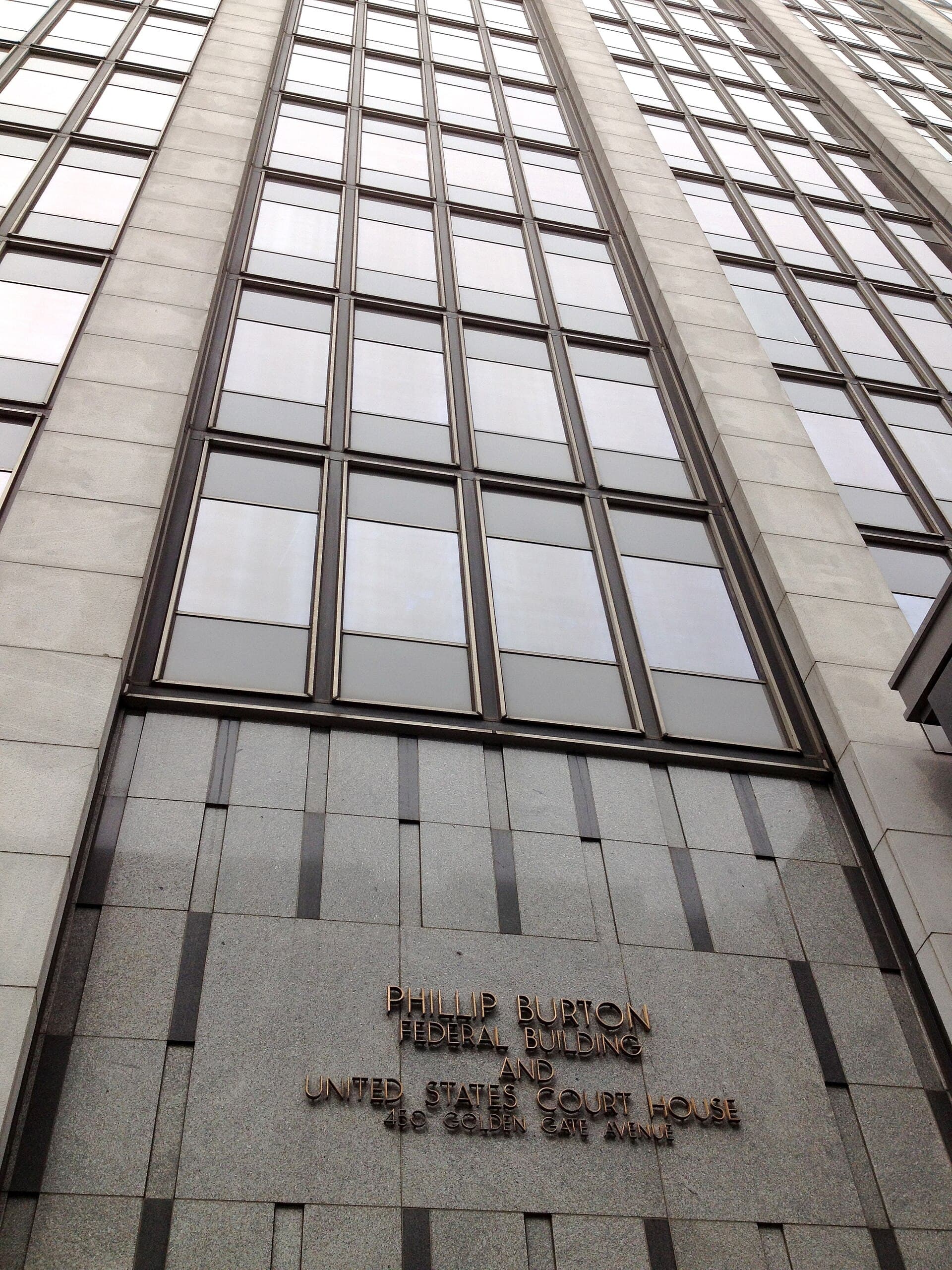
ARCHIVE PHOTO — Phillip Burton Federal Building and United States Courthouse, 450 Golden Gate Avenue, San Francisco, March 14, 2013. Court-location context, not the October 2026 hearing or a photographed election worker. Sam Wheeler / Wikimedia Commons, CC BY-SA 3.0. Wikimedia-served 1920-pixel resize; no local crop.
NewsCubby articles are produced with AI assistance.
Correction
Corrected October 31, 2026: This article clarifies the temporary order's limits and adds the government's notice of its intention to seek modification, dissolution or appellate review. That notice does not itself grant relief or suspend the order.
Reporting Sources
Photo & Video Credits
Credit: Sam Wheeler / Wikimedia Commons. License: CC BY-SA 3.0. Source: file page.