World
Pope Leo’s November 6 departure: the South America trip explained
Departure recap, November 6: Leo left Rome at 7:05 a.m. local time for a tour of Uruguay, Argentina and Peru. This report explains the announced itinerary.
What to know
- The Holy See confirmed Leo's November 6 departure from Rome for Montevideo. His scheduled arrival was 4:30 p.m. in Uruguay, or 2:30 p.m. Eastern time.
- Uruguay hosts Leo through November 8, with stops in Montevideo, Paysandú and Florida. The last papal visit to the country was in 1988.
- In Argentina from November 8 to 11, his plans include a meeting with President Javier Milei, public worship and a visit to a federal prison.
- Peru is the final and longest leg. Leo arrives on November 11, visits his former diocese of Chiclayo and departs for Rome on November 16.
This is a recap of the November 6 departure and the itinerary announced that morning. It is not a live arrival report. References to upcoming events below describe the program as announced at departure.
Pope Leo XIV left Rome for Uruguay on Friday, November 6, opening a 12-day trip through three South American countries. The Holy See said his plane took off from Fiumicino Airport at 7:05 a.m. in Rome, or 1:05 a.m. Eastern time. Montevideo is the first stop, followed by Argentina and Peru.
This is the first visit to Latin America of Leo's pontificate. It is also a return to a region where he spent much of his ministry, especially Peru, where he became a citizen and served as bishop of Chiclayo. The trip went ahead after doctors cleared him to travel following lung cancer surgery in October, the Vatican said.
What happens first in Uruguay?
The Holy See's departure bulletin confirmed that Leo left the Vatican by car before boarding his flight to Montevideo. In a telegram sent to Italian President Sergio Mattarella as he left, Leo invoked peace and fraternity for the countries he was due to visit and offered prayers for Italy. The day's first official events in Uruguay are scheduled after a transatlantic flight of more than 13 hours.
The Uruguayan Foreign Ministry's program puts the airport welcome at Carrasco International Airport in the afternoon. The public ceremony in Montevideo is scheduled for 5:30 p.m. local time, or 3:30 p.m. Eastern, in Plaza Independencia. A meeting with officials, civil society and diplomats is on the program before a private visit with President Yamandú Orsi at 6:15 p.m. local time. The evening ends with vespers at the city's metropolitan cathedral.
The Uruguayan presidency describes the trip as the first papal visit in 38 years. John Paul II made his second trip to the country from May 7 to 9, 1988. Uruguay is strongly secular by regional standards, AP reports. Leo's scheduled meetings in Montevideo bring together elected officials, diplomats, students and representatives of civil society as well as clergy and worshippers.
The Saturday itinerary reaches outside the capital. Leo is scheduled to travel to Paysandú to celebrate Mass before returning to Montevideo. A visit to the Casavalle area, an education event at the Catholic University of Uruguay and a prayer vigil at Estadio Centenario are on the program. AP reported from the city's north side on the parish that will host Leo in an area affected by violence. Residents hope the pope will bless them, parish priest Pablo Coimbra told Vatican News.
The final stop in Uruguay is Florida, where the Sunday Mass is scheduled at the cathedral and national shrine of Our Lady of the Thirty-Three. After lunch with bishops and an airport farewell, the pope is due to fly to Buenos Aires. The Uruguay leg combines a national reception, neighborhood visits and public gatherings in cities outside Montevideo.
Why is the Argentina visit significant?
Leo is due in Argentina from Sunday, November 8, through Wednesday, November 11. The Vatican itinerary lists a welcome at the Casa Rosada and a meeting with Milei on Sunday. A subsequent address at the Palacio Libertad is scheduled for officials, diplomats and members of civil society. Reuters reports that the Vatican expects regional political instability, environmental damage and arms trafficking to feature among the themes of the wider tour.
Argentina is the birthplace of Leo's predecessor, Pope Francis, who did not make an official visit home as pontiff. AP reports that Leo plans to honor Francis during his time in Buenos Aires. The agenda also includes a visit to the Devoto federal prison, where Francis ministered while he was archbishop of Buenos Aires. Those stops connect the visit to Francis's ministry in the city where he lived and worked before his election to the papacy.
The itinerary also gives space to people and institutions outside government and church leadership. On Monday, Leo is scheduled to visit staff and residents at the Don Orione care home in Claypole, celebrate Mass in Buenos Aires and attend a meeting on working life at the Catholic University of Argentina. A gathering with leaders of Christian communities and other religious traditions is listed later that day. The program extends to Córdoba and includes a Mass at the Basilica of Our Lady of Luján, an Argentine pilgrimage site, before the flight to Lima.
Why is the Peru leg a homecoming?
Leo will spend the final leg in Peru, beginning with his scheduled November 11 arrival at the Callao air base serving Lima. Born Robert Francis Prevost in Chicago, he spent years in Peru as an Augustinian missionary and later became bishop of Chiclayo. Reuters reports that he also became a Peruvian citizen. The Vatican has framed this part of the trip as a return to communities that knew him as a priest and bishop before he moved to Rome.
The Holy See's biography traces that connection across several assignments. Francis appointed Prevost apostolic administrator in Chiclayo in 2014. Prevost became a Peruvian citizen by naturalization in August 2015, and Francis named him bishop of Chiclayo the following month. He also served in leadership roles at the Peruvian bishops' conference. In 2023 Francis called him to Rome to lead the Vatican office responsible for bishops. The November return comes about a year and a half after the May 2025 conclave elected him pope.
In Lima, the official agenda includes a visit with the country's president and an address to public officials, civil society and diplomats. A meeting on Peru's future and a youth prayer vigil at the National Stadium are planned for the following day. On November 13, Leo is due to fly north to Chiclayo and celebrate Mass near Pimentel, where the former diocesan bishop will return to an area that formed a substantial part of his ministry.
The next day includes a helicopter trip to Santa Cruz de Succhabamba for Mass and a return to the Chiclayo area. On November 15, Leo is scheduled to travel to Cusco in the Andes and Pucallpa in the Amazon region on the same day. In Pucallpa, he is due to meet missionaries and representatives of Amazonian peoples. The remaining Lima events include a visit to a shelter for older people and a farewell Mass before he leaves Peru on November 16. He is due back in Rome the next morning.
How did the Vatican decide the trip could go ahead?
Leo underwent surgery on October 13 for localized lung cancer. On October 26, the Holy See Press Office confirmed the trip after a medical assessment. It said his physician, Luigi Carbone, found no medical reason to prevent travel and that follow-up exams showed no further cancer treatment was necessary. In the same statement, Leo said he was looking forward to returning to the continent where he had “experienced so many moments of my life.”
Matteo Bruni, the Holy See Press Office director, outlined the travel program to journalists on November 3. Friday's departure moved the trip from preparation to a confirmed event. The subsequent itinerary spans public Masses, long-distance flights, meetings with governments and shorter visits with people in care institutions and local communities. Each of the three countries has a distinct program.
What to watch
The first scheduled opportunity to hear Leo address the region from South America is Friday's meeting with authorities, civil society and diplomats in Montevideo. His visit with Orsi and the cathedral service follow that evening. Sunday brings the transition from Uruguay to Argentina. In Peru, the Chiclayo and Pimentel events will show how Leo addresses the people of the diocese he once led, while the Pucallpa stop takes him to communities in the Amazon region.
Want more? Explore today's headlines on NewsCubby and join My Day free to make NewsCubby part of your day.
Prepared with AI assistance.
Thanks for reading NewsCubby. See you next time.
Visual sources
Archive images are identified by date and location. Images or official documents may be cropped and reframed.
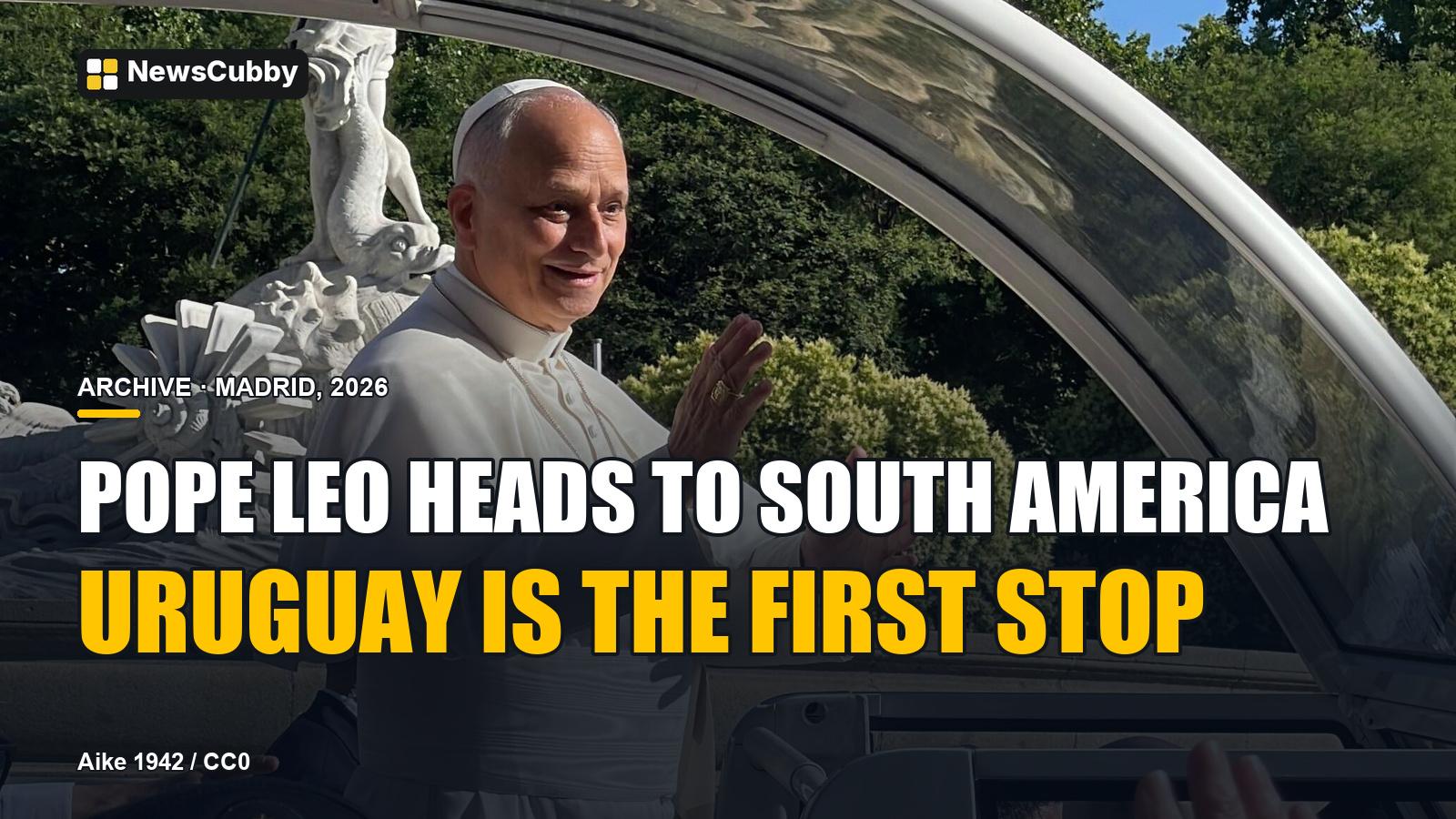
- Pope Leo XIV in Madrid, June 2026 archive — Aike 1942 / CC0 1.0 Universal.
- Palacio Salvo overlooking Plaza Independencia, Montevideo, May 5, 2017 (archive) — Mx. Granger / CC0 1.0 Universal. Cropped, resized and animated; NewsCubby context, credit and captions overlaid.
- Pope John Paul II at the Vatican, 1987 archive — Reagan White House Photographic Office / U.S. National Archives / U.S. federal public domain, 17 U.S.C. § 105.
- Plaza de Mayo, Buenos Aires, 2012 archive — McKay Savage / CC BY 2.0 Generic.
- Cathedral of Lima, 2013 archive — Avodrocc (Christian Córdova) / CC BY 2.0 Generic.
- Pope Leo XIV's inaugural Mass in the Vatican, May 2025 archive — Freddie Everett / U.S. Department of State / U.S. federal public domain, 17 U.S.C. §§ 101 and 105.
Reporting Sources
- Holy See departure bulletin
- Vatican News departure report
- Vatican News departure report in Spanish
- Official Vatican itinerary
- Official Vatican itinerary in Spanish
- Uruguay Foreign Ministry
- Presidency of Uruguay
- Holy See biography
- Holy See medical release
- Vatican News press briefing
- The Associated Press dispatch
- The Associated Press itinerary report
- The Associated Press community report
- Reuters dispatch, republished by TV5
Photo & Video Credits
Credit: Aike 1942 / CC0. License: CC0 1.0 Universal. Source: file page.