Entertainment
Ron Howard: Part 2 of 5 - The Corman Deal
Roger Corman wanted Ron Howard to star in Eat My Dust! Howard's price was a chance to direct, and Grand Theft Auto led to Splash, Cocoon and Imagine.
What to know
- Roger Corman offered Howard the lead in *Eat My Dust!* in 1976, and Howard used the job to secure a path toward directing.
- The result was *Grand Theft Auto* (1977), Howard's feature directorial debut, which he co-wrote with Rance Howard and also starred in.
- Before leaving *Happy Days* in 1980, Howard had already started building a directing career and went on to direct several NBC TV movies between 1978 and 1982, including *Skyward*.
- *Night Shift* (1982), with Henry Winkler, Michael Keaton and Shelley Long, was his big directorial break and also marked the start of his working relationship with Brian Grazer.
- *Splash* (1984), *Cocoon* (1985) and the founding of Imagine Entertainment in November 1985 established Howard as a filmmaker with momentum well beyond his sitcom fame.
Ron Howard's move into directing did not begin with a studio franchise or a prestige drama. It began with a bargain. While he was still starring on *Happy Days*, producer Roger Corman wanted Howard for the 1976 action comedy *Eat My Dust!* Howard, who had wanted to direct from a young age, used the offer to push for something bigger: a chance to develop another film and, if Corman liked it, direct it himself. That arrangement led to *Grand Theft Auto* in 1977, a low-budget feature Howard co-wrote with his father, Rance Howard, and made while he was still working on *Happy Days*. From there, his directing path moved quickly through TV movies, *Night Shift*, *Splash*, *Cocoon* and, by November 1985, a new company with producer Brian Grazer: Imagine Entertainment.
How did Roger Corman's offer arrive at the right moment?
By the mid-1970s, Howard was already widely known as Richie Cunningham on *Happy Days*, but he was also looking past acting. He later attended the University of Southern California's School of Cinematic Arts and did not graduate, and he had said he knew from a young age that he might want to go into directing thanks to his early experience as an actor. So when Roger Corman came calling, Howard saw more than another acting assignment.
Corman offered Howard the lead role in what became *Eat My Dust!* and sent him the script with a fee of $75,000. Howard read it on the *Happy Days* set and said he "thought it was terrible: a broad, zany car-chase comedy with weak jokes and cardboard characters." That did not end the conversation. Howard understood that Corman's low-budget operation had a reputation for giving people chances, and he wanted to turn an acting offer into a directing opening.
Howard was already taking concrete steps in that direction. He had written a comedy with Rance Howard called *Tis the Season*, about a student who rents a room in a massage parlor, and had raised half the budget from Australia. In other words, he was not simply hoping to direct someday. He was already trying to get a film made.
That context matters because it explains why *Eat My Dust!* became a turning point. Howard did not take the job because he loved the script. He took it because he believed it could lead to the next stage of his career.
What exactly was the Corman deal?
Howard first asked Corman to co-finance *Tis the Season*, but Corman was not enthusiastic about that comedy. Instead, he proposed a different path. If Howard starred in *Eat My Dust!*, Corman would consider a second film that Howard could direct, as long as Corman liked the idea enough to develop it and Howard also appeared in it.
It was a conditional offer, but it was enough for Howard to say yes. He agreed to star in *Eat My Dust!*, and the movie was shot around his *Happy Days* schedule. It was a practical, almost transactional moment, but it opened a real door. Howard was using his value as a television star to gain access to something he wanted more.
The production itself also gave him a close view of how fast, disciplined, low-budget filmmaking worked. Howard later wrote, "I learned a lot from observing Chuck Griffith's fast, nimble, low-budget approach to filmmaking, and I just liked the indie vibe around the Corman machine." That line helps explain why this period mattered. Even before he directed his own feature, he was studying a system built on speed, efficiency and problem-solving.
*Eat My Dust!* itself was a hit. Corman called it the first New World movie to earn $5 million in rentals. For Howard, though, the longer-term value was not just box office. It was proof that the deal had been worth making.
How did Grand Theft Auto become his directing debut?
The deal led directly to Howard's directorial debut. Corman agreed to finance Howard's idea for a film that became *Grand Theft Auto* (1977). It was a road action comedy starring and directed by Howard, with the screenplay written by Howard and Rance Howard, who also co-starred.
That made the film unusually personal for the start of a directing career. Howard was not just stepping behind the camera for hire. He was directing material he had written with a close collaborator and shaping a project built specifically for the low-budget conditions Corman had outlined.
The numbers underscore what kind of debut this was. *Grand Theft Auto* was made on a budget of $602,000 and earned over $15 million at the box office. Critical reception was negative, but the film was a commercial success. For a first feature made through a Corman deal, that mattered. It showed Howard could deliver a movie on a small budget that found an audience.
The production story also reflects the pressure and discipline of the system. When Howard pleaded with Corman for an extra half day to reshoot a scene, Corman responded, "Ron, you can come back if you want, but nobody else will be there." It is a funny line, but it also captures the lesson: if Howard wanted to direct, he had to learn to work fast and finish what he started.
*Grand Theft Auto* remains the only film Howard has both directed and starred in. That gives the movie a special place in his filmography. It was not only the first Ron Howard feature as director. It was also a one-time overlap between his acting identity and his emerging directing one.
What was he directing while he was still on *Happy Days*?
Howard did not wait until the end of his acting run to begin directing seriously. *Grand Theft Auto* came out three years before he left *Happy Days* in 1980. That means his second career was already underway while audiences still mainly knew him as Richie.
He went on to direct several TV movies for NBC between 1978 and 1982, including *Skyward*, the 1980 TV movie starring Bette Davis. That period is easy to overlook because it sits between a major sitcom role and the better-known theatrical features that followed, but it was important training ground. Television movies required pace, planning and reliability, and Howard was building credits in that form before his larger studio successes arrived.
His exit from *Happy Days* in 1980 therefore looks less like a sudden break than a transition that had been developing for several years. He left just before the start of the show's eighth season to become a film director. By then, he was no longer someone merely interested in directing. He had already directed a feature and was adding television work as well.
That overlap also helps explain why Howard's directing career took hold so quickly in the early 1980s. When he stepped away from *Happy Days*, he was not starting from zero. He had already tested himself under Corman conditions, delivered a profitable feature and begun working steadily behind the camera.
Why was Night Shift such a key breakthrough?
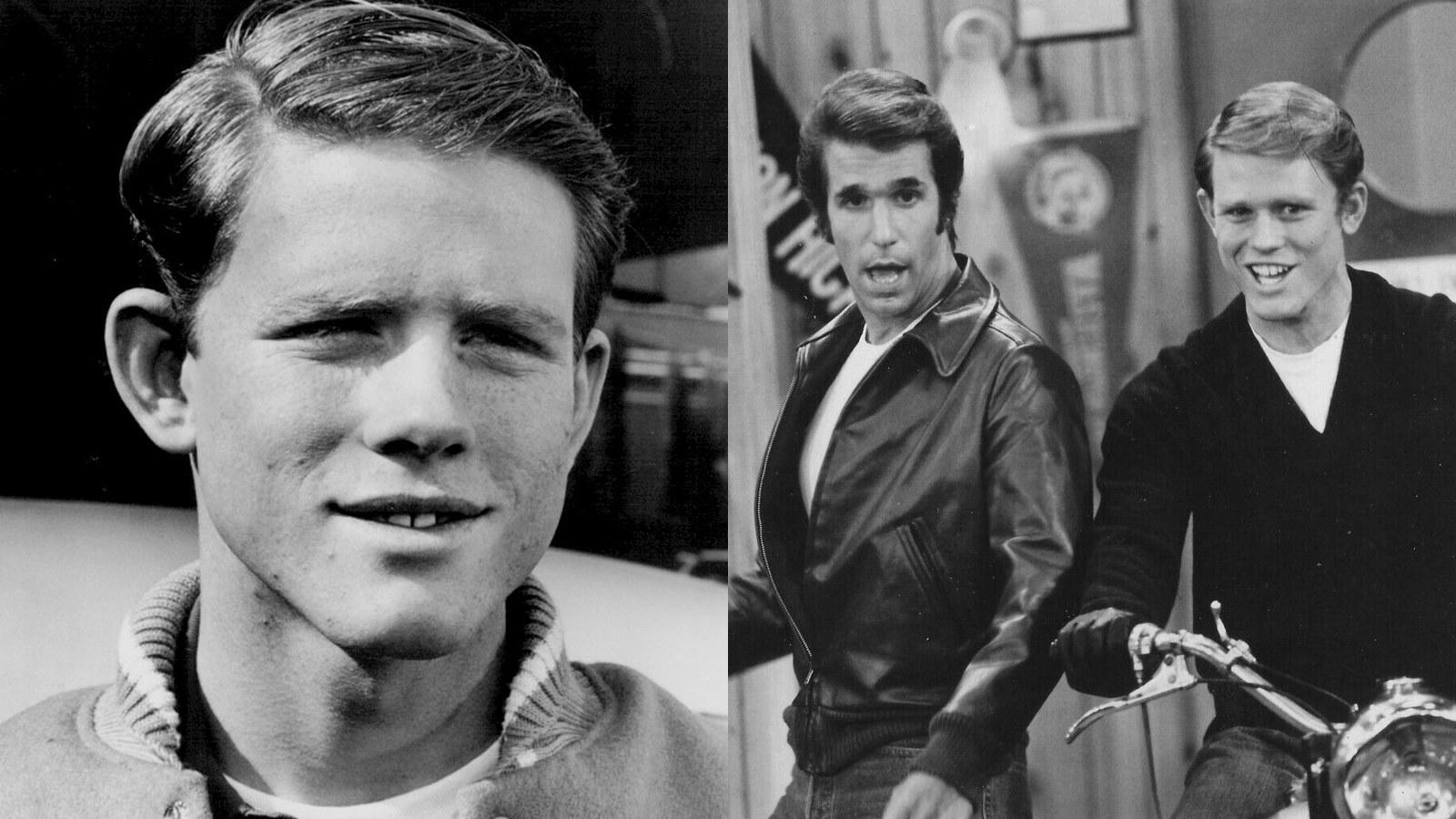
Howard's big directorial break came in 1982 with *Night Shift*, and the reasons are clear. The film starred Henry Winkler, Michael Keaton and Shelley Long, with Keaton in his first starring role. For Howard, it was also a significant reunion: Winkler had been his co-star on *Happy Days*.
The movie worked with critics and audiences. It was a critical and financial success and grossed $21,095,638 at the domestic box office. Winkler was nominated for the Golden Globe Award for Best Actor – Motion Picture Musical or Comedy, and Keaton won the Kansas City Film Critics Circle Award for Best Supporting Actor.
Just as important, *Night Shift* was where Howard and Brian Grazer met, with Howard directing and Grazer co-producing. It was Grazer's first feature film as a producer. That working relationship would become one of the central partnerships of Howard's career.
*Night Shift* sits at an interesting midpoint in the story. It still carried links to Howard's television past through Winkler, but it also introduced a producer who would remain central to his future. The film showed that Howard could handle a studio comedy with recognizable stars and get results, and it widened the circle of people who now saw him as a director first rather than a former child actor or sitcom lead.
How did Splash expand his range and his reach?
After *Night Shift*, Howard directed *Splash* in 1984. *Splash* is a romantic fantasy comedy starring Tom Hanks, Daryl Hannah, John Candy and Eugene Levy, from a screenplay by Lowell Ganz, Babaloo Mandel and Bruce Jay Friedman, with a story by Friedman and producer Brian Grazer. That last credit matters in this period because it shows how closely Howard and Grazer were already collaborating.
*Splash* was a major step up in visibility. It was critically and commercially successful, earned over $69 million on an $11 million budget, became the tenth-highest-grossing film of 1984 and was nominated for the Academy Award for Best Original Screenplay. It was also the first film released by Touchstone Pictures.
For Howard, the film broadened the sense of what he could do. *Grand Theft Auto* and *Night Shift* had comedy and speed, but *Splash* added fantasy, romance and a softer tone. It also connected him with Tom Hanks years before *Apollo 13*. That later partnership belongs to another chapter, but *Splash* is where the Howard-Hanks screen relationship begins.
There is also a business story inside *Splash*. Its success directly fed the next major step in both men's careers.
What did Cocoon and Imagine Entertainment set up for the next phase?
Howard's next film after *Splash* was *Cocoon* in 1985. The science fiction comedy-drama starred Don Ameche, Wilford Brimley, Hume Cronyn, Brian Dennehy, Jack Gilford, Steve Guttenberg, Maureen Stapleton, Jessica Tandy, Gwen Verdon, Herta Ware, Tahnee Welch and Linda Harrison. It was released on June 21, 1985, drew positive reviews and grossed $85.3 million against a $17.5 million budget.
*Cocoon* also brought major awards recognition to one of its performers. The film earned Academy Awards for Best Supporting Actor, won by Don Ameche, and Best Visual Effects. For Howard, that meant another commercial hit and another sign that he could move among genres without losing his audience.
Then came the business structure that would help define the rest of his career. Imagine, then called Imagine Films Entertainment, was founded in November 1985 by Brian Grazer and Ron Howard following the success of *Splash*. It originated from a merger of Howard's Major H Productions and Grazer's Brian Grazer Productions. The company would go on to become a major film and television production operation, but at the start it represented something simpler and just as important: Howard was no longer only a director for hire. He was building a long-term base with a producing partner he had met on *Night Shift* and strengthened through *Splash*.
That is where Part 2 ends. Howard's Corman bargain had led not just to one directing job, but to a run of films that proved he could open movies, shift genres and build lasting partnerships. Part 3 picks up with the years ahead, including more work with Tom Hanks, bigger studio ambitions and the road to NASA drama in *Apollo 13*.
This story is part of NewsCubby's five-part Ron Howard career series. For more coverage, visit TV & Streaming, Movies, Entertainment and watch short videos on the Videos page.
Timeline
- **March 1, 1954:** Ron Howard is born in Duncan, Oklahoma.
- **1974:** Howard begins playing Richie Cunningham on *Happy Days*.
- **April 7, 1976:** *Eat My Dust!* premieres in San Antonio.
- **1976:** Howard makes his deal with Roger Corman while starring in *Eat My Dust!*.
- **1977:** *Grand Theft Auto* is released as Howard's feature directorial debut.
- **1980:** He leaves *Happy Days* just before the start of its eighth season to focus on directing.
- **1982:** *Night Shift* becomes his big directorial break and brings him together with producer Brian Grazer.
- **1984:** *Splash* becomes a critical and commercial success and earns an Academy Award nomination for Best Original Screenplay.
- **June 21, 1985:** *Cocoon* is released and later earns Don Ameche the Academy Award for Best Supporting Actor.
- **November 1985:** Howard and Brian Grazer found Imagine Entertainment.
*Want more? Explore today's headlines on NewsCubby and join My Day free to make NewsCubby part of your day.*
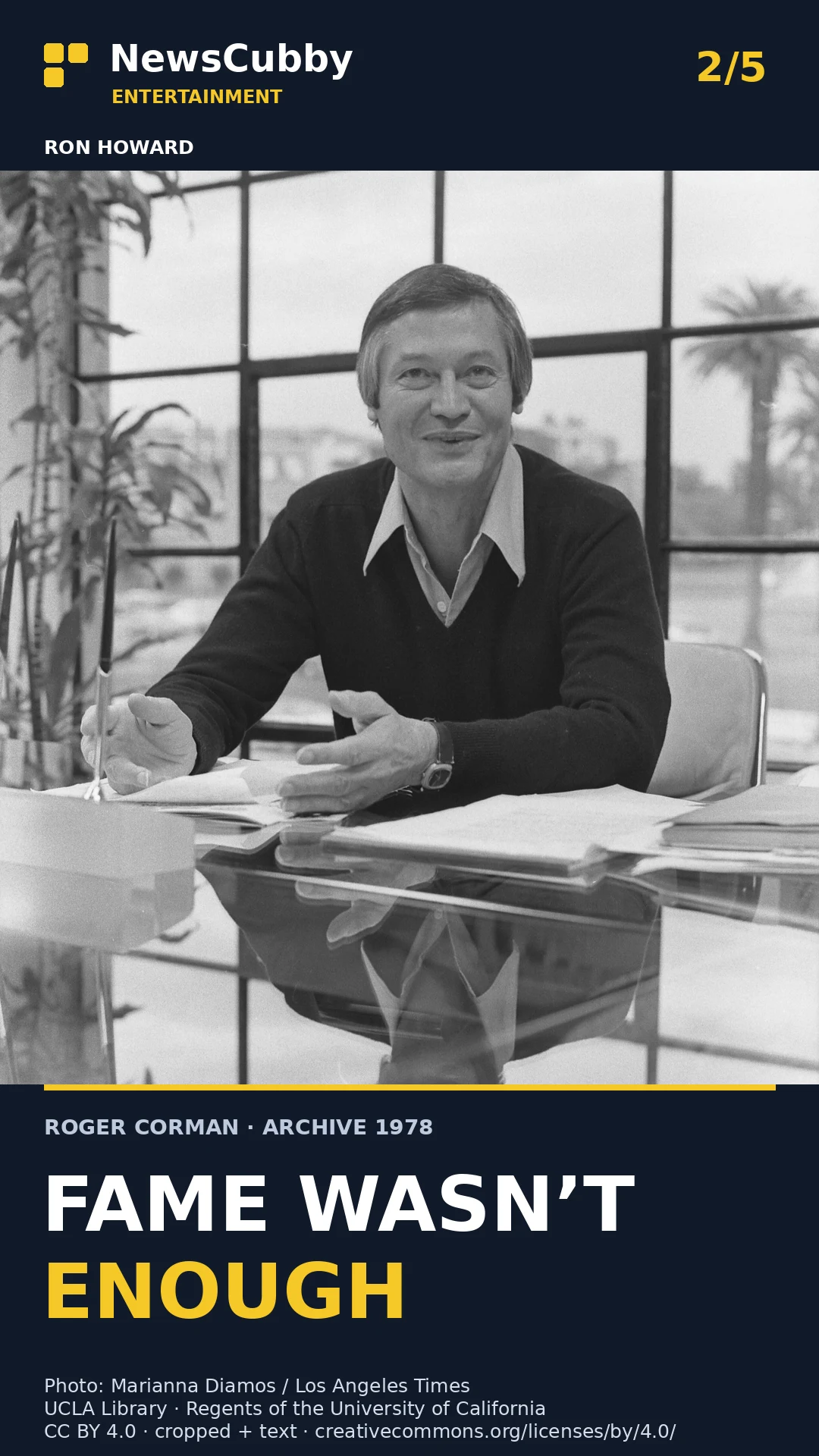
*ARCHIVE PHOTOS: Filmmaker Roger Corman in Los Angeles in February 1978 (left), and Ron Howard with his Imagine Entertainment partner Brian Grazer at the Tribeca Film Festival in April 2011 (right). Photos: Marianna Diamos, Los Angeles Times / Wikimedia Commons / CC BY 4.0 (left); David Shankbone / Wikimedia Commons / CC BY 3.0 (right). Both cropped.*
*NewsCubby articles are produced with AI assistance and reviewed by humans.*
Video photo credits
Shot 1 (0.000–4.500s): Ron Howard 2011 Shankbone 3.JPG
Creator: David Shankbone Source: https://commons.wikimedia.org/wiki/File:Ron_Howard_2011_Shankbone_3.JPG License/status: CC BY3.0 Unported — https://creativecommons.org/licenses/by/3.0/ Actual changes: Photographic crop/resize, restrained pan/zoom, captions/logo/credit overlays. No invented imagery or solid filler.
Shot 2 (4.500–14.933s): Filmmaker Roger Corman, portrait, 1978.jpg
Creator: Marianna Diamos / Los Angeles Times; UCLA Library, Regents of University of California Source: https://commons.wikimedia.org/wiki/File:Filmmaker_Roger_Corman,_portrait,_1978.jpg License/status: CC BY4.0 International — https://creativecommons.org/licenses/by/4.0/ Actual changes: Photographic crop/resize, restrained pan/zoom, captions/logo/credit overlays. No invented imagery or solid filler.
Shot 3 (14.933–24.733s): Ron Howard Brian Grazer 2011 Shankbone.JPG — Howard-only crop
Creator: David Shankbone Source: https://commons.wikimedia.org/wiki/File:Ron_Howard_Brian_Grazer_2011_Shankbone.JPG License/status: CC BY3.0 Unported — https://creativecommons.org/licenses/by/3.0/ Actual changes: Howard-only natural upper-body crop, downscaled from1660x2547 to1080x1920; restrained motion/overlays. Replaces rejected252x338 Rance portrait; NOT represented as Rance or1977 event.
Shot 4 (24.733–28.500s): Happy days at arnolds 1975.JPG
Creator: ABC Television Source: https://commons.wikimedia.org/wiki/File:Happy_days_at_arnolds_1975.JPG License/status: Public domain in United States: published1975 without notice — https://commons.wikimedia.org/wiki/Commons:Copyright_rules_by_territory/United_States Actual changes: Photographic crop/resize, restrained pan/zoom, captions/logo/credit overlays. No invented imagery or solid filler.
Shot 5 (28.500–34.200s): Solo A Star Wars Story Japan Premiere Red Carpet Ron Howard (42769865252).jpg
Creator: Dick Thomas Johnson Source: https://commons.wikimedia.org/wiki/File:Solo_A_Star_Wars_Story_Japan_Premiere_Red_Carpet_Ron_Howard_(42769865252).jpg License/status: CC BY2.0 Generic — https://creativecommons.org/licenses/by/2.0/ Actual changes: Photographic crop/resize, restrained pan/zoom, captions/logo/credit overlays. No invented imagery or solid filler.
Shot 6 (34.200–39.700s): TomHanksPrincEdw031223 (11 of41).jpg
Creator: Raph_PH Source: https://commons.wikimedia.org/wiki/File:TomHanksPrincEdw031223_(11_of_41).jpg License/status: CC BY2.0 Generic — https://creativecommons.org/licenses/by/2.0/ Actual changes: Natural wider seated portrait from uncropped original; downscaled, restrained movement/overlays; preserves full face/chin above headline/caption zones.
Reporting Sources
Photo & Video Credits
Credit: Marianna Diamos / Los Angeles Times; UCLA Library; The Regents of the University of California. License: CC BY 4.0 International. Source: file page.