World
Trump weighs Iran deal or military action, says no strike Sunday
Trump said he faces a choice between a deal with Iran and finishing the war, then said there would be no strike Sunday. Here's what each side said.
What to know
- President Donald Trump said Sunday that his decision on Iran comes down to reaching a deal or ending the war by force. "Do I make a deal with them, or do I finish them off?" he said in a phone interview with Fox News' "Sunday Morning Futures," according to CBS News and The American Conservative. Bloomberg quoted him saying it is "getting to be decision time."
- Later Sunday, asked whether he planned to attack, Trump said, "No. There will not be a strike today," the Associated Press reported. The White House had not announced a decision as of 8 p.m. ET.
- In Michigan on Sunday, Trump told FOX 2 Detroit that the war would not be resolved until it was certain Iran had no nuclear capability, the station reported. "I'm going to make a great deal," he said.
- Iran's Foreign Ministry spokesman said Tehran has not closed the window of diplomacy and is still passing messages through intermediaries, but he rejected what he called US demands for "complete surrender," according to the AP. Qatari mediators were in Tehran on Sunday in what a source described to Reuters as a US-coordinated effort to ease tensions; no outcome had been announced as of 8 p.m. ET.
- The war, which began with US-Israeli strikes on Feb. 28, reached its 240th day on Sunday. In early trading Sunday evening, Brent crude was down 0.89% at $115.68 a barrel and US crude down 1.03% at $102.22, CNBC reported at 7:52 p.m. ET. AAA's national average for regular gas was about $4.29 on Sunday.
President Donald Trump said Sunday that his choice on Iran comes down to two options: reach an agreement or end the war by force. Hours later, he told reporters there would be no US strike that day. Iran, for its part, said diplomacy remains possible while insisting it will not surrender.
The comments came on the 240th day of a conflict that has pushed oil prices above $100 a barrel, disrupted shipping through the Strait of Hormuz and become an issue in the final stretch before the Nov. 3 midterm elections. Here's what was said, what we know and what remains unclear.
What exactly did Trump say?
Trump spoke by phone with Fox News' "Sunday Morning Futures." Fox posted a segment from the interview under the headline "Trump touts booming economy, control in Strait of Hormuz as GOP fights to hold Congress."
Outlets transcribed his key line slightly differently. CBS News quoted him: "Now, my question is, do I make a deal with them, or do I finish them off?" The American Conservative reported the line as "Do I make a deal with them, or do I finish them off? That's the only question."
Bloomberg's version was longer. It quoted Trump saying, "I have a decision to make: Do I finish it off, which would be very easy to do, or do I make a deal?" and adding, "We don't play games." Bloomberg also reported that he said it was "getting to be decision time."
In the same interview, Trump said the United States controls the Strait of Hormuz, CBS reported. He also criticized the 2015 nuclear agreement negotiated under President Barack Obama, which Trump withdrew from during his first term.
The language echoed remarks from earlier in the week. On Friday, CBS reported, Trump said the US "may do another little Epic Fury," a reference to the name of the US military campaign. A day earlier he had asked aloud, "Do we want to finish it off or do we just want to let it wither?"
Then what did he say about a strike?
Later Sunday, before leaving the White House for a campaign event in Michigan, Trump took questions from reporters, according to The American Conservative. Asked whether he planned to launch an attack on Iran, he first suggested it would be foolish to telegraph such a move, the AP reported, as carried on CBS News' live page. Then he said, "No. There will not be a strike today."
At Joint Base Andrews, The American Conservative reported, Trump also said, "There are two very different sets of intelligence reports — I have them both," and added that "we're doing very well with Iran." He did not describe what the two sets of reports say.
At 6:58 p.m. ET, Trump reshared on Truth Social his Oct. 18 endorsement of Israeli Prime Minister Benjamin Netanyahu, whose country votes Tuesday, with a new message. In it, Trump wrote that "Iran now has No Navy, No Air Force" and that its military and economy "are in shambles." He ended: "Vote for Bibi Netanyahu for Prime Minister, we have to finish the job that we started!" The post did not announce a decision or a timeline.
The White House has not announced a decision either way, and NewsCubby found no separate White House written statement or Pentagon statement on Iran after the "no strike today" remark as of 8 p.m. ET. NewsCubby is not speculating about when or whether the US might use force; this article reports only what officials have said on the record.
What did Trump say in Michigan?
Trump carried the theme into his campaign stop in Port Huron, Michigan, on Sunday evening. At the rally, he said Iran would never obtain a nuclear weapon and suggested the standoff would be settled "one way or the other," according to Iran International, a London-based Persian-language outlet that is critical of Iran's government. He also claimed the US had "obliterated" Iran's enrichment capacity in two military operations, Midnight Hammer and Epic Fury, and again called the 2015 nuclear deal one of the worst agreements he had seen.
In an interview with FOX 2 Detroit's Roop Raj before the rally, Trump said the war would not be resolved until it was certain Iran had no nuclear capabilities, the station reported. He said it mattered more to make a good deal than a fast one: "I'm going to make a great deal. I'm a longterm person; I'm not a short term person." Asked whether high prices could affect how Michiganders vote, he said, "You want to see not only energy problems but death problems? Let them have a nuclear weapon because they will use it. And, I have to do that first," according to FOX 2.
Those remarks did not include a new decision or a timeline.
What is Iran saying?
Iran's message on Sunday was that talks are still possible, but not on Washington's current terms.
Foreign Ministry spokesman Esmail Baghaei, in an interview with a German broadcaster that was reported by Iranian state media, said Tehran had not closed the window of diplomacy and that messages were still being exchanged through intermediaries, the AP reported. He also said the US was persisting with unilateral demands and with the phrase "complete surrender," which he said no Iranian would accept.
Foreign Minister Abbas Araghchi said a resumption of fighting would not change Iran's positions. "Whether there is war or not, our policies remain the same," he said, according to AFP, as carried by CBS News. Speaking at a televised event in Tehran, as reported by Al Arabiya, he added that he was "already thinking about the post-war period," argued that management of the Strait of Hormuz "will no longer be the same," and said the region should move toward "the complete absence of foreign forces." Iran International reported that he also described US bases as the main source of insecurity for the countries that host them.
Later Sunday, Baghaei took aim at Secretary of State Marco Rubio on X. According to Iran International, Baghaei quoted Rubio's criticism of Iranian attacks on ships, then set it beside a May remark in which Trump, describing a US seizure of a tanker and its oil during the blockade, said, "We're sort of like pirates." Baghaei wrote that Trump might not be pleased that his secretary of state had "so quickly forgotten" that comment.
On Saturday, Iran's ambassador to Pakistan, Reza Amiri Moghadam, said Iran remained open to talks under the interim agreement that Pakistan helped broker in June, the AP reported. He said Iran had signaled it was willing to reopen the Strait of Hormuz if the US lifted its naval blockade of Iranian ports, and he accused Trump of rejecting that approach.
Parliament speaker Mohammad Bagher Ghalibaf said the United States was stuck in a "quagmire," according to Al Jazeera. He said Washington must now take steps to extricate itself. Ghalibaf also warned that any attack on Iran's territory would bring what he called an unimaginable response, Iran International reported.
Those warnings followed similar ones on Saturday. The Revolutionary Guards said even limited strikes would draw a response "several times greater," according to the semi-official Fars News Agency, as cited by Al Jazeera. President Masoud Pezeshkian, in comments broadcast by state-run Press TV, blamed Washington for the collapse of the June interim deal but said both sides should return to it and "conclude it," Al Jazeera reported. NewsCubby found no new public statement from Supreme Leader Mojtaba Khamenei's office on the US as of 8 p.m. ET.
Who is mediating?
Pakistan and Qatar helped broker the June interim agreement, according to the AP. On Sunday, Qatari mediators were in Tehran as part of an effort to lower tensions that was coordinated with the United States, an official briefed on the matter told Reuters, as carried by Dawn and Al Arabiya. Reuters said no further details were available.
Iran framed the visit differently. A senior Iranian official told Al Jazeera the delegation's trip was part of routine exchanges between the two countries and said the main obstacle to a diplomatic solution was not mediation but what the official called US refusal to accept Iran's demands, according to Iran International's summary of the Al Jazeera report.
Neither Qatar, Iran nor the US had announced any result of the visit as of 8 p.m. ET.
How did we get here?
The war began on Feb. 28, when US and Israeli strikes killed Iran's supreme leader, Ayatollah Ali Khamenei, according to TIME and CBS News. His son, Mojtaba Khamenei, succeeded him; CBS reported that he was injured and has not been seen in public.
In early March, Iran closed the Strait of Hormuz, the narrow waterway that carried about a fifth of the world's oil before the war, according to TIME's timeline. A two-week ceasefire brokered by Pakistan began April 8. Talks in Islamabad led by Vice President JD Vance ended without a deal, and the US imposed a naval blockade on Iranian ports on April 12, TIME reported.
An initial agreement was reached in mid-June, and talks continued in Switzerland with Qatari and Pakistani mediation, according to TIME. But the strait briefly reopened and closed again within days, and tensions have risen since.
In recent days, the head of US Central Command, Adm. Brad Cooper, flew over the strait and said more than 3,000 commercial vessels had transited with US military support over the past six months, the AP reported. Director of National Intelligence Jay Clayton sent a memo warning that Iranian plots against Americans were at "advanced stages," CBS reported on Friday. The State Department has also reduced staffing at US embassies in Jordan, Lebanon, Qatar and the United Arab Emirates and ordered nonessential staff to leave Saudi Arabia, according to CBS.
US Ambassador to the United Nations Mike Waltz told the Financial Times the war could last another year, CBS reported.
What does this mean for oil and gas prices?
Oil futures reopened at 6 p.m. ET Sunday, and early trading pointed lower. As of 7:52 p.m. ET, Brent was down 0.89% at $115.68 a barrel, and US West Texas Intermediate was down 1.03% at $102.22, CNBC reported. CNBC said Saudi Arabia reported intercepting Houthi drones and missiles on Sunday. These are early, thin-trading figures and can move quickly.
On Friday, Brent crude, the global benchmark, settled at $116.72 a barrel, up $3.55, its highest close since April 29 and up about 6% for the week, according to Reuters and The Wall Street Journal. US crude settled at $103.27, CNBC reported.
Shipping through Hormuz remains below normal. Data from the analytics firm Kpler, cited by MarketWatch, showed a seven-day average of about 12.65 million barrels a day through the strait, roughly 26% below the prewar level of 17.15 million.
At the pump, AAA's national average for a gallon of regular was about $4.29 on Sunday, according to AAA's daily figures, down from about $4.49 a month ago but up from about $3.06 a year ago. Diesel averaged about $6.35. AAA said last week that October was on track to be the most expensive October on record for gas.
Trump has accused Iran of trying to drive up oil prices before the midterm elections, CBS reported, after Iran claimed attacks on commercial ships that Trump called fake.
How is the war affecting Iranians?
Inside Iran, prices have risen sharply. The AP reported that rice prices are up more than 60% and beef more than 150%. President Masoud Pezeshkian said on Saturday that many families are struggling to afford food, and he described the country as being in "a state of neither war nor peace," according to the AP.
What we know
- Trump said in a Fox News interview that his choice is between a deal with Iran and finishing the war, and later said there would be no strike Sunday. - In Michigan on Sunday, Trump told FOX 2 Detroit the war would not be resolved until it was certain Iran had no nuclear capability, and that he would take time to reach "a great deal." On Truth Social, he urged Israelis to reelect Netanyahu, writing, "we have to finish the job that we started!" - Iran says diplomacy remains open through intermediaries but rejects what it calls demands for "complete surrender." - Qatari mediators were in Tehran on Sunday in what a source told Reuters was a US-coordinated effort; an Iranian official called it a routine visit, according to Al Jazeera. - Brent crude closed Friday at $116.72 and was at $115.68 in early trading Sunday evening, CNBC reported. The national average for regular gas was about $4.29 on Sunday.
What we don't know yet
- Whether Trump has made a decision, and what a deal acceptable to both sides would include. - What, if anything, came of the Qatari mediators' visit to Tehran. - What the "two very different sets of intelligence reports" Trump mentioned say. - Whether Sunday evening's early dip in oil prices holds once full trading resumes Monday.
What happens next
Watch for any White House statement on Iran, the outcome of the Qatari mission, comments from Iran's Foreign Ministry and how oil prices trade into Monday. Israel also holds national elections on Tuesday, Oct. 27, CBS reported. NewsCubby will update this story as officials release new information.
*Credits: reporting from CBS News, the Associated Press, AFP, Fox News, FOX 2 Detroit, Bloomberg, The American Conservative, Al Jazeera, Al Arabiya, Iran International, Dawn, Fars News Agency, Press TV (Iranian state media), TIME, Reuters, The Wall Street Journal, MarketWatch, CNBC, The Times of Israel and AAA, plus a public Truth Social post by President Trump. NewsCubby articles are produced with AI assistance and reviewed by humans.*
Sources, credits & editorial notes
- CBS News (Frank Andrews, Khaled Wassef), Iran war live updates incl. AP and AFP items, updated 3:55 p.m. ET Oct. 25
- Fox News, "Sunday Morning Futures" segment "Trump touts booming economy, control in Strait of Hormuz...," Oct. 25, 2026
- The American Conservative (Jude Russo), "Iran War Day 240: Trump Says No Strikes on Iran Planned for Sunday," Oct. 25
- Bloomberg, "Trump says decision time nears…," via Yahoo Finance, 10:57 a.m. ET Oct. 25, 2026
- Al Jazeera (Fiona Kelliher, Chris Hamill-Stewart), "Iran war live: Trump says 'no strike today'; Qatar mediators in T
- Associated Press, "Iran says messaging continues with the US...," Oct. 25, 2026
- TIME (Rebecca Schneid), "How Did We Get Here? A Timeline of the U.S.-Iran War," June 22, 2026
- The Wall Street Journal, "Oil prices rise as Middle East risks persist," Oct. 23, 2026
- MarketWatch, "Oil prices rise on fears of Middle East conflict escalation," Oct. 23, 2026 (Kpler data)
- CNBC, Oct. 23, 2026
- AAA, national average gas prices, checked Oct. 25, 2026
- Iran International, live page and Qatari delegation report, Oct. 25, 2026
- Dawn, "Qatari mediators in Tehran in US-coordinated effort to ease regional tensions, official says" (Reuters), Oct
- Al Arabiya, "Qatari mediators reportedly in Tehran in US-coordinated effort to ease tensions," Oct. 25, 2026 (Araghch
- Al Jazeera (with AFP and Reuters), "Iran blames US for deal failure, urges new try amid fear of new attacks," Oct. 24
- CNBC, "Stock market today: Live updates," oil futures, updated 7:52 p.m. ET Oct. 25, 2026
- The Times of Israel (Lazar Berman), "Trump says US won't strike Iran today," Oct. 25, 2026 (confirms the gaggle quote
- FOX 2 Detroit (Roop Raj, Megan Ziegler), "Trump exclusive in Michigan...," Oct. 25, 2026, 3:23 p.m. ET
- Donald J. Trump, Truth Social post resharing Oct. 18 Netanyahu endorsement, 6:58 p.m. ET Oct. 25, 2026
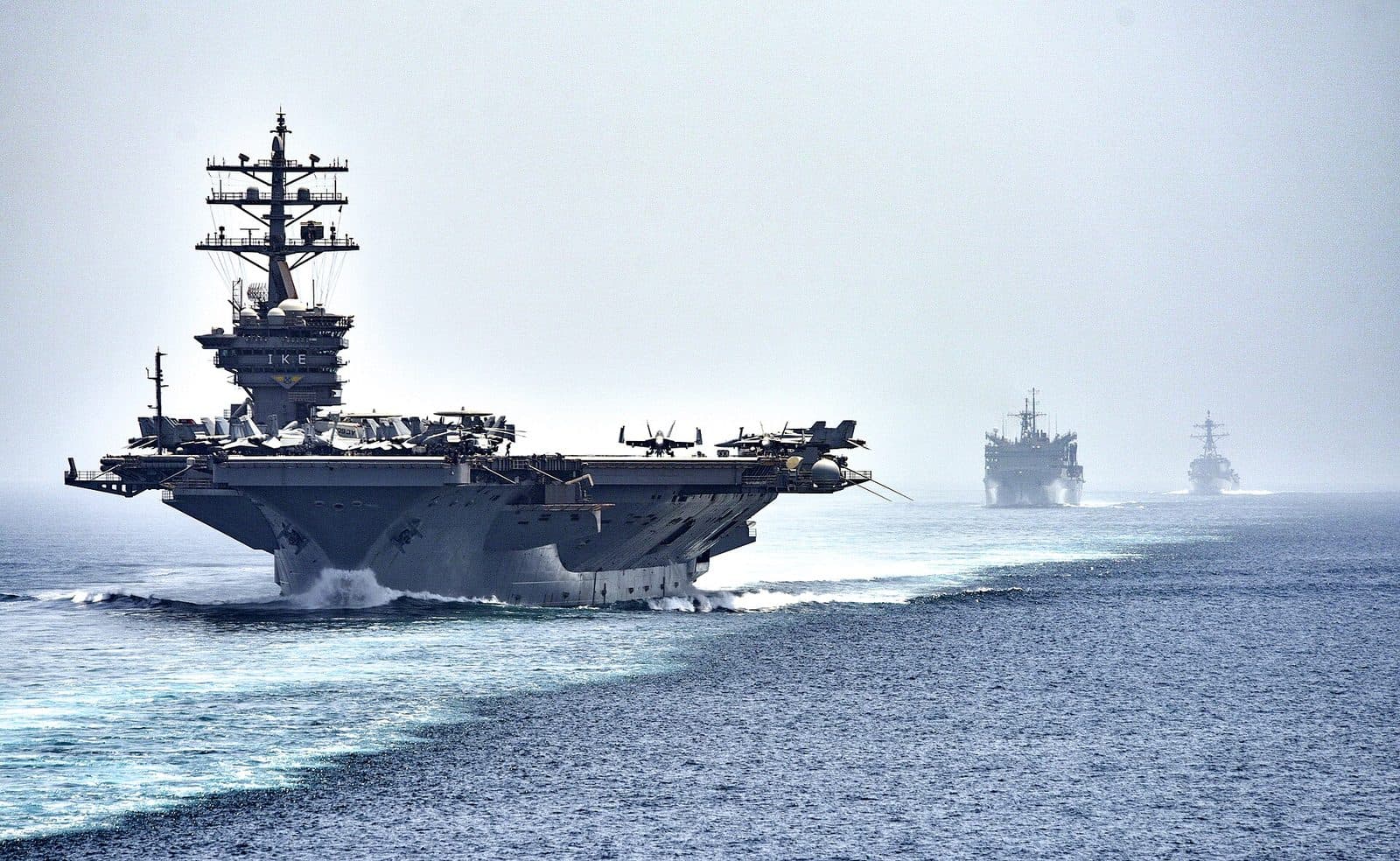
- Photo: U.S. Navy / Wikimedia Commons; public domain (archive photo, July 21, 2016)