World
Ukraine says Starlink speed limits remain: what is still restricted?
Zelenskyy disputes the restoration claim as U.S. senators seek records on who controls restrictions affecting fast-moving terminals.
What to know
- Zelenskyy and other Ukrainian officials said Friday that movement-speed limits remained, despite Trump's assurance that access had been restored.
- The reported threshold concerns terminals moving at roughly 160 kilometers per hour, or 100 miles per hour, rather than an ordinary download-speed limit.
- Starlink and Starshield are related services with different government and commercial arrangements; responsibility for particular restrictions remains disputed.
- Four U.S. senators have requested technical, contractual and decision-making records from SpaceX by November 2.
Ukraine says satellite communications restrictions are still affecting its drones, a day after President Donald Trump said access had been restored. The disagreement is about more than a slow internet connection: Ukrainian officials describe a limit tied to how fast a connected terminal is moving, with consequences for aircraft operating above roughly 100 miles per hour.
President Volodymyr Zelenskyy said Friday that restrictions on Starlink and Starshield remained in effect. His remote address to the Hudson Institute put the operational question back in public view: a political assurance that service is working and a military user's report that a particular capability remains unavailable are not necessarily descriptions of the same thing.
Reuters separately reported confirmation from Ukrainian officials that the restrictions persisted. The public evidence does not establish precisely who authorized every restriction, what instructions were transmitted or whether all affected terminals share the same service conditions. Those are now among the questions U.S. senators have asked SpaceX to answer with records.
What changed on Friday
The immediate news is the gap between the restoration claim and Ukraine's account of conditions in the field. Reuters reported that five Ukrainian officials familiar with the matter said limits continued for Starlink-connected drones moving faster than 160 kilometers per hour. Presidential adviser Serhiy Beskrestnov cautioned that isolated instances of operation at slightly higher speeds did not demonstrate that the restriction had been removed.
That distinction matters when evaluating a claim of recovery. A terminal connecting successfully under one set of conditions does not establish that the same terminal will remain connected while moving faster, in another location or under a different service configuration. Conversely, a restriction affecting a particular moving device does not demonstrate that every Starlink user in Ukraine has lost connectivity.
Hudson's event listing confirms that Zelenskyy participated remotely in a discussion with the institute's president, John Walters, on October 23. Ukrinform, Ukraine's state news agency, reported his statement that the speed restrictions remained. His remarks are the Ukrainian government's account; NewsCubby has not independently tested battlefield equipment.
A speed limit on movement
In an earlier Associated Press interview, Beskrestnov described a connection cutoff when a terminal traveled above the threshold. He said forcing aircraft to fly more slowly could make them more vulnerable. This is different from a household internet service delivering fewer megabits per second: the relevant speed is the movement of the equipment carrying the connection.
The distinction helps explain why saying that satellite internet is available does not fully answer Ukraine's complaint. A communications service may support a stationary position while failing to provide a capability needed by a fast-moving aircraft. Whether particular equipment can remain connected during that movement is the issue Ukrainian officials have raised, rather than whether someone can load a website elsewhere in the country.
The Senate correspondence reinforces the same point. It asks specifically about restrictions on devices moving faster than 100 miles per hour and about when those restrictions began and ended. It also seeks information on other capabilities or access points that may have been limited. The senators are asking for a detailed account of affected services, not simply an assurance that an entire network is on or off.
Why Starlink and Starshield cannot be treated as identical
SpaceX operates the underlying Starlink network. Starshield is a military and intelligence product using related technology, including enhanced capabilities such as encryption, according to the October 19 Senate letter. The letter says the United States procured Starshield services to support Ukrainian military operations.
Elon Musk has said Starshield systems are controlled by the U.S. government and that limits on their speed or use are government decisions. The senators juxtaposed that position with SpaceX's ownership and operation of the underlying infrastructure. Their questions concern how those responsibilities interact, rather than establishing that either statement alone resolves responsibility for what happened.
There are at least three distinct questions in that inquiry. Who has contractual authority to change access? Who issues the operational direction? Who implements a technical change? The same organization need not perform all three roles. Knowing who owns a satellite network is therefore not, by itself, proof of who ordered a specific restriction on a government-procured service.
The letter also asks whether SpaceX can decline, modify or delay a government-directed change. That question is especially important to interpreting competing accounts: a company may be describing its understanding of the contract, while officials or users describe what equipment can actually do. The contracts, notices and implementation records could help connect those separate accounts.
The congressional request for records
Democratic Senators Jeanne Shaheen, Richard Blumenthal, Sheldon Whitehouse and Chris Coons sent their request to SpaceX legal vice president Christopher Cardaci. They asked for information and documents by November 2. Their letter is an oversight demand from those senators, not a court finding or a bipartisan committee conclusion about culpability.
The requested chronology covers October 10 through October 15. For each restriction, the senators want the affected capabilities, its starting date and duration, and the personnel who participated in or received notice of the decision. If SpaceX did not make the decision, they want to know when and how it learned of the direction and how the instruction was communicated.
Another question concerns Germany, which the letter identifies as funding Ukraine's access to Starlink. The senators ask when the German government was notified about degradation of capabilities in light of SpaceX's contractual obligations. Raising that question does not establish that a contract was breached; it identifies information they say is necessary to assess the sequence of events.
The document request extends to records approving or discussing the restrictions, communications with U.S. federal agencies and contracts covering Starshield support for Ukraine or countries on NATO's eastern flank. It includes modifications and addenda. That scope recognizes that the relevant rules may be contained in changes to an agreement, rather than in a public description of a product.
The senators also offered to review classified information separately. As a result, even a substantive response would not necessarily become fully public. Readers should distinguish a deadline for supplying records to Congress from a promise that every contract or operational detail will appear online that day.
Ukraine is raising several air-defense problems
The satellite complaint is part of a broader discussion about defending Ukrainian territory. An official Ukrainian account of Zelenskyy's October 19 online meeting with members of both chambers and parties in Congress said he connected the restrictions to frontline logistics, medium-range strikes and defense against Russian attack drones. He singled out jet-powered Shahed drones as especially difficult to intercept.
The same readout separately discussed early warning of ballistic missile attacks and the delivery of Patriot interceptor missiles. Those are related defense concerns, but they are not interchangeable systems. Restoring communications would not by itself deliver interceptor missiles, while a missile shipment would not establish that a satellite terminal's movement restriction had been removed.
In an October 20 account of Zelenskyy's conversation with Secretary of State Marco Rubio, Ukraine's presidency again listed early warning, interceptors and Starlink/Starshield service among the issues discussed. The readout said the teams would follow up. It documented a diplomatic conversation, not an independently verified restoration of every capability Ukraine requested.
What would demonstrate a resolution
The most useful next evidence would identify the affected service and terminals, the restriction that changed and when users verified normal operation. A general statement that access has returned leaves open whether it refers to stationary communications, movement above a threshold or a narrower category of equipment.
For responsibility, the records sought by the senators would be more informative than assumptions about who must control a network bearing a company's name. For operational recovery, Ukrainian testing and specific corroboration would be more informative than isolated reports of a successful connection. Neither requires publishing sensitive tactical details to distinguish a limited improvement from a complete restoration.
For now, the verified public disagreement remains: Trump has described access as restored, while Ukraine's president and other officials say the movement limits persist. The issue is not evidence that all satellite communications in Ukraine have stopped. It is whether a particular wartime capability has been restored, who controls that capability and what records can resolve the conflicting accounts.
Sources, credits & editorial notes
- U.S. Senate: October 19 letter to SpaceX
- Ukraine presidency: October 19 congressional meeting
- Ukraine presidency: October 20 call with Marco Rubio
- Reuters: Ukrainian officials say restrictions remain
- Associated Press: Beskrestnov explains movement-speed limit
- Ukrinform: Zelenskyy says restrictions remain October 23
- Hudson Institute: October 23 address
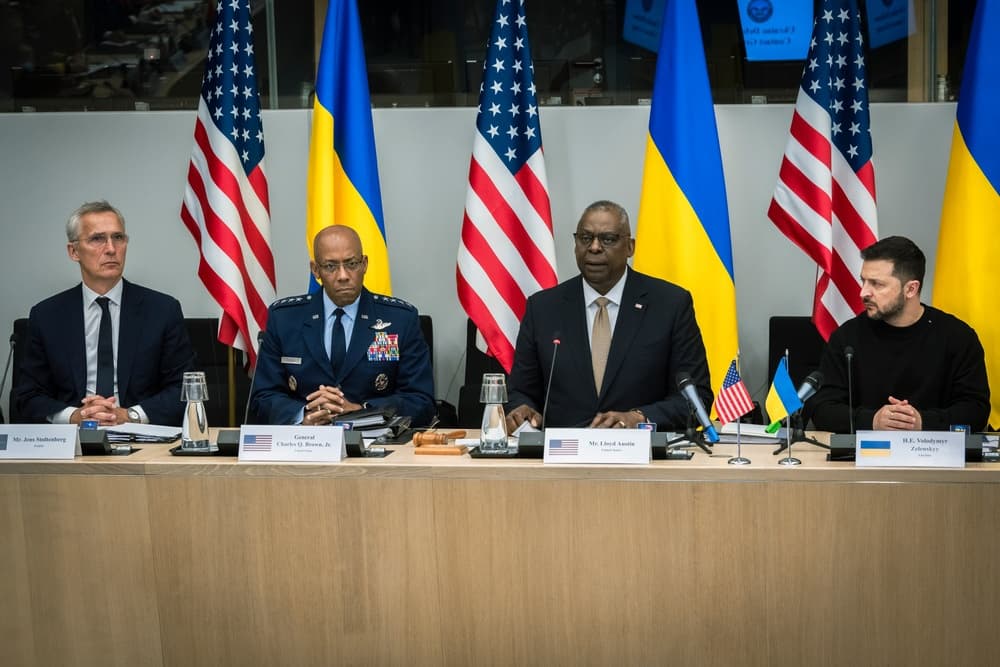
- Photo: Chad J. McNeeley / U.S. Defense Department; public domain