World
Israel votes: Netanyahu, Eisenkot and the fight to govern
Israel's election will decide 120 parliamentary seats. Who can turn those seats into a government is a separate question.
What to know
- Voters are choosing the 120-member Knesset, not directly electing a prime minister.
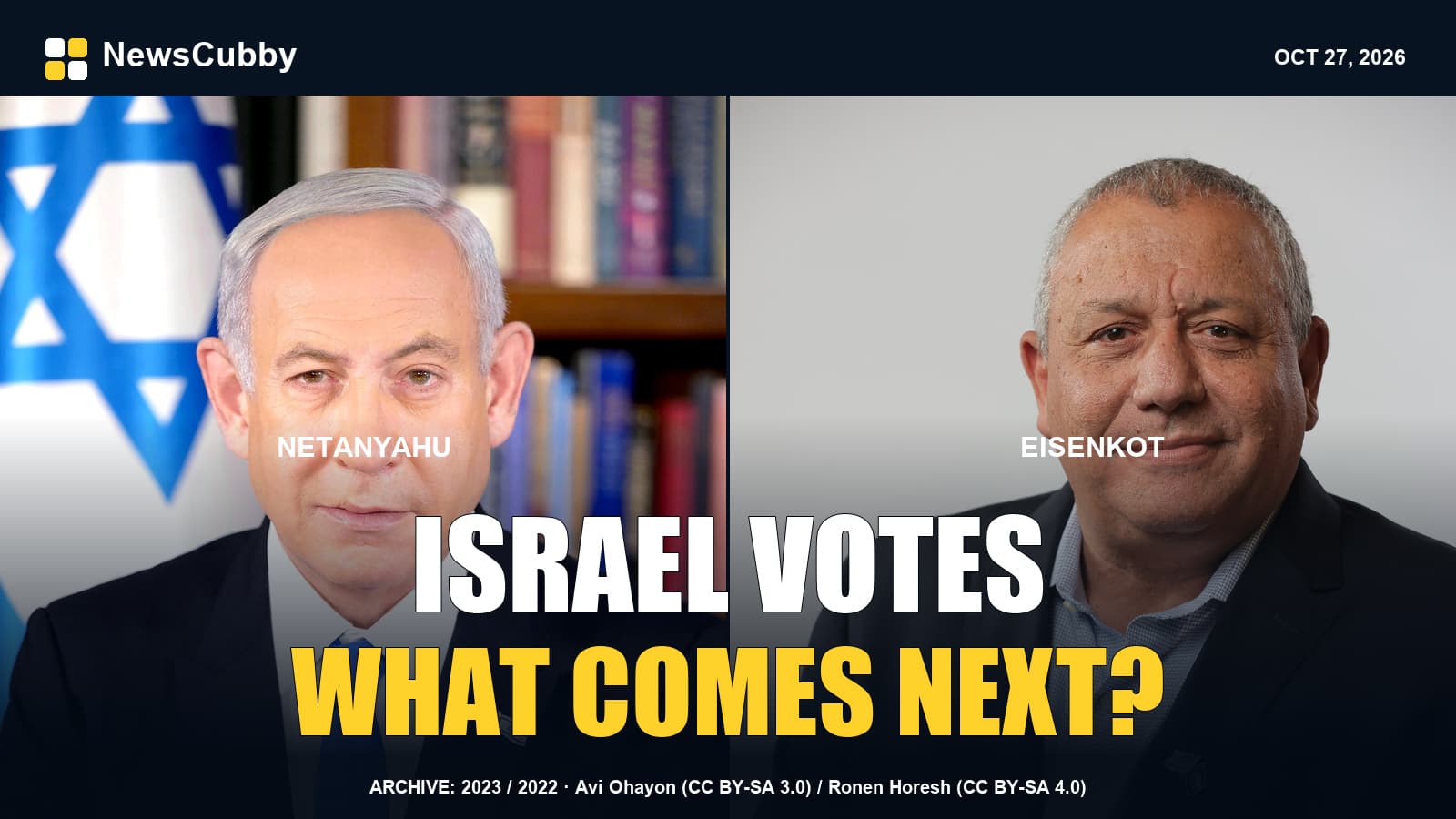
- Netanyahu leads Likud; Eisenkot, a former army chief of staff, leads Yashar.
- A coalition with 61 seats would hold a parliamentary majority. Smaller parties can determine whether that majority is possible.
- Party lists must clear a 3.25% national electoral threshold to receive seats.
- Exit polls, counted results and a completed governing agreement are different milestones. This report does not declare a winner.
Israelis voted Tuesday in their first national election since the Hamas-led October 7, 2023, attacks, with Prime Minister Benjamin Netanyahu facing a challenge from former military chief Gadi Eisenkot. The election tests Netanyahu's leadership after years of war while reopening arguments over military service, political accountability and the country's institutions. Most polling stations were scheduled to close at 10 p.m. local time, or 4 p.m. Eastern, ABC News reports.
But the first party across the finish line may not supply the next prime minister. Israel elects a parliament, and the ability to assemble support inside that parliament determines who governs. A party can celebrate a strong showing while still lacking partners. An incumbent can lose ground without immediately leaving office.
Why is this election consequential?
The campaign takes place after a period in which security questions have reached into almost every part of Israeli political life. The Associated Press describes the vote as a judgment on Netanyahu's long leadership. The central question is whether voters trust him to continue, or want another leader to take responsibility for what follows.
October 7 is central to that argument. Voters are considering both the failure to prevent the attack and the decisions taken afterward. Those are related questions, but they are not identical: a judgment about preparedness does not automatically settle a judgment about wartime policy or future threats.
The practical stakes extend beyond the identity of the prime minister. Coalition agreements determine which parties control ministries and which priorities reach the legislative agenda. Security policy, military recruitment and the balance between political and judicial authority could therefore be shaped by negotiations among several parties, rather than by one leader's campaign platform alone.
Who are Netanyahu and Eisenkot offering to lead?
Netanyahu's case rests heavily on his security experience and his record confronting Israel's adversaries. Reuters' election-day reporting places his political survival at the center of the contest. His supporters see continuity and experience as assets; opponents argue that prolonged leadership should also bring accountability for failures under that leadership.
Eisenkot offers a different political profile: a former Israel Defense Forces chief of staff challenging a veteran civilian politician. Axios reports that he has campaigned for a national inquiry into October 7 and for drafting ultra-Orthodox men. These are concrete disputes about responsibility and the distribution of national obligations, not simply differences in campaign style.
His military background does not make the election a straightforward choice between war and peace. AP's campaign explainer reports that the leading contenders are not offering a revived peace process as their central appeal. Readers should judge specific proposals on Gaza, Iran and negotiations, rather than assume that a change of prime minister would settle those questions.
Why don't Israelis vote directly for prime minister?
Under the electoral system described by the Knesset, voters choose a party list. Seats are distributed nationally by proportional representation. The ballot therefore helps determine the strength of a parliamentary group, rather than awarding a separate presidential-style mandate to an individual leader.
That distinction changes how results should be read. A party's first-place finish can strengthen its leader's negotiating position. It cannot, by itself, demonstrate that enough lawmakers will support that leader's proposed government. Parties that disagree with the incumbent can also disagree with one another about budgets, religion, security and who should lead.
Think of the election as two connected decisions. Voters establish the composition of parliament. Elected parties then negotiate how that parliament can sustain a government. Reporting only the largest party answers the first question incompletely and leaves the second unresolved. Both the distribution of seats and the willingness to cooperate matter.
Why do 61 seats and the threshold matter?
With 120 seats in parliament, 61 represents an outright majority. It is the clearest measure of whether a coalition could sustain itself without depending on outsiders. It is not a separate prize awarded to the leading party, and this article does not treat every party outside Netanyahu's camp as an automatic Eisenkot supporter.
The Knesset's official explanation sets the electoral threshold at 3.25% of valid votes. Lists below that threshold do not participate in the distribution of seats. That can make a relatively small change near the cutoff important to the overall balance, even when the largest parties' relative positions barely move.
The allocation also involves rules for remaining seats and permitted surplus-vote agreements. A simple percentage-to-seat conversion can therefore mislead. For an election-night assessment, follow the official allocation and clearly identified projections. Do not add together competing graphics as if they were the same count, or combine a poll's party totals with another poll's coalition estimate.
Which smaller parties could shape the outcome?
Reuters' candidate guide identifies Netanyahu's long-standing ultra-Orthodox partners, Shas and United Torah Judaism, alongside the far-right parties led by Bezalel Smotrich and Itamar Ben-Gvir. On the other side, opposition parties include leaders with different political backgrounds and priorities. A shared desire to replace the incumbent does not erase those differences.
Arab-led parties are another important part of the parliamentary picture. Reuters identifies Ra'am and the Joint List among potential balance-shifters. Their seats cannot simply be assigned to either leading contender in advance. Joining a government, supporting it from outside and abstaining on a confidence vote are different choices with different political consequences.
That is why turnout and party participation matter beyond the two largest lists. AP reported busy polling places in several Arab towns Tuesday, while party leaders urged participation. Those observations are not a national turnout figure or a forecast of seats. They establish activity at the locations observed, rather than a completed picture of how a community voted.
Why are military service and accountability dividing voters?
The debate over ultra-Orthodox military-service exemptions concerns who bears the burden of national defense. It also affects coalition bargaining because religious parties have their own priorities and leverage. ABC News identifies the exemptions as one of the campaign's contentious issues, alongside Netanyahu's corruption trial and arguments over judicial changes.
A proposed inquiry into October 7 raises another institutional question: how the country should investigate decision-making and assign responsibility. An election can replace political leaders, but it does not substitute for an inquiry's examination of records and testimony. Conversely, promising an inquiry does not establish its eventual findings.
These disputes can complicate agreements even among parties that want a different government. A coalition needs commitments its members can defend to their own voters. Agreements about military service or institutional reform may be difficult precisely because they touch deeply held views about religion, citizenship and the limits of political power.
What happens after the ballots are counted?
President Isaac Herzog consults parliamentary representatives before assigning a lawmaker the task of forming a government. The presidency's official description makes clear that this is a constitutional process. It is not the same as a television network announcing which party leads an exit poll.
The Knesset says the first assignment follows within seven days of publication of election results. The designated lawmaker normally has 28 days, with a possible extension of up to 14 days. If a government is assembled, its proposed program and membership go before parliament for a confidence vote.
The outgoing government continues until a new one is established. Failed negotiations can lead to additional constitutional steps and potentially another election. AP's government-formation explainer cautions that knowing who will govern can take weeks or months. A slow coalition process, on its own, is not evidence that the election result has been ignored.
What should Americans watch, and what remains unknown?
The United States has a direct interest in the leadership of a close partner and in decisions affecting the wider Middle East. ABC's reporting notes the relevance of Israel's regional conflicts. For American readers, the useful question is which policies a prospective government could actually implement with its parliamentary partners.
Campaign endorsements and personal relationships attract attention, but they cannot replace the domestic arithmetic. The next government's negotiating room will depend on its coalition commitments as well as its relationship with Washington. A strong personal connection between leaders is one factor; it is not a governing agreement or a guarantee of a particular regional outcome.
What we know
Tuesday's vote determines the makeup of the next Knesset. The constitutional rules explain how a government can emerge from it. The reported campaign disputes include security, October 7 accountability and military service. These established facts provide a framework for evaluating the results without predicting them.
What we don't know yet
At this report's reporting cutoff, NewsCubby had not verified a final seat allocation or a completed coalition agreement. Exit-poll estimates must be labeled as estimates. A candidate's victory speech must be attributed to that candidate. Neither should be presented as proof that a government has already been formed.
What happens next?
Watch three developments separately: verified counting updates, the resulting parliamentary balance and public commitments about coalition participation. Each can change the interpretation of the previous one. The strongest election coverage will explain what a new number establishes, what it leaves unresolved and which formal step comes next, rather than turning every update into a premature declaration of victory.
For more context, read NewsCubby’s pre-election guide, Iran and the U.S. election fact check, and U.S. early-vote tracker.
*Want more? Explore today's headlines on NewsCubby and join My Day free to make NewsCubby part of your day.*
*Archive portraits: Benjamin Netanyahu, February 1, 2023, Avi Ohayon / Wikimedia Commons, CC BY-SA 3.0 (https://creativecommons.org/licenses/by-sa/3.0/); Gadi Eisenkot, November 14, 2022, Ronen Horesh / Wikimedia Commons, CC BY-SA 4.0 (https://creativecommons.org/licenses/by-sa/4.0/). Separate portraits combined, cropped and overlaid with typography by NewsCubby; not photographs of today’s voting. Composite adaptation shared under CC BY-SA 4.0. No endorsement implied.*
*NewsCubby articles are produced with AI assistance and reviewed by humans.*
Sources, credits & editorial notes
- AP: Election-day reporting
- AP: Campaign explainer
- AP: Government formation
- AP: Election-day developments
- Reuters: Leading candidates, October 26
- Reuters: Election-day report
- ABC News: Election stakes
- Axios: Campaign issues
- Knesset: Elections
- Knesset: Seat allocation
- Knesset: Forming a government
- Presidency: Constitutional role
- Knesset: Basic Law, the Government
- Photo: Avi Ohayon; CC BY-SA 3.0
- Photo: Ronen Horesh; CC BY-SA 4.0