Politics
D.C. and Virginia sue to block Trump’s 250-foot arch before Nov 5 vote
The suit says the arch breaks D.C.’s 130-foot height limit and lacks congressional approval. Those are claims, not a ruling.
What to know
- D.C. and Virginia sued the Interior Department and the National Park Service in federal court in Washington on Saturday, October 31.
- They argue the 250-foot arch exceeds the Height of Buildings Act’s 130-foot limit and lacks specific congressional authorization.
- They are seeking a temporary restraining order before work that the administration says could start as soon as November 5.
- The National Capital Planning Commission is scheduled to vote on final plans on Thursday, November 5; staff have recommended approval with comments.
- Judge Tanya Chutkan consolidated the case with an earlier challenge to the arch that she is overseeing.
Washington, D.C., and Virginia have taken President Donald Trump’s proposed 250-foot arch to federal court, seeking to stop construction before the administration can turn its plans into a building site. Their lawsuit, filed Saturday, October 31, against the Interior Department and the National Park Service, adds a regional-government challenge to a project already facing litigation.
The two governments argue that the monument would violate a 130-foot height restriction and lacks required congressional authorization, NBC News reported. They also allege violations of environmental and historic-preservation laws and ask for a temporary restraining order. Those are the plaintiffs’ legal claims, not a judicial determination that the project is unlawful. The administration has offered a competing interpretation of the law and is seeking final planning approval.
ABC News reported that construction could begin November 5 if the National Capital Planning Commission approves the project that day. That condition matters: a proposed starting date is not a completed approval, a construction permit already exercised or a guarantee that work will proceed. Court action could also affect the timetable.
What do the 250 and 130 feet mean?
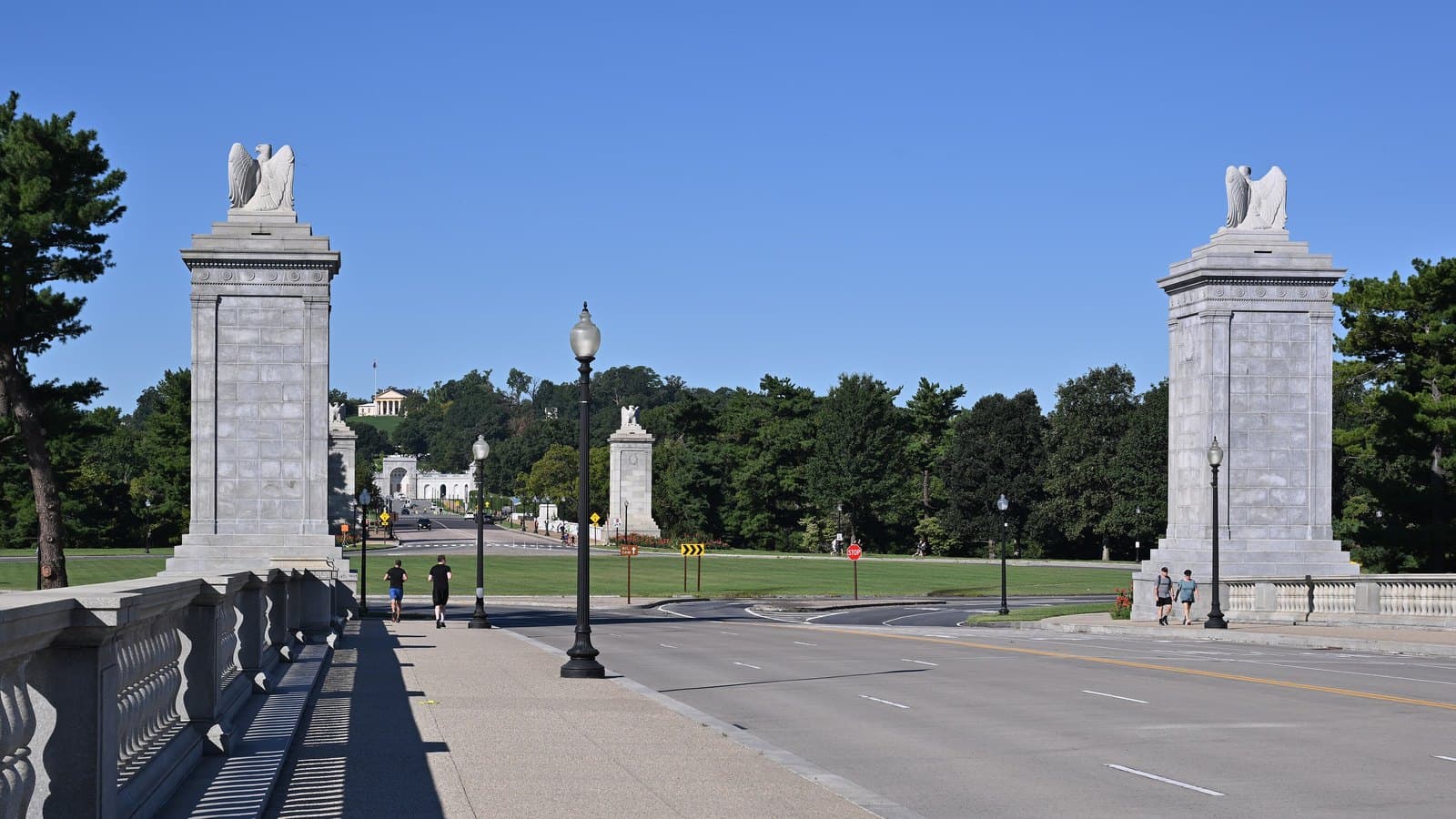
The proposed location is Memorial Circle on Columbia Island, at the western end of Arlington Memorial Bridge. Despite its proximity to Virginia and Arlington National Cemetery, the site is in the District of Columbia. The jurisdictional detail is central to the dispute over Washington’s building rules.
Interior’s legal submission distinguishes a 166-foot arch from an overall height of approximately 250 feet once the observation deck and statuary are included. The smaller number does not make the larger one inaccurate. They describe different parts of the same proposal, and the government’s own planning materials identify the complete structure as 250 feet tall.
The plaintiffs invoke the Height of Buildings Act. Its text is more complicated than an absolute 130-foot ceiling for everything in Washington. The D.C. Code ties permitted heights to street widths, sets a 130-foot maximum on business streets and contains other limits and exceptions. The lawsuit argues that the relevant exceptions do not permit this arch.
Interior argues that the statute does not bind federal buildings and that, even if it did, the proposed arch remains permissible. Its justification draws on Congress’s 1925 authorization of the Arlington Memorial Bridge project and earlier plans for architectural features at Columbia Island. Whether those authorities sustain today’s proposal is contested.
The practical issue is therefore not just how many feet appear on a drawing. It is which legal rules apply, what Congress previously authorized and whether that authority extends to the current design. Comparing 250 with 130 explains the plaintiffs’ objection; it does not, by itself, resolve those questions.
Has the planning commission approved it?
The commission’s project record separates preliminary and final review. It approved preliminary plans in July with comments requiring further work. The November 5 agenda requests approval of final site and building plans. Treating July’s decision as blanket clearance would erase a stage the agency’s own record preserves.
A staff report prepared for November recommends final approval with comments. Its proposed reasoning accepts an argument that the 1925 congressional action waived the height restriction for this project. Readers should distinguish that recommendation from an adopted commission decision. The report tells commissioners what staff proposes; it does not establish that the scheduled vote has happened.
That distinction also separates design review from judicial review. A commission may decide that a submission satisfies the standards it administers while a court considers whether the government has underlying statutory authority to proceed. Neither process can accurately be described as the other’s substitute.
Federal law supplies another layer. Title 40, section 8106 requires express congressional authority for structures on federal public grounds in the District. Section 8903 separately governs authorization of covered commemorative works. Their application is part of the legal dispute; citing either provision does not establish that every proposed memorial is governed identically.
The institutional question is consequential beyond the design’s appearance: who can authorize a permanent addition to the capital’s public landscape? The plaintiffs seek a judicial answer before work changes the site. Interior’s position rests on authority it says already exists. Disagreement over that authority cannot be settled merely by calling the project a national monument.
What harms do D.C. and Virginia allege?
D.C. and Virginia allege that construction would disrupt traffic, damage the environment and complicate emergency preparedness. Those asserted harms support their request for urgent relief. They should not be reported as effects already measured after construction, or as findings that a judge has endorsed.
The planning record does identify concrete transportation changes for review. An updated project synopsis describes expanded traffic analysis covering additional approaches beyond the circle. The proposal includes changes to vehicle movements and pedestrian access, so evaluating it requires attention to how the surrounding network operates, rather than the monument’s footprint alone.
The staff recommendation acknowledges potential delays on Washington Boulevard while describing pedestrian and bicycle safety benefits. That is a planning assessment, not proof that the jurisdictions’ concerns are imaginary or that every predicted delay will occur. Forecasts depend on the assumptions and design choices being evaluated.
Axios also reported the administration’s tourism argument, along with its claim that the arch would serve national security purposes. The existence of those asserted purposes does not automatically answer the separate questions about statutory permission, environmental review or local effects. Equally, opposition to the project’s symbolism is not itself a legal ruling against it.
What's next
The immediate developments to watch are an actual court order and the commission’s actual November decision. A request for a temporary restraining order is not an order granting one; a staff recommendation is not a vote; and a conditional construction date is not an accomplished groundbreaking. U.S. District Judge Tanya Chutkan consolidated the new suit with an earlier challenge she is overseeing and ordered a joint briefing schedule, AP reported. Keeping those distinctions intact is essential to understanding what Saturday’s lawsuit changed—and what remains unresolved.
For more on the administration’s recent court fights, read about the dismissal of Trump’s suit against The Wall Street Journal, the order shielding California election workers and the Justice Department’s appeal of that order.
*Want more? Explore today's headlines on NewsCubby and join My Day free to make NewsCubby part of your day.*
*ARCHIVE PHOTO: Memorial Circle on Columbia Island, the proposed arch site, seen from Arlington Memorial Bridge on Sept. 7, 2026. Not the current event. Photo: G. Edward Johnson / Wikimedia Commons / CC BY 4.0 (cropped).*
*NewsCubby articles are produced with AI assistance and reviewed by humans.*
Reporting Sources
- ABC News: DC, Virginia file suit to block construction on Trump's proposed arch (Oct. 31)
- Axios: D.C., Virginia sue to block Trump's 250-foot arch (Oct. 31)
- AP: Virginia and DC sue over Trump's arch, adding to legal challenges
- NBC News: Virginia and D.C. sue to stop proposed Trump arch
- D.C. and Virginia complaint (via Politico)
- NCPC: Project 8778, New Monumental Arch
- NCPC: Executive Director's Recommendation, November 2026
- Interior: Height of Buildings Act justification
- D.C. Code § 6–601.05
- 40 U.S.C. § 8106 and § 8903