Politics
Two senior DOJ officials resign, including Florida prosecutor
Miami U.S. Attorney Jason Reding Quiñones and national security chief John Eisenberg stepped down Friday, opening vacancies in two distinct offices.
What to know
- On November 6, Blanche announced the resignations of Reding Quiñones in South Florida and Eisenberg in Washington.
- Reding Quiñones’ resignation took effect Friday. The department lists Yara Klukas as acting U.S. attorney for the Southern District of Florida.
- The Florida inquiry examines allegations involving former federal officials. CBS News reported Friday that it had yielded no charges alleging the overarching conspiracy.
- Eisenberg led the National Security Division, a separate office with nationwide responsibilities. His departure followed the resignation of civil rights chief Harmeet Dhillon on Thursday.
Two senior Justice Department officials resigned Friday, November 6. Jason Reding Quiñones left as U.S. attorney for the Southern District of Florida, whose office had been overseeing an investigation into former federal officials that President Donald Trump has promoted. John Eisenberg stepped down as assistant attorney general in charge of the department’s National Security Division. Attorney General Todd Blanche announced the departures separately.
Reding Quiñones said his resignation was effective Friday. His departure leaves a federal prosecutor’s office in South Florida without its Senate-confirmed chief and raises a separate question about who will oversee the inquiry in Fort Pierce. Eisenberg’s departure opens a leadership vacancy in Washington, where his division coordinates federal work involving terrorism, espionage and other national security threats. The department’s updated roster lists Yara Klukas as acting U.S. attorney in South Florida. Blanche’s announcement did not name a successor to Eisenberg.
What did the officials say Friday?
In his announcement about Reding Quiñones, Blanche thanked the prosecutor for his work on cases involving violence, drug and sex trafficking, and crimes that cross national borders. He singled out the indictment of former Cuban leader Raúl Castro. Blanche gave no reason for the resignation. In his own statement, Reding Quiñones thanked Trump and the staff of the district, where he had previously served as a federal prosecutor.
Later Friday, Blanche said he had accepted Eisenberg’s resignation. He credited the National Security Division with prosecuting terrorism cases and working with other agencies to disrupt threats. He gave no public reason for Eisenberg’s departure. CBS News reported the departures came during the same week as Dhillon’s, and said Dhillon had notified the White House of her intention to leave before the election.
The announcements came three days after the midterm elections, in which Democrats won control of both chambers of Congress. Blanche and Reding Quiñones gave no reason for the departures in their public statements.
What was the South Florida office investigating?
The inquiry, based in Fort Pierce, has examined whether former law enforcement and intelligence officials conspired to undermine Trump through investigations that spanned more than one administration, according to CBS News’ reporting on the case. Investigators have also examined whether former CIA Director John Brennan misled Congress about the preparation of the intelligence assessment on Russia’s interference in the 2016 election. Brennan and his lawyers have denied wrongdoing, AP reported in September. The phrase “grand conspiracy” refers to the investigators’ theory. CBS reported that the inquiry had produced no charges alleging that overarching conspiracy.
The earlier intelligence assessment was a distinct government record. The declassified January 2017 assessment described a Russian effort to influence the election. Its authors expressly did not assess the impact of those activities on the election result. The current Florida inquiry concerns allegations about the conduct of U.S. officials. Whether a criminal allegation proceeds depends on the evidence prosecutors can bring in a case.
Federal grand juries can hear witness testimony and consider evidence gathered by prosecutors. Their proceedings generally take place in secret, under the federal criminal procedure rules. An indictment, if a grand jury returns one, formally sets out charges that can be challenged in court. A scheduled appearance or subpoena can be a step in gathering information without identifying the witness as a suspect or signaling how the grand jury will act.
What had changed in the inquiry before Friday?
The investigation has had several changes in personnel. AP reported that a senior career prosecutor was replaced on the team in April after questioning the strength of the case. Joseph diGenova, a former U.S. attorney in Washington, took on a leadership role and resigned in September without bringing charges. CBS reported that some lawyers temporarily assigned to the inquiry returned to their home offices when their assignments ended.
The two news organizations also reported different aspects of the inquiry’s recent management. AP, citing people familiar with the matter, said investigators had postponed some planned grand jury testimony. CBS reported that in late October, Blanche said Reding Quiñones had remained in charge and that the investigation would continue. Blanche dismissed suggestions that the department was frustrated with its pace. His Friday announcement did not announce a decision on the investigation. Bloomberg Law reported, citing a person familiar with the matter, that the department intends the inquiry to continue under Klukas. The department’s public roster confirms her role leading the district, and does not describe any assignment for the investigation.
What does the U.S. attorney’s office do beyond that inquiry?
Reding Quiñones was sworn in on August 13, 2025, after a nomination by Trump and confirmation by the Senate, according to his Justice Department biography. He had previously served as a Florida trial judge and worked in the department’s National Security Division. The Miami native also served as a federal prosecutor in South Florida and in the Eastern District of Virginia.
The Southern District of Florida office covers nine counties, from the Florida Keys north to the Treasure Coast, with offices including Miami and Fort Pierce. Under federal law, a U.S. attorney prosecutes federal offenses in the district and represents the United States in civil litigation. The district has dedicated teams for appeals, financial crimes and other kinds of federal cases.
The Castro indictment that Blanche cited illustrates that broader work. Prosecutors brought charges in May related to the 1996 downing of civilian aircraft flown by the Miami-based group Brothers to the Rescue, as CBS News reported. Those allegations belong to a separate prosecution. Friday’s personnel announcement did not alter the charges or announce a change in that case.
What did Eisenberg oversee in Washington?
Eisenberg was sworn in on June 5, 2025, according to his Justice Department biography. His job included overseeing teams that prosecute counterterrorism, counterintelligence, export control and national security cyber cases. Other parts of the division advise on national security law, support U.S. victims of terrorism overseas and review certain foreign investments for national security concerns. Eisenberg had previously advised the National Security Council during Trump’s first term.
The division also serves as a point of contact between federal prosecutors and intelligence agencies. Its Office of Intelligence administers work under the Foreign Intelligence Surveillance Act, including litigation before the specialized courts that review certain surveillance applications. CBS reported that some national security prosecutions handled by U.S. attorneys around the country require consultation with, or approval from, the division. A decision about its next leader has implications for district offices well beyond Florida.
Eisenberg and Harmeet Dhillon, who resigned Thursday, held the same rank of assistant attorney general but ran different divisions. The Civil Rights Division enforces statutes governing areas such as voting, housing and disability rights. Reding Quiñones held a district-level post. These departures therefore leave the department with separate handovers, involving different teams and different sets of pending cases.
What to watch
With an acting U.S. attorney listed for South Florida, the next leadership decisions concern a permanent nominee for that district and who will run the National Security Division. Federal law provides a process for filling a U.S. attorney vacancy on an interim basis. A permanent appointment ordinarily involves a presidential nomination and Senate confirmation. The new balance of power described in NewsCubby’s congressional election coverage provides context for any nominations that reach the next Senate.
One option under that law is for the attorney general to appoint an interim U.S. attorney. The appointment ends when a presidential appointee qualifies or after 120 days, whichever comes first. If the interim term expires while the vacancy remains, the district court can appoint someone to serve until the vacancy is filled. A September Justice Department legal opinion also describes a separate federal vacancies law as an option for temporary coverage.
In Florida, the next substantive development would be an on-record decision about supervision of the Fort Pierce investigation or a public filing that changes its status. Neither was part of Friday’s announcements. In Washington, an acting appointment or a later nomination would show who will assume Eisenberg’s responsibilities. Each is a distinct decision from the resignations Blanche announced.
Want more? Explore today's headlines on NewsCubby and join My Day free to make NewsCubby part of your day.
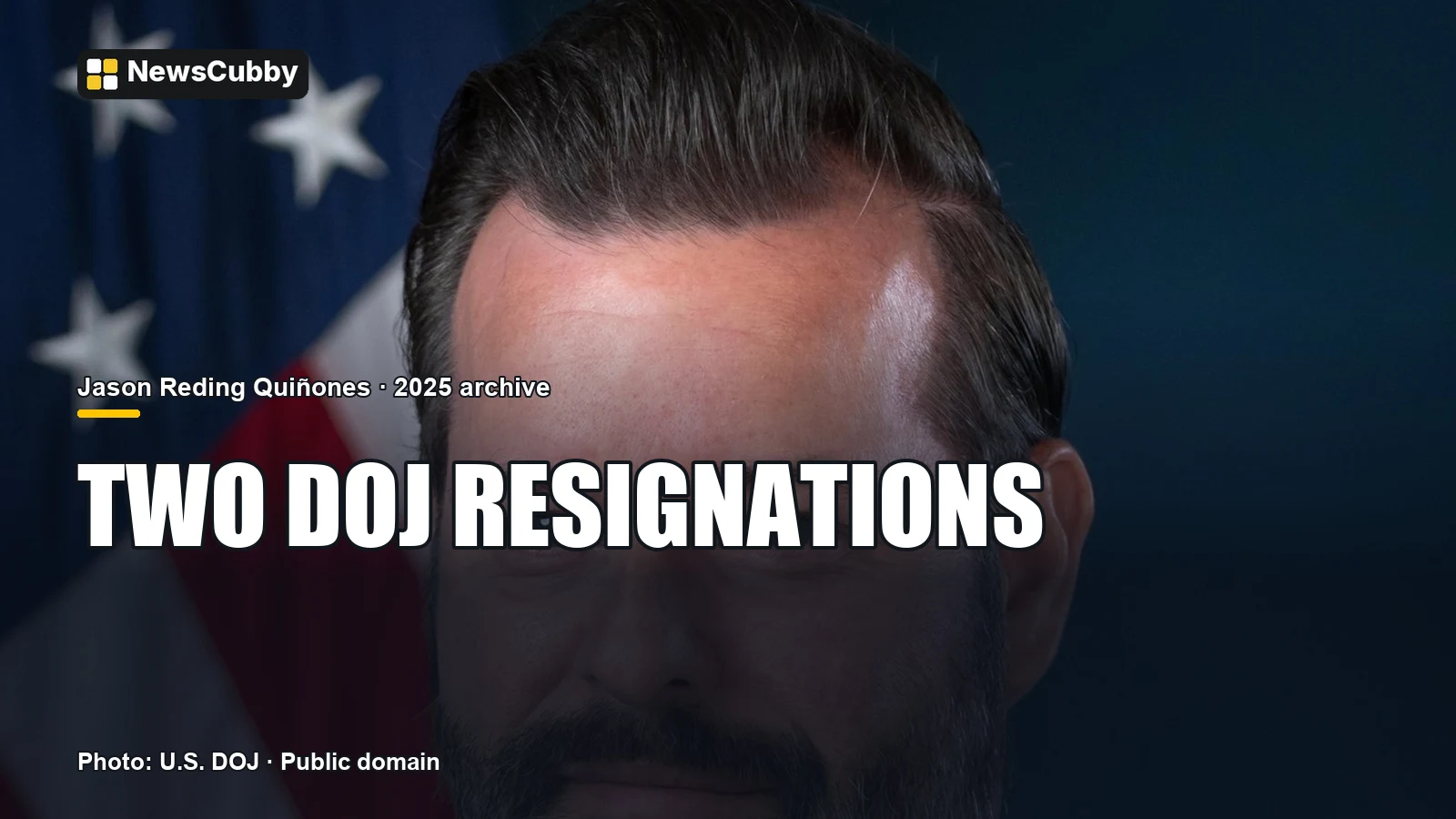
ARCHIVE PHOTO: Jason Reding Quiñones in his 2025 official portrait. Photo: U.S. Department of Justice / Wikimedia Commons, U.S. federal public domain. The source image was previously cropped. The NewsCubby cover reframes the portrait, softens its background and adds a gradient, headline, credit and logo.
NewsCubby articles are produced with AI assistance.
Reporting Sources
- updated roster
- his announcement about Reding Quiñones
- his own statement
- Blanche said
- CBS News
- CBS News’ reporting on the case
- AP reported in September
- declassified January 2017 assessment
- the federal criminal procedure rules
- Bloomberg Law reported
- his Justice Department biography
- Southern District of Florida office
- federal law
- CBS News reported
- his Justice Department biography
- Harmeet Dhillon, who resigned Thursday
- Federal law provides a process
- NewsCubby’s congressional election coverage
- Justice Department legal opinion
- NewsCubby
Photo & Video Credits
Credit: U.S. Department of Justice / Wikimedia Commons. License: U.S. federal public domain. Source: file page.
Editorial notes
Sources
- Attorney General Todd Blanche on the resignation of Jason Reding Quiñones
- Jason Reding Quiñones’ resignation statement
- Attorney General Todd Blanche on accepting John Eisenberg’s resignation
- Associated Press reporting on both resignations, via AOL
- CBS News reporting on Reding Quiñones and the Fort Pierce inquiry
- CBS News reporting on Eisenberg and the National Security Division
- Associated Press on Joseph diGenova’s September departure
- Justice Department biographies and district office · John A. Eisenberg · Southern District of Florida
- Declassified U.S. intelligence assessment from January 2017
- Federal Rules of Criminal Procedure · Federal duties statute · Federal vacancies statute
- Justice Department legal opinion on temporary U.S. attorney appointments
- Current Justice Department roster, listing Yara Klukas as acting · Bloomberg Law on the Florida handover
- CBS News on the separate Castro indictment
Photo: U.S. Department of Justice / Wikimedia Commons, 2025 official portrait, previously cropped · U.S. federal public domain, 17 U.S.C. §§ 101 and 10
Video image credits
Jason Reding Quiñones — U.S. Department of Justice. 2025; exact day not verified. U.S. federal public domain.
https://commons.wikimedia.org/wiki/File:Jason_Reding_Qui%C3%B1ones_%28cropped%29.jpg
https://www.justice.gov/legalpolicies
Todd Blanche — U.S. Department of Justice. Exact capture day not verified; official profile image served in August 2026 directory. U.S. federal public domain.
https://www.justice.gov/legalpolicies
John Eisenberg — U.S. Department of Justice. Exact day not verified; official image served June 2026 directory. U.S. federal public domain.
https://www.justice.gov/nsd/staff-profile/assistant-attorney-general-john-eisenberg
https://www.justice.gov/legalpolicies
Fort Pierce federal courthouse — United States District Court, Southern District of Florida. 2018 report; exact capture day not specified. U.S. federal public domain.
https://www.flsd.uscourts.gov/sites/flsd/files/2018-EXTERNAL-State-of-the-Court-Report.pdf
https://commons.wikimedia.org/wiki/File:Alto_Lee_Adams,_Sr._U.S._Courthouse.png
Yara Klukas — U.S. Department of Justice. Exact day not verified; official profile updated June 10, 2026. U.S. federal public domain.
https://www.justice.gov/usao-sdfl/staff-profile/yklukas-first-assistant-united-states-attorney
https://www.justice.gov/legalpolicies
DOJ headquarters — Ed Brown (Edbrown05). 2005-05-04. Public domain by photographer dedication (PD-self).
https://commons.wikimedia.org/wiki/File:Dept_of_Justice.jpg
https://commons.wikimedia.org/wiki/File:Dept_of_Justice.jpg
Video and cover changes include cropping, motion, resizing, gradient, wording, subtitles and logo.