Politics
Democrats win Congress: what changes for Trump and Jeffries
Democrats have won the House and Senate. The result reshapes Washington, but new laws and a Jeffries speakership still require votes.
What to know
- AP and Reuters report that Democrats won both chambers in the November 3, 2026, elections.
- Congressional terms begin January 3, 2027. The election does not immediately replace the current Congress.
- Jeffries could become the first Black House speaker. He has not yet been elected to that office.
- A congressional majority gives Democrats important legislative and oversight powers, while Trump retains the presidency and veto power.
- The final size of each majority, leadership choices and specific legislative deals remain separate questions.
Democrats have won control of the U.S. House and Senate in the November 3 midterm elections, according to the Associated Press and Reuters. The result puts Congress and President Donald Trump on opposing sides of the partisan divide when the new congressional terms begin in January.
The immediate consequence is a change in who will organize Congress, not an overnight change in federal law. Hakeem Jeffries is positioned to become the first Black speaker of the House, but he must still win the speakership vote. That distinction is central to understanding what the election changed and what remains ahead.
Who won control of Congress?
The AP’s national result report says Democrats won the House and Senate. Reuters independently reported the same outcome early Wednesday, describing Democratic gains that extended into Republican-leaning states. Its reporting identified Kansas and South Carolina as examples of the party’s reach beyond familiar battlegrounds.
That follows the earlier, narrower results NewsCubby covered on election night. Our report on Roy Cooper’s North Carolina victory explained why a Republican-held seat changing hands mattered. Our Virginia Senate report covered a Democratic hold. Those articles are snapshots of the count at their stated publication times; this article addresses the subsequent national outcome.
Our election-night guide to the races shaping Congress provides further background on those contests.
The national result matters even before every individual contest is settled. Once enough seats have been won to determine a chamber’s majority, the remaining races affect its eventual size rather than necessarily leaving control unresolved. Readers should distinguish a national majority call from a complete, certified list of every winner.
Why does control matter if Trump is still president?
Congress and the presidency have different responsibilities. The House’s explanation of the legislative process describes bills moving through committees and floor votes before both chambers agree on the text sent to the president. A bill approved by only one chamber is not a new federal law.
Democratic control therefore changes the political conditions for Trump’s legislative proposals. A proposal supported by the president still needs congressional approval through the applicable process. Conversely, a Democratic proposal will not become law simply because the party controls Congress.
That creates room for bargaining, but it also creates opportunities for stalemate. A campaign promise, a newly introduced bill, a committee vote and a signed law are different stages. For households and businesses following potential changes to taxes, benefits or federal programs, the practical question is which stage a proposal has actually reached.
Is Hakeem Jeffries already the speaker?
No. The AP describes Jeffries as poised to become the first Black speaker, not as having already taken office. The distinction is important: voters elect representatives, and the House selects its speaker.
According to the House’s official history, parties generally choose their candidates separately before nominations reach the floor. Members then vote at the start of a new Congress. A party’s internal choice and the House’s election are related, but they are not the same action.
The Congressional Research Service explains that a speaker needs a majority of votes cast for named individuals. That threshold can be lower than 218 when members are absent or vote “present.” A simple headline saying a leader has won the speakership before that vote would skip a necessary step.
AP also reports that Jeffries has put living costs and oversight of the Trump administration at the center of his plans. Those are stated priorities, not enacted policies. His potential election would be historic, but the milestone should be reported as completed only after the House has elected him.
What can change through oversight?
Congress does more than vote on legislation. The House’s institutional history explains that hearings can examine proposed laws, investigate issues that might require legislation and scrutinize federal programs. Committees can make information about government decisions part of a public record.
The Senate describes oversight as reviewing, monitoring and supervising how legislation is implemented. That work can include hearings and information gathered from agencies. A change in congressional control can therefore alter which questions receive attention and which administration decisions face sustained examination.
For readers, an announced investigation should be treated as the start of a process rather than proof of wrongdoing. A hearing, a request for records and a completed finding are distinct events. The useful evidence will be the documents, testimony and conclusions that emerge, along with any response from the officials or agencies involved.
What does the result mean for spending and nominations?
Federal spending is another important point of contact between Congress and the White House. The House describes raising and spending public money as one of Congress’s central responsibilities, commonly called the power of the purse. The congressional budget and appropriations process gives lawmakers a role in deciding how public resources are allocated.
That makes future spending proposals important to watch. Readers should look for the actual text and scope of an agreement rather than assume an election result has already changed a particular program. An appropriation is a legislative action, not a consequence that takes effect automatically when a race is called.
The Senate also has a distinct role in presidential appointments. Its official explanation says the Constitution assigns it advice-and-consent responsibilities for ambassadors, Supreme Court justices and other specified officers. The House does not perform that confirmation role.
A new Senate majority therefore matters for the path presidential nominees must take. But winning an election does not itself remove existing officials or reject a particular nominee. Each nomination’s status must be checked individually.
Can Democrats pass everything with a simple majority?
No. Different congressional actions have different voting requirements. The Senate says most measures require a simple majority to pass, but ending debate on legislation generally requires three-fifths of senators duly chosen and sworn. With a full Senate, that is normally 60 votes.
The president also retains the power to veto legislation. Overriding a veto requires two-thirds in each chamber, a higher threshold than an ordinary majority. These rules explain why controlling Congress and being able to enact every item on a party’s agenda are different things.
The final membership and lawmakers’ willingness to work across party lines will matter. So will differences within each party. A majority label is a useful starting point for understanding power, but the result of an actual vote depends on the votes cast and the procedure being used.
Does a news organization’s call certify the result?
No. AP explains that its race callers declare a winner when trailing candidates no longer have a path to victory. Its decision team examines results and the remaining vote, rather than treating a candidate’s declaration or concession as the deciding factor.
An AP call is a journalistic determination. Official certification is a separate government process. That is why a result can be reported before every ballot has been counted, while final totals and administrative steps remain outstanding.
For readers returning to earlier election coverage, check its timestamp. An article written while several races were uncalled can accurately describe that moment without representing the latest state of the count. NewsCubby’s earlier North Carolina and Virginia stories are linked here as background, not as current national tallies.
What happens next?
The Senate’s official guide says the Constitution sets the start of congressional terms in January; Congress ordinarily convenes at noon on January 3 unless a law sets a different meeting time. The coming transition includes leadership decisions and the formal organization of the new House and Senate.
The next useful developments to watch are the remaining race outcomes, the final size of the majorities, the House speaker election and the text of the first major proposals. None should be confused with a policy already taking effect.
The election has settled the broad direction of congressional control. What that means in practice will now be determined through votes, appointments, oversight and negotiations between a Democratic Congress and a Republican president.
*Want more? Explore today’s headlines on NewsCubby and join My Day free to make NewsCubby part of your day.*
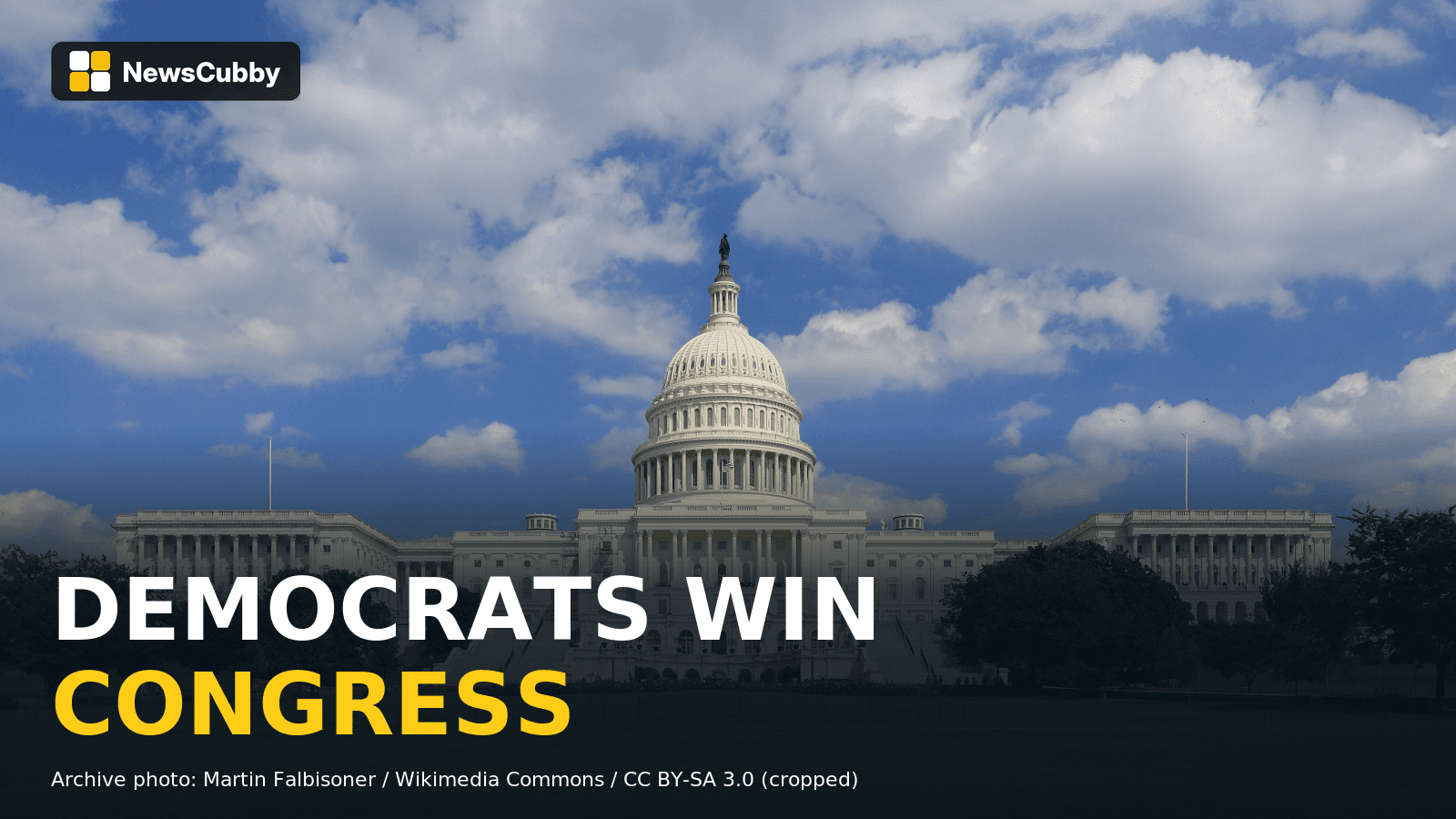
*ARCHIVE PHOTO: The U.S. Capitol, September 2013, not the current election. Photo: Martin Falbisoner / Wikimedia Commons, CC BY-SA 3.0 (cropped with NewsCubby text and branding).*
*NewsCubby articles are produced with AI assistance and reviewed by humans.*
Reporting Sources
Photo & Video Credits
Credit: Martin Falbisoner / Wikimedia Commons. License: CC BY-SA 3.0. Source: file page.
Editorial notes
Photo credit
The accompanying NewsCubby Short uses archival photographs, not footage of Election Night 2026. Photographs were cropped, scaled and animated with camera movements and text overlays. Government imagery does not imply endorsement.
- Shots 1, 6, 7 and 8: Hakeem Jeffries speaking before flags, seated in the House chamber, speaking with reporters outside the Capitol, and addressing President Trump's first 100 days. Office of the House Democratic Leader. Archival images; capture dates not verified except the stated first-100-days event context. Official source and copyright policy: U.S. Government work unless otherwise noted; no contrary image credit was found.
- Shot 2 and article cover: US Capitol west side, September 5, 2013. Martin Falbisoner / Wikimedia Commons, CC BY-SA 3.0. Cropped, scaled and overlaid with text; the adapted photograph is distributed under the same license. The NewsCubby logo remains its trademark.
- Shot 3: Donald Trump's official portrait, June 2025. Daniel Torok / White House, public-domain U.S. Government work. Original portrait. White side margins cropped.
- Shot 4: Hakeem Jeffries official portrait, 2021. Franmarie Metzler / U.S. House, public-domain U.S. Government work. Original portrait.
- Shot 5: Mike Johnson official portrait, 2024. Ike Hayman / U.S. House of Representatives. Public-domain U.S. Congress / Office of Speaker work, with image-specific rights recorded on Wikimedia Commons. Official source and original photograph. Exact date differs between metadata records, so only the year is shown. This is an archival portrait of the current Speaker, not Jeffries or an election-night reaction.
- Shot 9: White House South Portico, archival date unspecified. National Park Service. Official image page and public-domain policy.
No generated people or architecture were used. The Short uses synthetic narration; the photographs retain archive or portrait-year labels.
Direct official photographs for the Jeffries images: shot 1, shot 6, shot 7, shot 8.