Politics
Gina Hinojosa wins Texas governor race: what changes next
Her defeat of Greg Abbott gives Texas its first Latina governor-elect and puts schools, household costs and executive power in focus.
What to know
- The Associated Press called the November 3, 2026 governor’s election for Hinojosa, who defeated Abbott.
- She will be Texas’ first Latina governor. Ann Richards, elected in 1990, was the last Democrat elected to the office before this result.
- Public education was a central campaign issue, including disagreements over vouchers, testing and state control of school districts.
- The governor can recommend policies, sign or veto bills and make appointments. The election does not itself rewrite existing law.
Gina Hinojosa has defeated Greg Abbott in the Texas governor’s race, according to The Associated Press. The Democratic state representative will become the state’s first Latina governor, replacing a Republican incumbent who sought a fourth term. The November 3 result ends a long run of Republican victories for the office and gives a former school board president the opportunity to turn an education-centered campaign into a governing agenda.
The immediate change is the choice of governor. Changes to school funding, private-school vouchers, taxes and other state policies will require additional decisions. Texas divides authority among its governor, separately elected officials and Legislature. Understanding those responsibilities helps explain which parts of Hinojosa’s platform could move through appointments and which depend on new legislation or money in the state budget.
Who is Gina Hinojosa?
Hinojosa’s public career began in the Austin school system. Her official Texas House biography describes her election to the Austin Independent School District board and subsequent service as its president. She later ran for the Texas House in 2016 and represents central Austin. Before elected office, she worked as a civil rights and labor lawyer after studying at the University of Texas and George Washington’s law school.
That background gives the education debate a particular connection to her record. The responsibilities of a school board member differ from those of a governor, but both involve decisions about money, oversight and the relationship between families and public institutions. As a legislator, she has served on the Public Education Committee. Her move to statewide executive office will put her in a different position: proposing a direction for agencies and negotiating with lawmakers rather than casting one House vote.
Why is the result historically significant?
The long gap since Richards’ election helps explain the national attention. Richards left office in 1995; Abbott first took office in 2015, after winning the 2014 election. Hinojosa’s victory therefore changes the party in the governor’s office after more than three decades. It also adds a new milestone in representation: Texas has elected a Latina to lead its executive branch for the first time.
A single result does not settle how Texas will vote in every future election. Nor does it identify one cause for the outcome. Comparing complete county returns, turnout and other races will offer a fuller picture than a statewide headline alone. The practical question now is how this change in leadership affects the government Texans use every day, from schools to state agencies.
What did the candidates disagree about on schools?
The Texas Tribune’s August education guide described a sharp contrast over private-school support. Abbott backed the education savings account program that allows public money to help pay for private or home-school education. Hinojosa campaigned to end that program. She also sought changes to high-stakes testing and the accountability system tied to school ratings, according to the guide by Jaden Edison, Sneha Dey and Megan Menchaca.
Those are distinct policy questions. Funding a private-school program, deciding how to assess a campus and choosing agency leadership do not all follow the same process. A family participating in an existing program should not assume that an election-night result changes its terms the next morning. The details of any enacted change would determine its timing and effect. The next administration’s written proposals will be more informative than a broad claim that education policy has already been reversed.
The Tribune’s October reporting by Sneha Dey and Megan Menchaca also highlighted opposition to state takeovers of districts and Hinojosa’s promise to replace Education Commissioner Mike Morath. Abbott, meanwhile, defended his administration’s record and emphasized property-tax relief, border security and public safety. These reports establish what the candidates emphasized; they do not prove that any one issue alone decided the election.
What can a Texas governor actually do?
The governor’s office lists signing or vetoing legislation, calling special sessions on designated subjects, recommending a budget and making appointments among its duties. Those powers can shape both the direction of debate and the administration of existing programs. The governor also recommends policy changes that members of the state House and Senate can introduce as bills.
Appointments deserve attention alongside high-profile legislation. The choice of people to lead or oversee government bodies can influence priorities and implementation. But authority depends on the particular office and the law governing it. A campaign announcement about changing an agency is therefore a starting point for examining the appointment process, the relevant statute and the proposed action, not evidence that every administrative step is complete.
The Texas Constitution supplies another important limit: a governor’s veto can be overridden by the required supermajority in both legislative chambers. The governor also has authority to reject individual spending items in an appropriations bill. These provisions make the Legislature’s work important even after the statewide contest has been decided. Passing a proposal and funding it remain separate tasks that may involve different negotiations.
How do the Legislature and budget fit into the transition?
Texas has a 150-member House and a 31-member Senate, according to the Legislative Reference Library. House members choose their speaker, while the separately elected lieutenant governor presides over the Senate. The governor’s victory does not appoint either chamber’s members or substitute for their votes. Lawmakers must pass legislation through both chambers before it reaches the governor.
Regular sessions occur in odd-numbered years and begin on the second Tuesday in January. They last 140 calendar days. The budget process includes agency requests, legislative proposals and negotiations between the chambers. This timetable gives readers concrete things to watch: which bills are filed, whether committees advance them, what each chamber approves and whether the final language matches campaign promises. The library’s legislative guide explains how to follow those steps.
What about property taxes and household costs?
Property taxes were part of the campaign, but the structure of the system matters. The Texas comptroller explains that Texas has no state property tax. Property taxes are locally assessed and administered, and state law sets rules for exemptions. Some exemptions are mandatory; others are available at local option. A governor can advocate a change in that framework, but does not simply replace every local tax bill with a new amount.
For households, the most useful test of a tax proposal is what it actually changes: eligibility, appraised value, rates, school funding or another part of the calculation. A promise of relief also raises the question of how affected services will be paid for. Those details should be evaluated in the proposal and the budget, rather than inferred from the identity of the winning candidate.
What is known, and what still needs to happen?
The race call establishes the reported winner; the formal election process continues. Texas law treats the governor and lieutenant governor returns separately from most other statewide contests. Those returns are opened and canvassed by the Legislature, with the result declared through the constitutional process. This is a regular part of the transition, not a reason by itself to suggest that the outcome is in doubt.
This article does not give a final vote margin because counting and certification are separate from the race call. It also does not declare any campaign policy enacted. The next substantive developments will be transition appointments, detailed policy proposals and legislative action. Each should be assessed on its own evidence and timing.
What should readers watch next?
Watch for the governor-elect’s transition team, her education leadership choices and the bills that lawmakers introduce for the next session. For schools, the key distinction will be between a proposed change and one that has completed the legal process. For household costs, look for the funding source and the people eligible to benefit.
NewsCubby’s Election Day guide explains the wider contests that brought voters to the polls. Our ballot-counting explainer describes what happens after a vote is cast, and our North Carolina Senate coverage follows another race that helped shape the national picture. Those stories provide context while Texas moves from choosing its next governor to establishing how she will govern.
Want more? Explore today’s headlines on NewsCubby and join My Day free to make NewsCubby part of your day.
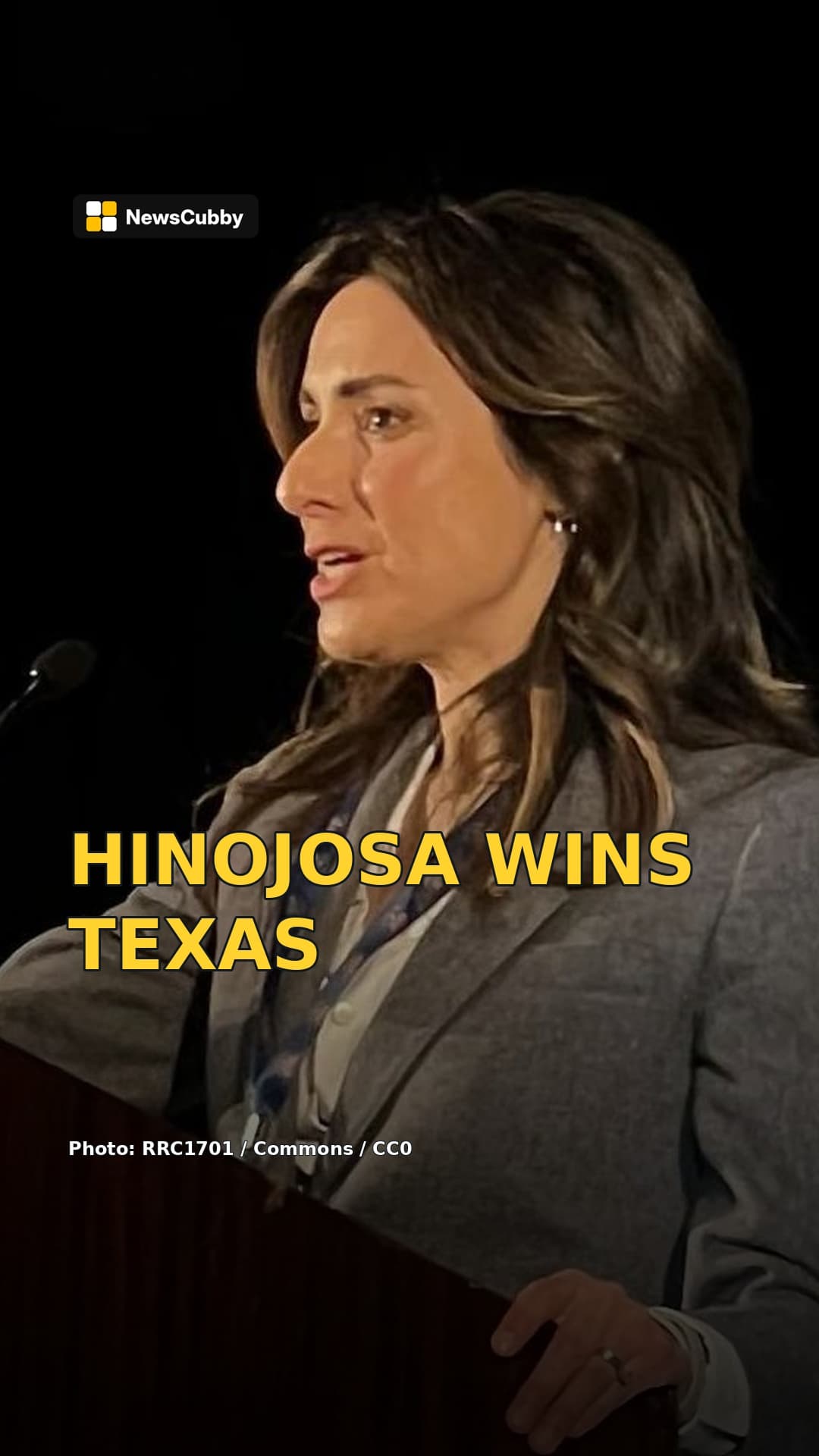
ARCHIVE PHOTO: Gina Hinojosa speaking at the AFL-CIO COPE convention, January 28, 2024. Photo: RRC1701 / Wikimedia Commons / CC0 1.0. Resized for this article.
Prepared with AI assistance.
Reporting Sources
- The Associated Press
- official Texas House biography
- The long gap since Richards’ election
- The Texas Tribune’s August education guide
- The Tribune’s October reporting
- The governor’s office
- The Texas Constitution
- Legislative Reference Library
- Texas comptroller
- Those returns are opened and canvassed by the Legislature
- CBS Texas: Governor result
Editorial notes
Photo credit
The accompanying Short uses archival photographs, cropped, resized and animated with pan/zoom and text overlays. These are not Election Night 2026 photographs. Government imagery and credited images do not imply endorsement. Narration is AI-generated; no voice clone or music is used.
- Gina Hinojosa at the AFL-CIO COPE convention, January 28, 2024. RRC1701 / Wikimedia Commons, CC0 1.0. Source photograph. Also used for the cover.
- Greg Abbott at NASA Johnson Space Center, March 26, 2024. NASA / Robert Markowitz, public-domain U.S. federal work. Source photograph. Not a concession photograph.
- Gina Hinojosa at the LBJ Library Future Forum, February 16, 2017. LBJ Library / Jay Godwin, public-domain U.S. federal work. Source photograph.
- Ann Richards at the University of Houston, May 1992. University of Houston Digital Libraries; author released the image into the public domain. Source photograph. Historical comparison, not her 1990 election.
- Svante Palm Elementary School, Austin, March 10, 2017. © 2017 Larry D. Moore / Wikimedia Commons, CC BY 4.0. Source photograph. Cropped, resized, animated and overlaid with text. Illustrative school context; no claim about this school's current condition or policy.
- Texas House of Representatives chamber. WhisperToMe / Wikimedia Commons, public-domain dedication. Source photograph. Archival; exact date unverified, not the current legislative session.
- Texas State Capitol, November 15, 2015. Daderot / Wikimedia Commons, CC0 1.0. Source photograph.
- Gina Hinojosa at the LBJ Library Forum, February 16, 2017. LBJ Library / Jay Godwin, public-domain U.S. federal work. Source photograph. A distinct photograph from the same event, not a recrop of the earlier image.
- Texas Governor's Mansion, April 16, 2014. Carol M. Highsmith, Lyda Hill Texas Collection, Library of Congress; public-domain dedication, no known copyright restrictions. Source photograph. Office/transition context, not a claim that Hinojosa already occupies the residence.