Entertainment
Henry Winkler: Part 3 of 5 - Hank Zipzer and Championing Kids Who Learn Differently
Henry Winkler turned his own school struggles into Hank Zipzer, a book series with Lin Oliver that became a CBBC show and led to an honorary OBE.

What to know
- Henry Winkler and Lin Oliver wrote 17 Hank Zipzer books from 2003 to 2010, drawing on Winkler's own school difficulties as a child.
- The idea was suggested by Alan Berger; Winkler named the character Hank because it is short for Henry, and Zipzer after a neighbor in the apartment building where he grew up.
- After the original run, Winkler and Oliver created the prequel *Here's Hank*, which explored Hank's life as a second grader and became the first book published in the United States to use the Dyslexie font.
- CBBC's *Hank Zipzer* ran from January 2014 to December 2016, with Winkler playing the music teacher Mr. Rock, a character based on the teacher at McBurney who encouraged him.
- The Hank Zipzer work brought public recognition, including the Key to the City of Winnipeg in 2010, an honorary OBE in 2011, a place among the U.K.'s Top 10 Literacy Heroes in 2013 and a Los Angeles Press Club honor in 2019.
Henry Winkler's career is often framed through his screen work, but one of its most personal chapters began with a children's book. In 2003, working with writer and producer Lin Oliver, he launched Hank Zipzer, a series rooted in his own school difficulties and in the Manhattan neighborhood where he grew up. The project expanded into a prequel, a CBBC television adaptation and a series of honors tied to literacy and education. In Winkler's career, Hank Zipzer remains a clear example of how lived experience can be turned into storytelling that reaches young readers with humor and warmth.
How did Hank Zipzer begin?
The origin story starts with a suggestion Henry Winkler did not immediately welcome. Alan Berger first raised the children's-book idea with Winkler in 1998. A few years later, during what Winkler described elsewhere as a lull in his acting career, Berger returned to the idea and suggested books based on the school difficulties Winkler had known as a child.
What changed the conversation was Berger's next thought: Winkler would not have to do it alone. He proposed that Winkler work with an experienced children's author, and that opened the door to a partnership rather than a solo project. Berger then introduced Winkler to Oliver, a writer and producer who would become his long-term collaborator.
That beginning matters because *Hank Zipzer* did not come from a publishing plan developed in isolation. It came from a practical nudge, then a match with the right partner, and finally a decision to turn personal memories into fiction for children. In Winkler's case, the idea was not simply to revisit school years. It was to translate those years into a character with comic energy, imagination and momentum.
Why was Lin Oliver the right collaborator?
Oliver brought exactly the experience Berger thought Winkler needed. She is a children's author and producer, and she is also the co-founder, with Steve Mooser, of the Society of Children's Book Writers and Illustrators. When she and Winkler met for lunch, they discussed his childhood experiences in school and began shaping a story around them. From that first conversation came Hank Zipzer.
The partnership worked in part because both writers came out of television. They were used to collaboration, pitching ideas and solving story problems together. Winkler has described a method that fits their backgrounds: Oliver types at the computer while he talks through scenes and ideas out loud. When Oliver reads the work back, he said, "we argue over every word," a line that says a lot about how carefully they built the voice of the books.
That process also helps explain why the series feels specific rather than generic. The two shaped the character together, from the first lunch onward. Their later work would prove that the method had lasting value, but Hank Zipzer was the place where it first found a wide audience.
What made Hank Zipzer so personal to Winkler?
At the center of the series is a direct line back to Winkler's own life. Hank is short for Henry. Zipzer was the surname of a neighbor in the apartment building where Winkler grew up. The books are based on him, and every character in the series is also based on a real person in his life.
The setting deepens that personal link. Hank Zipzer is placed in Winkler's childhood home territory on Manhattan's Upper West Side. In the series overview, Hank lives on the Upper West Side and attends P.S. 87 at Amsterdam Avenue and West 78th Street. His closest friends are Frankie Townsend and Ashley Wong. That geography gives the books a rooted New York feel rather than an abstract school setting.
The original run lasted from 2003 to 2010 and totaled 17 volumes. It began with *Niagara Falls, or Does It?* and ended with *A Brand-New Me!* Between those two came titles such as *The Zippity Zinger*, *Summer School! What Genius Thought That Up?* and *The Curtain Went Up, My Pants Fell Down*. The titles alone suggest the tone: energetic, embarrassed, inventive and funny. The books turn classroom pressure, school mix-ups and everyday misunderstandings into comedy, but the core idea remains grounded in a boy who thinks fast and keeps going.
For Winkler, that made the series more than a side project. It became a way to take memories that were difficult in real life and rebuild them as stories in which a young reader could recognize frustration, creativity and resilience all at once.
How did *Here's Hank* expand the idea?
After the main Hank Zipzer series ended, Winkler and Oliver built a prequel called *Here's Hank*. Instead of moving forward, they went back and explored Hank's life as a second grader. That shift made the larger Hank world accessible to younger readers while keeping the same central character at the center of the storytelling.
One practical feature of *Here's Hank* became especially notable. The series uses a special font called Dyslexie, and it marked the first time that font was used in a book published in the United States. That detail is easy to miss if the books are only described as a franchise extension, but it says something important about the authors' approach. The format of the page was part of the reading experience, not just the words themselves.
The prequel also showed that Winkler and Oliver did not see Hank as limited to one age or one phase of school. They found more room in the character, more room in the voice, and more room in the idea that a familiar child from one series could be reintroduced in a new way.
How did the books become a CBBC television series?
Hank Zipzer moved from page to screen in Britain. The television version was a British children's series created by Henry Winkler and based on the books by Winkler and Oliver. It starred Nick James as Hank, with Winkler himself taking the role of Mr. Rock, Hank's music teacher.
The adaptation made one major change right away: instead of remaining in the United States, the television series was set in London. CBBC commissioned the show in 2013, and filming began in October of that year. The first series premiered in January 2014. A second series began airing on Aug. 13, 2015, and the third began on May 26, 2016. After that came an 84-minute Christmas film, *Hank Zipzer's Christmas Catastrophe*, released on Dec. 12, 2016. Taken together, the show ran from January 2014 to December 2016 on the CBBC channel.
The route to television was not a straight American network path. Winkler said the team could not find an American buyer for the show, so it was sold to the BBC. After the program succeeded there, it was later broadcast on the Universal Kids Channel in the United States. The series then found a streaming afterlife: HBO Max began streaming all three seasons on May 13, 2022, and added *Hank Zipzer's Christmas Catastrophe* on Dec. 2, 2022.
That arc says a lot about the material. A story that began with one actor's school memories in New York became a British television series with three seasons, a Christmas film and later streaming availability.
Why was Mr. Rock such an important role for Winkler?
Mr. Rock was not just a part for Winkler to play in the adaptation. The character was based on a music teacher Winkler had in high school at McBurney. He said that teacher was the only one in his high school who believed in him. Winkler also recalled a line that stayed with him: "Winkler if you ever do get out of here you are going to be great."
That memory gives Mr. Rock a deeper place in the Hank Zipzer story. On screen, Winkler was not simply appearing in a series based on his books. He was also embodying a figure of encouragement drawn from his own life. In a project built from school memories, that matters. The show was not only about classroom chaos or comic disasters; it also made room for the kind of teacher a child remembers for decades.
There is another useful detail here. In the original books, Mr. Rock appears as a teacher who becomes significant in Hank's school life, including in *The Life of Me: Enter at Your Own Risk* and *A Brand-New Me!* The television version made him Hank's music teacher and placed Winkler in the role. That gave the series an emotional bridge between the fictional student and the real adult whose experiences inspired him.
How was the Hank Zipzer work recognized?
The recognition attached to Hank Zipzer was not limited to book sales or television adaptation. Winkler has been recognized for contributing to a greater understanding of dyslexia and learning disabilities through the series. In 2010, he received the Key to the City of Winnipeg for "contributions to education and literacy," a citation that connected the books directly to their effect beyond entertainment.
The following year brought one of the highest-profile honors in this chapter of his career. In 2011, Queen Elizabeth appointed Winkler an Honorary Officer of the Order of the British Empire, or OBE, "for services to children with special educational needs and dyslexia in the UK." The wording is precise, and it shows how the Hank Zipzer work was understood in public life: not just as children's publishing, but as support for young readers and students.
More recognition followed. In 2013, he was named one of the United Kingdom's Top 10 Literacy Heroes. In 2019, the Los Angeles Press Club awarded him the Bill Rosendahl Public Service Award for Contributions to the Public Good for his children's books.
The television adaptation earned attention too. In 2016, Nick James won the British Academy Children's Awards for Performer for playing Hank Zipzer. James said he had received messages from parents and children saying the show helped them understand and come to terms with dyslexia. That response fits the larger pattern: Hank Zipzer was entertainment, but it was also outreach.
What did the Hank Zipzer success lead to next?
The biggest sign that Hank Zipzer was not a one-off is the body of work that followed. Winkler and Oliver continued writing together after the original series and its prequel. Their later collaborations included *Ghost Buddy*, the *Alien Superstar* series and *Detective Duck*. In Henry Winkler's Television Academy bio, the total is put simply: he and Oliver have written 39 novels together.
That total changes how Part 3 of this series reads. Hank Zipzer was not just a detour from acting. It became one of the main lanes of Winkler's career, linking authorship, adaptation and public advocacy. It also shows why Oliver matters so much in this period. She was not only the co-writer on one successful set of books, but the partner in a long-running creative chapter.
There is also a useful bridge to what comes next in this five-part series. If Hank Zipzer shows Winkler turning personal experience into books and television for young audiences, Part 4 turns to another side of his off-camera career: his producing work on *MacGyver*. The through line is the same one that keeps appearing in Winkler's career. He rarely stayed in just one lane for very long.
For more from NewsCubby's five-part Henry Winkler career series, visit TV & Streaming, Movies, Entertainment and find short videos from the series on the Videos page.
Timeline
- **1998:** Alan Berger first suggests the children's-book idea to Henry Winkler.
- **2003:** Winkler and Lin Oliver launched the series with *Niagara Falls, or Does It?*
- **2003-2010:** The original Hank Zipzer series ran for 17 books.
- **2010:** Winkler received the Key to the City of Winnipeg for "contributions to education and literacy."
- **2011:** He was appointed an Honorary Officer of the Order of the British Empire, or OBE.
- **2013:** He was named one of the United Kingdom's Top 10 Literacy Heroes, and CBBC commissioned *Hank Zipzer*.
- **Jan. 2014:** The first TV series of *Hank Zipzer* premiered on CBBC.
- **Aug. 13, 2015:** The second TV series began airing.
- **May 26, 2016:** The third TV series began airing.
- **Dec. 12, 2016:** *Hank Zipzer's Christmas Catastrophe* was released.
Catch up on the series: Part 1: From Yale to the Fonz · Part 2: The Fonz's Jacket Goes to the Smithsonian
*Want more? Explore today's headlines on NewsCubby and join My Day free to make NewsCubby part of your day.*
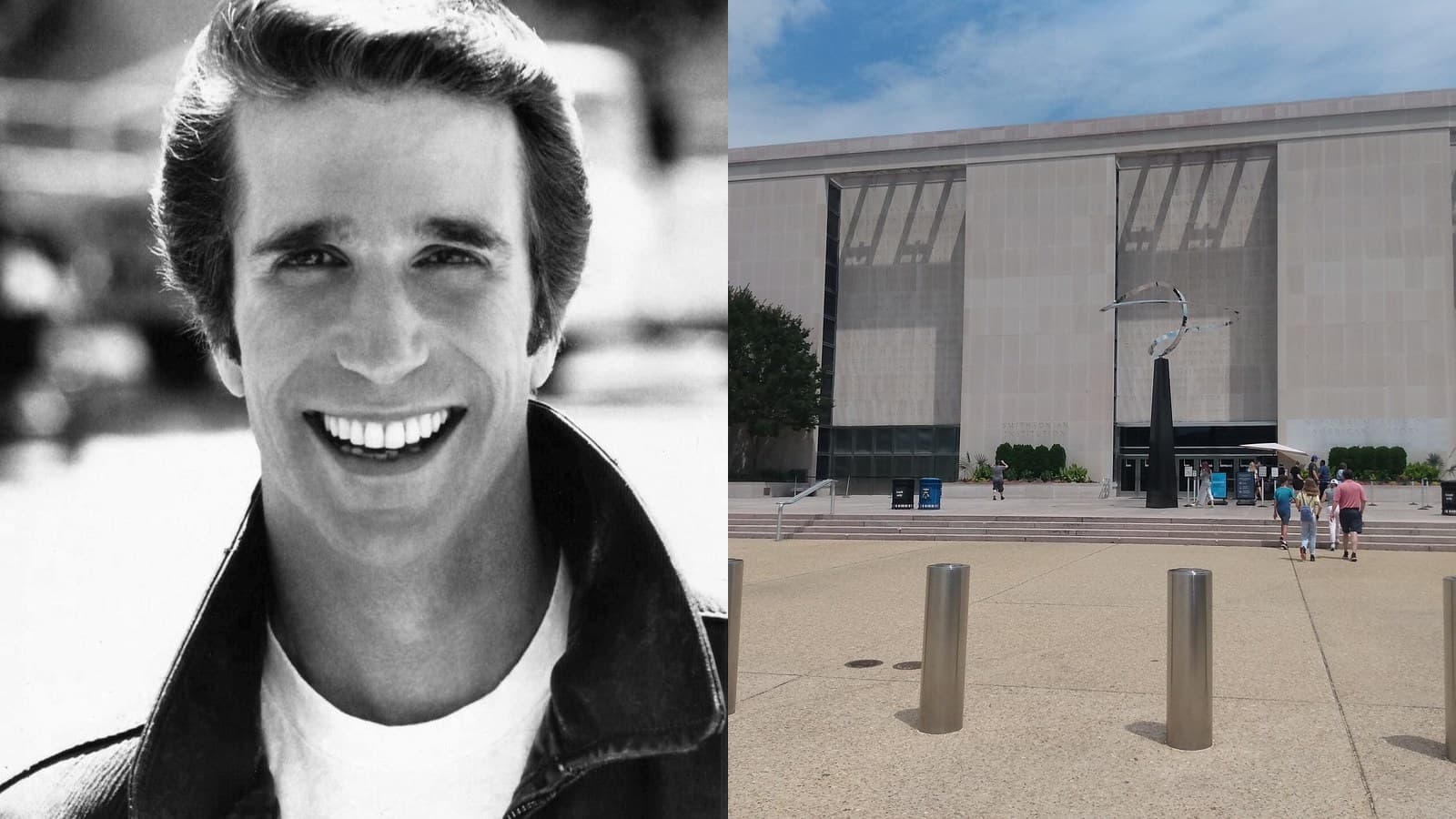
*ARCHIVE PHOTOS: Henry Winkler speaking at the Foreign and Commonwealth Office in London on March 5, 2013 (left) and at the Barbican Centre in London on June 21, 2024 (right). Photos: Foreign and Commonwealth Office / Wikimedia Commons / OGL v1.0 (left); Raph_PH / Wikimedia Commons / CC BY 2.0 (right). Right photo cropped.*
*NewsCubby articles are produced with AI assistance and reviewed by humans.*