Politics
Houston limits ICE cooperation after Texas election shift
Houston's new rule narrows police contact with ICE after Texas Democrats' wins, drawing federal criticism and renewed state-law questions.
What to know
- The signed order took effect November 6 and directs Police Chief J. Noe Diaz to update officers' instructions.
- ICE contact requires both a qualifying jail booking and a positive database match for an administrative immigration warrant.
- A person receiving a traffic citation and being released does not meet that jail-booking threshold.
- The order governs Houston police, not ICE's independent federal operations. State-law and funding disagreements remain central to the dispute.
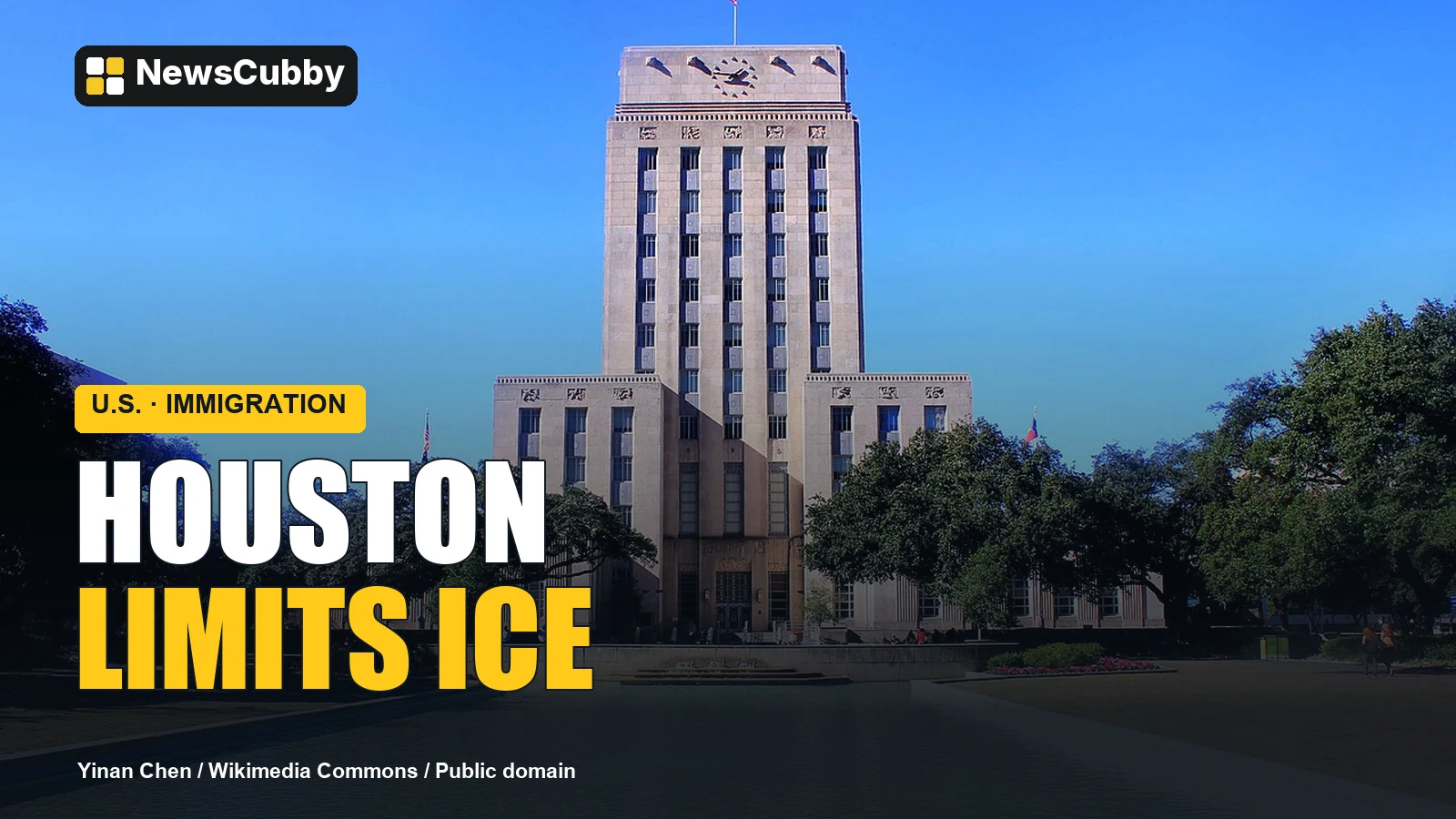
*Houston City Hall, 2014\. Archive photograph: Yinan Chen / public domain.*
Houston is limiting when its police officers contact U.S. Immigration and Customs Enforcement, turning this week's Texas election shift into an immediate change in how local officers assist the federal government's deportation campaign. Mayor John Whitmire signed the directive Friday, November 6, after Democrat Gina Hinojosa defeated Republican Governor Greg Abbott, according to Reuters and The Associated Press.
The change concerns a consequential decision during a police encounter: whether an immigration database alert becomes a call to federal agents. It preserves notification in qualifying criminal-custody cases while removing immigration status alone as a reason to contact ICE or hold someone. Whitmire says he wants other Texas cities to consider Houston's approach; federal officials are criticizing the move.
What does the signed order actually change?
Executive Order EO 1-74 makes the custody threshold specific. A person must already be going to jail on new criminal charges or another criminal warrant, and officers must have a positive National Crime Information Center match for an ICE administrative warrant. The reference to another warrant means an outstanding criminal arrest warrant or similar judicial process under which the person is being booked.
That is different from treating the two requirements as alternatives. An administrative ICE warrant by itself is insufficient under the directive. Nor does a minor traffic ticket automatically make someone a qualifying criminal-custody case. The distinction turns on whether the encounter ends in jail booking, rather than citation and release.
The order also directs the chief to ensure people are not held in the field solely for ICE pickup. Its stated purpose is to allocate finite police resources to public safety while retaining lawful authority. This changes the department's notification and detention procedures; it does not decide an individual's immigration case or grant anyone lawful status.
Why are administrative and criminal warrants different?
Administrative immigration warrants are issued by federal immigration officials, rather than criminal-court judges, The Texas Tribune explains. A database entry can therefore concern a civil immigration matter rather than a new criminal charge. The fact that the alert appears in a law-enforcement database does not erase that distinction.
Houston's new rule requires officers to connect the alert to a separate basis for jail custody before making the specified ICE contact. For readers, the important question is what each document authorizes and which agency is acting. A police officer handling a traffic violation, a jail processing a criminal arrest and an immigration officer enforcing federal law have different assignments.
The policy also differs from federal deputization. Section 287(g) of immigration law provides for written agreements under which trained state or local officers perform designated immigration functions under federal supervision. Diaz said HPD does not participate in that program. Communication with ICE and acting as a delegated immigration officer are separate forms of cooperation.
How did Houston reach this point?
The policy has changed more than once this year. In April, City Council sought restrictions on police involvement in administrative immigration cases. The council's accompanying explanation described concerns about prolonged encounters and officers being diverted from other duties. It distinguished administrative warrants from the criminal process used to take someone to jail.
State officials responded with financial pressure. An April 13 notice from the governor's Public Safety Office accused Houston of breaching immigration-cooperation assurances attached to its grants. It identified roughly \$110 million in fiscal-year 2026 funding that could be terminated and reclaimed. That amount concerned Houston, not a nationwide funding cut.
After the council revised its ordinance, HPD's April 23 directive required officers encountering an administrative-warrant database match to contact ICE's support center and bring a supervisor to the scene. Even when there were no local criminal charges, the instructions provided for verification and a reasonable wait if ICE requested a pickup. Friday's order replaces that approach where the policies conflict.
Did the election repeal Texas immigration law?
No. Whitmire changed a city policy after an election; voters did not repeal the relevant state statute through that mayoral announcement. The law at the center of the dispute is Texas' 2017 Senate Bill 4, the measure addressing local cooperation with immigration enforcement.
The enrolled legislation prohibits local policies that bar or materially limit enforcement of immigration laws. It addresses immigration-status inquiries during lawful detention, information sharing, assistance to federal officers and access to jails. Those provisions explain why a city instruction about contacting ICE can trigger a dispute with state leadership.
Whitmire opposed the measure as a state senator. Reuters reports that he now argues Houston's approach is a permissible interpretation focused on criminal offenders. The police union has questioned the directive's relationship to SB 4\. These competing positions concern how the law applies; a mayor's executive order and a union objection are not court judgments resolving that question.
Why does the policy matter beyond Houston?
Houston illustrates how state and local decisions can affect federal enforcement without changing federal immigration law. The federal government determines its own operations, but a local department decides how its officers handle daily encounters within applicable law. The point where those systems exchange information can determine whether an otherwise routine police interaction leads to immigration enforcement.
The election changed Whitmire's assessment of the political and financial risks. Reuters reports that he consulted incoming state leaders before acting. In the city's announcement, he linked the decision to reducing fear among workers, students and families.
Incoming officials' support does not itself change existing statutes or grant conditions. That makes Houston a practical test of how quickly an election can alter enforcement priorities during a transition, and what still requires legal or administrative action. Other cities considering changes would face their own policies, responsibilities and state-law constraints.
The city decision coincides with Stephen Miller's appointment as White House chief of staff, announced November 6 and due to take effect Monday, November 9\. Miller is a longtime Trump adviser closely associated with his immigration agenda, according to The Associated Press. The federal staffing change and Houston's order are separate decisions showing how the immigration debate continues after the election.
How have federal officials and residents responded?
DHS criticized restrictions on local cooperation, saying partnerships help federal agents carry out their duties. In a statement provided to KPRC, the department argued that reduced cooperation can mean a more visible federal enforcement presence. It did not announce a specific new Houston operation in that statement. Its warning is a policy response, not evidence that such an operation has begun.
Supporters also want proof of implementation. FIEL Houston welcomed the change while saying it should have happened earlier. FOX 26's reporting described the police union's concern about legal exposure for officers and the ACLU of Texas' intention to monitor compliance. Those reactions identify different standards of success: community trust, officer clarity and continued public safety.
What do police records show before the change?
HPD's quarterly immigration report, dated October 28, covers July 1 through September 30, before the new order. It records 88 immigration-related database matches or ICE contacts. Seventeen people were transferred to ICE, 58 were released at the scene and 13 were jailed on separate charges unrelated to immigration.
Those categories show why a total-contact figure cannot be read as the number of people deported. They also provide a starting point for evaluating the new policy, not a calculation of how many people it will affect. The report does not apply the November rule retrospectively to those encounters. A meaningful comparison will require the circumstances of later stops and their outcomes, using the same reporting period and definitions.
What should readers watch next?
The immediate question is how supervisors apply the jail-booking threshold. Diaz told KPRC that instructions were being distributed and reviewed with officers. Written guidance, supervisory decisions and encounter records will show whether practice follows the announcement.
State and federal responses also matter: a funding notice, lawsuit or new operational instruction would be a concrete development beyond political criticism. For now, Houston has changed its own police procedures, while the broader argument over local participation in federal immigration enforcement continues.
*Want more? Explore today's headlines on NewsCubby and join My Day free to make NewsCubby part of your day.*
*ARCHIVE PHOTO: Houston City Hall and reflecting pool, January 11, 2014\. Not the November 2026 announcement. Photo: Yinan Chen / Wikimedia Commons / Public domain. The cover crops and resizes the photograph and adds a gradient, headline, credit and logo. Photo source.*
*NewsCubby articles are produced with AI assistance.*
Video photo and graphic credits
John Whitmire speaking at Veterans Day Ceremony, 2024 (5369) — Ed Uthman. Houston Mayor John Whitmire speaking at a Veterans Day ceremony, November 11, 2024\. Archive photograph; not the November 2026 announcement. CC BY 2.0. Image source. Cropped, resized, camera motion, gradient, text, subtitles, credit and NewsCubby logo added.
Houston Police Department Chevy Caprice No.43503 — Jason Lawrence. Houston Police Department Chevrolet Caprice, June 2, 2020\. Archive photograph, not an ICE referral or current enforcement scene. CC BY 2.0. Image source. Cropped, resized, camera motion, gradient, text, subtitles, credit and NewsCubby logo added.
The Texas Capitol, Austin, Texas (LCCN2014632031) — Carol M. Highsmith; The Lyda Hill Texas Collection, Library of Congress. Texas Capitol in Austin, April 16, 2014\. Archive photograph illustrating Texas state law, not a new legislative vote. Public domain / Carol M. Highsmith; no known publication restrictions. Image source. Cropped, resized, camera motion, gradient, text, subtitles, credit and NewsCubby logo added.
ICE Headquarters in Washington DC 2009 — Ser Amantio di Nicolao; Wikimedia source edits by WikiPedant. ICE headquarters building in Washington, D.C., photographed February 15, 2009\. Archive view, not a November 2026 operation. CC BY 3.0. Image source. Wikimedia source includes rotation, levels and sharpening edits by WikiPedant in February 2026\. NewsCubby crops/resizes it and adds camera motion, gradient, text, subtitles, credit and logo.
Houston City Hall and reflecting pool — Yinan Chen. Houston City Hall and reflecting pool, January 11, 2014\. Archive photograph, not the November 2026 announcement. Public Domain. Image source. Cropped, resized, camera motion, gradient, text, subtitles, credit and NewsCubby logo added.
Document: City of Houston, Executive Order EO 1-74, effective November 6, 2026, section 4 operative legal-text excerpt. Cropped, resized and moved for readability; explanatory labels added. Seal and signature excluded. No blanket photographic license or public-domain status is asserted for the entire PDF.
Reporting Sources
Photo & Video Credits
Credit: Yinan Chen / Wikimedia Commons. License: Public domain. Source: file page.
Editorial notes
Sources
- City of Houston — Executive Order EO 1-74, effective November 6, 2026
- Houston Mayor's Office — November 6 policy announcement
- Reuters — Houston curtails police cooperation with ICE, November 6
- Associated Press — Houston limits ICE cooperation, November 6
- The Texas Tribune — HPD policy change, November 6 (authorized KPRC republication)
- Texas Governor's Public Safety Office — April 13 Houston grant notice
- Houston Police Department — April 23 administrative-warrant directive
- Texas Legislature — Senate Bill 4, enrolled 2017 law
- KPRC — Whitmire and Diaz explain new policy, November 6
- KPRC — DHS response and full statement, November 6
- FOX 26 — Police union and community responses, November 6
- 8 U.S.C. § 1357(g) — Delegated immigration authority and cooperation
- Houston City Council — April immigration-ordinance proposal and background
- Houston Police Department — October 28 quarterly report, July–September 2026
- Associated Press — Miller succeeds Wiles, November 6
- Photo: Yinan Chen / Wikimedia Commons / Public domain (archive, cropped)