World
Mayon volcano stays at Alert Level 3 after minor eruption Monday
PHIVOLCS recorded minor Strombolian activity at Mayon early Monday; about 1,500 evacuees remain in shelters and a 6-km danger zone stays closed.
What to know
- PHIVOLCS recorded minor Strombolian activity at Mayon's summit crater at 1:15 a.m. Monday Philippine time (12:15 p.m. Sunday ET).
- Alert Level 3 means an increased tendency toward a hazardous eruption. It has been in place since Oct. 30.
- PHIVOLCS logged 14 volcanic earthquakes and one rockfall event in the overnight monitoring period, NET25 reported.
- About 1,510 people from 420 families spent All Saints' Day in seven evacuation centers, provincial officials said.
- Up to 785 schools in Albay were affected by Friday's eruption, The Philippine Star reported.
Mayon volcano remains at Alert Level 3 on Monday, November 2, after the Philippine Institute of Volcanology and Seismology recorded a minor eruption at its summit crater before dawn. About 1,500 evacuees remain in shelters in Albay province, and authorities are keeping everyone out of a six-kilometer permanent danger zone around the volcano.
The new activity came three days after a moderately explosive eruption on Friday, Oct. 30, sent an ash column about 3,000 meters above the crater and prompted PHIVOLCS to raise the alert from Level 2 to Level 3 on a five-level scale. Mayon sits in Albay, about 330 kilometers southeast of Manila.
What happened early Monday?
PHIVOLCS said its thermal camera at the Upper Lidong Observation Station and cameras at the Mayon Volcano Observatory on Ligñon Hill captured minor Strombolian activity at 1:15 a.m., GMA News reported. Strombolian activity is a burst of gas that throws glowing lava fragments from the crater. The agency repeated that Alert Level 3 remains in effect and that no one should enter the six-kilometer zone.
Tokyo's Volcanic Ash Advisory Center, which issues aviation ash warnings for the region, posted a matching advisory at 18:14 UTC Sunday. It logged an eruption at 17:15 UTC, the same moment as the PHIVOLCS report. Ash was not identifiable in satellite imagery, and the advisory included no ash-cloud forecast.
Mariton Bornas, chief of the PHIVOLCS monitoring and eruption prediction division, told Bombo Radyo Legazpi that Strombolian bursts carry ballistic projectiles. Chunks of lava can strike the area near the crater.
Why did Mayon erupt again?
Bornas said Mayon released a large volume of magma during its effusive eruption from January to August. That led scientists to expect a quieter period, as after past eruptions. Small activity was considered normal, she said, but the Oct. 30 explosion was not expected, because sulfur dioxide emissions had not been especially high since the alert was lowered in August. She said the volcanic gas comes from fresh magma that rose under the volcano earlier this year.
PHIVOLCS Director Teresito Bacolcol told ABS-CBN News on Sunday that Friday's blast may have been triggered by a blocked conduit. Gas trapped inside the volcano built up pressure until it was released explosively. The changes happened quickly, without the gradual drop in sulfur dioxide that has come before some past eruptions. That is why officials say "anything could happen."
Bacolcol said the volcano still showed signs of unrest on Sunday. Before Monday's activity, PHIVOLCS had counted 14 volcanic earthquakes and seven rockfall events in 24 hours, plus a weak ash emission on Oct. 31 that rose about 200 meters.
What does Alert Level 3 mean?
PHIVOLCS uses a five-level system. Level 3 signals magmatic unrest and an increased tendency toward a hazardous eruption. Reuters reported that at this level, Mayon has a higher chance of lava flows and hazardous eruptions in the coming days to weeks.
Under Level 3, PHIVOLCS bars entry to the six-kilometer permanent danger zone because of lava flows, rockfalls, pyroclastic density currents and other hazards. Pilots are told to avoid flying near the summit. A move to Level 4 would mean a hazardous eruption is imminent, and evacuations would likely widen. Level 5 means a hazardous eruption is under way.
Bacolcol also warned that prolonged heavy rain over Albay could send lahars down river channels that start on Mayon's slopes. Lahars are fast-moving flows of volcanic debris and water. Rain does not change the volcano's internal activity, he said, but it can turn loose ash and rock into dangerous mudflows.
Who has been displaced?
Friday's eruption first displaced 746 families, or 2,041 people, from inside the danger zone in Tabaco and Ligao cities and Camalig town, according to the Albay Public Safety and Emergency Management Office. By its 5 p.m. report on Saturday, 420 families, or 1,510 people, remained in evacuation centers, the Daily Tribune reported. Others moved in with relatives in safer areas.
The shelters include the San Antonio, Buang, Mariroc and Buhian sites in Tabaco City; the Bungkaras center and Tagaytay Elementary School in Camalig; and a center in Barangay Baligang in Ligao City.
Many families marked All Saints' Day on Nov. 1 away from home. On that holiday, Filipinos traditionally visit their relatives' graves. The Department of Social Welfare and Development's Bicol office delivered food packs to 167 displaced families in Camalig and handed out 404 ready-to-eat packs and 91 family food packs in Malilipot. More than 2,000 additional packs are set for towns hit by ashfall from Friday's plume.
How are schools affected?
Friday's eruption struck at 11:53 a.m., and the provincial government suspended afternoon classes at all levels in public and private schools, The Philippine Star reported. Up to 785 public and private schools in Albay were affected, a disruption that reached 311,259 students, teachers and school workers, the paper said.
The Department of Education said 48 schools sit within six to eight kilometers of the volcano. Two of them, Calbayog and Magapo elementary schools, are inside the six-kilometer permanent danger zone. Education officials said an alternative mode of learning would be used until Mayon's activity subsides, and division offices in Legazpi City and Ligao are monitoring possible evacuations.
What happened earlier this year?
Mayon has been active for most of 2026. PHIVOLCS raised it to Alert Level 3 on Jan. 6, the Philippine Daily Inquirer reported, and lava flowed for months down the Mi-isi, Bonga and Basud gullies.
NASA's Earth Observatory reported in March that pyroclastic flows had traveled about 4 kilometers through the Mi-isi Gully. Sulfur dioxide emissions averaged 2,466 tons per day during the eruption and peaked at 6,569 metric tons on Feb. 4. PHIVOLCS said that peak was the highest one-day level in 15 years.
On Aug. 5, PHIVOLCS lowered Mayon to Alert Level 2, citing a general decline in unrest since July 23. Lava-collapse rockfalls had dropped from an average of 278 a day to 12. Volcanic earthquakes had fallen from 57 a day to 13. The agency estimated the erupted lava and related deposits at about 89 million cubic meters.
PHIVOLCS warned at the time that the lower alert "should not be interpreted to mean that the volcano's unrest has ceased." It said the volcano was still pressurized and sulfur dioxide emissions remained high compared with baseline levels.
Why does Mayon matter?
Mayon is the Philippines' most active volcano and is known for its nearly symmetrical cone. NASA says it rises more than 2,400 meters above sea level and has erupted 65 times in the past 5,000 years. Reuters counts more than 50 eruptions in the last four centuries.
Its eruptions have been deadly. Pyroclastic flows killed more than 1,000 people in 1814, at least 400 in 1897 and 77 in 1993, according to NASA. More than 73,000 people were evacuated during a 1984 eruption. Reuters reported that the 1814 lava flows buried an entire town.
Mayon is also a popular tourist destination because of its near-perfect cone, Reuters noted. The danger-zone ban applies to visitors as well as residents.
Timeline
- **Jan. 6, 2026:** PHIVOLCS raises Mayon to Alert Level 3 as an effusive eruption begins.
- **Feb. 4:** Sulfur dioxide peaks at 6,569 metric tons, a 15-year one-day high.
- **July 11-18:** Eruptive activity peaks at the summit crater.
- **Aug. 5:** PHIVOLCS lowers Mayon to Alert Level 2.
- **Oct. 30:** A moderately explosive eruption sends ash about 3,000 meters high; the alert returns to Level 3 and 2,041 people evacuate.
- **Oct. 31:** A weak ash emission rises about 200 meters.
- **Nov. 1:** About 1,510 evacuees spend All Saints' Day in shelters.
- **Nov. 2, 1:15 a.m. local time:** PHIVOLCS records minor Strombolian activity.
What to watch
- PHIVOLCS' daily Mayon bulletin, which reports earthquakes, rockfalls, sulfur dioxide and ground swelling.
- Any move to Alert Level 4, which would widen evacuations beyond the six-kilometer zone.
- Rain forecasts for Albay and lahar warnings for river channels on Mayon's slopes.
- School reopening decisions from education officials in Albay.
- Aviation advisories from Tokyo's Volcanic Ash Advisory Center for flights near the summit.
For more international news, read NewsCubby's world briefs on the Black Sea grain corridor, the G20 and Bulgaria, our report on Europe's youth-led protests and our Iran coverage, or visit the world news section.
What's next
PHIVOLCS updates Mayon's status in a daily bulletin, and Albay officials update evacuation counts through the provincial emergency office. Residents should follow local evacuation instructions and stay out of the six-kilometer permanent danger zone.
*Want more? Explore today's headlines on NewsCubby and join My Day free to make NewsCubby part of your day.*
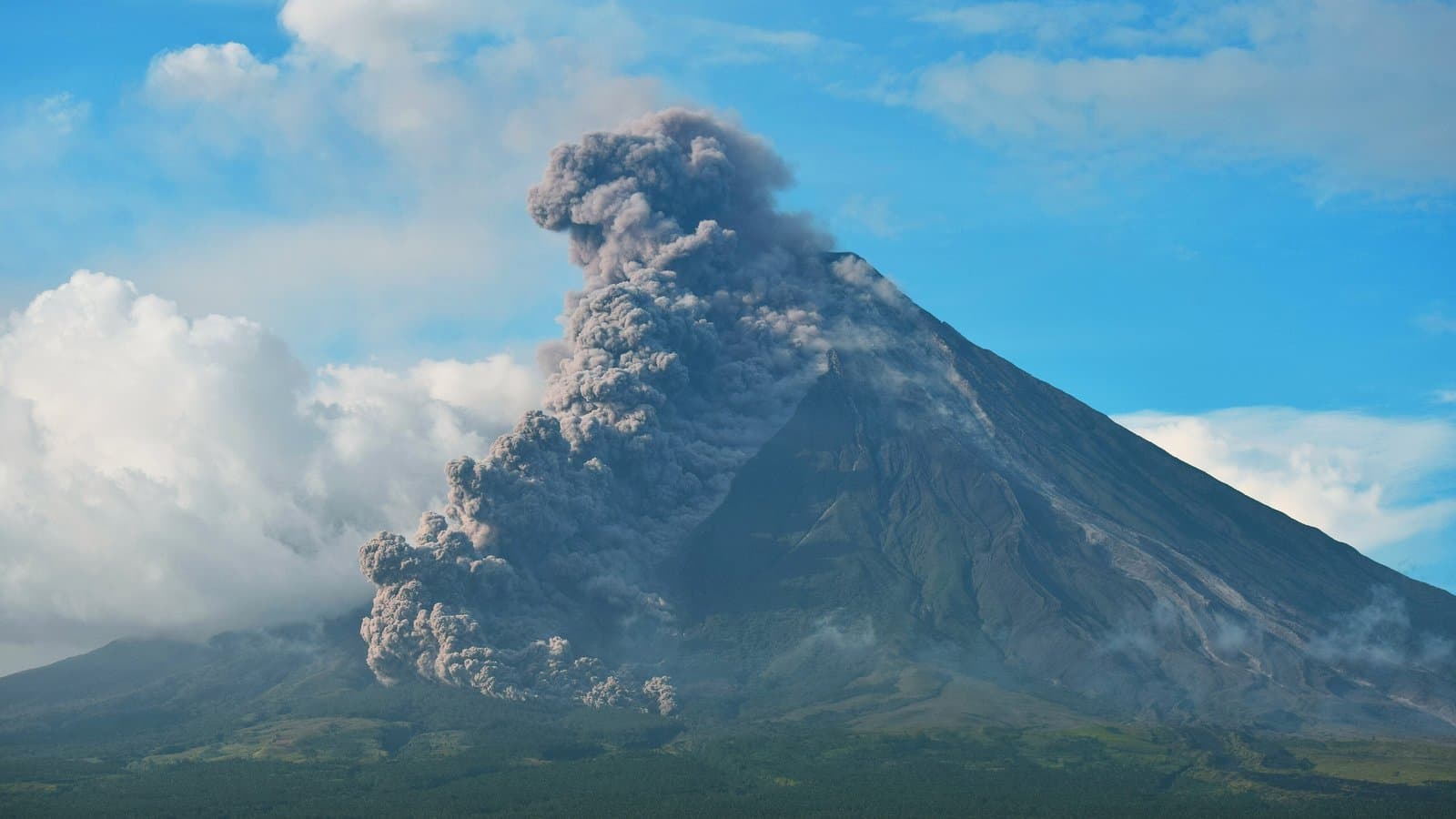
*ARCHIVE PHOTO: Mayon Volcano erupts behind Daraga Church in Albay in January 2018. Photo: Jaycee Esmeria / Wikimedia Commons / CC BY-SA 4.0.*
*NewsCubby articles are produced with AI assistance and reviewed by humans.*
Reporting Sources
- Reuters via Business Recorder, Philippines raises Mayon alert
- DOST-PHIVOLCS HazardHunterPH, current volcano alert status
- Japan Meteorological Agency, Tokyo VAAC advisory 2026/817
- The Philippine Star, Mayon eruption affects 785 schools, Nov. 1, 2026
- NASA Earth Observatory, Eruption at Mayon, March 2026
- ABS-CBN News, Mayon stays under Alert Level 3 after moderately explosive eruption, Nov. 1, 2026
- Daily Tribune, 420 families spend All Saints' Day in Albay evacuation centers, Nov. 1, 2026
- GMA News, Minor eruption occurs at Mayon volcano summit crater, says PHIVOLCS, Nov. 2, 2026
- NET25 News, Mayon minor Strombolian activity; Alert Level 3 stays, Nov. 2, 2026
- Bombo Radyo Legazpi, PHIVOLCS watching Mayon's new pattern, Nov. 2, 2026
- Philippine Daily Inquirer, Mayon Volcano's status lowered to Alert Level 2, Aug. 5, 2026
Photo & Video Credits
Credit: Jaycee Esmeria / Wikimedia Commons. License: CC BY-SA 4.0. Source: file page.