Politics
Cassidy Hutchinson indictment rejected: What comes next?
A grand jury rejected the proposed indictment over her January 6 testimony. What the decision establishes, and what remains unresolved.
What to know
- A Washington grand jury rejected the proposed indictment on October 27, multiple independently sourced reports said.
- NBC reported that her name was not stated when the refusal was announced in court; an official separately identified the matter as Hutchinson's.
- Hutchinson maintains that she testified truthfully. Trump denies her disputed account of his actions.
- The refusal is a charging decision, not a trial verdict. No verified timetable for another prosecution attempt has been announced.
A federal grand jury in Washington declined on Tuesday to indict Cassidy Hutchinson over her testimony to Congress about January 6, according to multiple news organizations with independent sources. The refusal is a setback for a Justice Department effort to charge a former White House aide whose account became a prominent part of the congressional investigation into the Capitol attack.
The decision does not amount to an acquittal after a trial, and it does not determine which disputed accounts of events are true. Hutchinson has stood by her testimony. Donald Trump has denied the account of his conduct that she relayed, and other witnesses disputed the specific presidential-vehicle episode. This October 28 edition explains the reported decision and its limits using information available late Tuesday evening, Eastern time.
What did the grand jury decide?
NBC's Michael Kosnar, Ryan J. Reilly, Justin Goldman and Dareh Gregorian reported that the grand jury returned a refusal to indict, commonly called a no bill. A senior U.S. official confirmed to the network that Hutchinson was the person involved. NBC also reported that the court announcement itself did not identify her.
That distinction is important for evaluating the public record. An announcement in court and an official's identification of the person concerned are different pieces of reporting. Together they explain the basis of the story, but they should not be rewritten as a publicly released indictment naming Hutchinson. No indictment was returned in the reported presentation.
ABC News separately confirmed through sources that prosecutors had sought charges concerning alleged false statements to Congress. CNN's Hannah Rabinowitz and Holmes Lybrand also reported the unsuccessful presentation based on two people familiar with it. The Associated Press obtained its own confirmation. Copies of those reports on affiliated websites are distribution of the same reporting, not additional independent witnesses.
What was Hutchinson's role in the January 6 investigation?
The official congressional record identifies Hutchinson as a former special assistant to the president and aide to White House Chief of Staff Mark Meadows. She appeared as the sole live witness at the House committee's June 28, 2022, hearing. Her proximity to senior White House officials made her account particularly consequential to the committee's examination of events.
The hearing transcript is the primary record for what she actually told lawmakers. It contains questioning about her responsibilities, conversations she witnessed and information other people relayed to her. Those categories should be distinguished. Hearing something directly and recounting a colleague's description of an event are different kinds of evidence, even when both appear in sworn testimony.
Her prominence does not resolve the legal question prosecutors considered. A witness can offer information that becomes central to a public investigation while individual statements remain contested. Conversely, a disagreement about one account does not automatically establish that the witness committed a criminal offense. The relevant issue would be the specific statement and the evidence needed to prove the elements of a charge.
Which account has been disputed?
ABC described the continuing dispute over Hutchinson's account of a confrontation in the presidential vehicle. She testified that another White House official told her Trump wanted to go to the Capitol and reacted physically after being told he could not. Trump rejected the account, and other White House personnel did not corroborate that particular detail.
The account was secondhand. That qualification belongs alongside the allegation rather than being left for readers to discover much later. Hutchinson has maintained that she stands by her testimony. The reported grand-jury decision does not settle what happened in the vehicle or establish that every statement she gave Congress has been independently verified.
CNN also reported that former special counsel Jack Smith told lawmakers this year that Hutchinson was not a powerful witness for his investigation in part because much of her account was secondhand. That assessment concerns how prosecutors evaluated a witness. It is not a judicial ruling that she lied, nor is it a substitute for the allegations and proof required in a separate false-statements case.
Why is a refusal to indict different from an acquittal?
The Justice Department's guide to charging explains that a federal grand jury considers evidence presented by prosecutors and decides whether an indictment should issue. The proceeding addresses whether a person should face charges. A trial, if one occurs later, asks whether the prosecution has proved those charges under the applicable standard.
An acquittal is a trial outcome. Tuesday's reported event occurred at the earlier charging stage. Calling it an acquittal would imply that a trial happened and ended with a not-guilty verdict, which is not what the reviewed reporting describes. Likewise, calling it a conviction or a finding of perjury would reverse the actual result.
Federal criminal procedure also distinguishes grand-jury proceedings from the open presentation of evidence at a trial. Rule 6 regulates the grand jury and its secrecy requirements. That framework helps explain why the public may learn a result without receiving the full evidentiary presentation or the individual jurors' reasoning.
Does the decision end the matter permanently?
NBC reported that the refusal does not prevent the department from making a future attempt to charge Hutchinson. That is a statement about what remains legally possible, not confirmation that prosecutors have decided to try again. The reviewed reporting did not supply an announced schedule for another presentation.
A future development would need to be reported separately. Another grand-jury presentation, a public decision to close an investigation or an actual charging document would each change the story in different ways. The absence of such an announcement should not be filled with predictions about an imminent arrest or an inevitable second attempt.
For readers, the most useful question is whether a new action has actually occurred. A political demand for prosecution, an investigative referral, a prosecutor's presentation and an indictment are not interchangeable. Each has a different author, evidentiary basis and procedural effect. The October 27 report concerns a presentation that did not produce the requested indictment.
What do the parties say?
Hutchinson has continued to defend the truthfulness of her testimony. Trump and Republican allies have challenged it and sought legal consequences. Those competing positions help explain the controversy but should remain attributed positions, rather than becoming the narrator's conclusion about who committed an offense.
ABC reported that Hutchinson could not immediately be reached and that a Justice Department spokesperson had not immediately responded. A lack of response to a particular inquiry is not an admission. It also is not evidence that an investigation has closed. Any later attributable response should be incorporated with its date and the specific point it addresses.
What we know
Independent reporting from several major news organizations describes the same central result: prosecutors did not obtain a grand-jury indictment against Hutchinson in Tuesday's presentation. Her congressional testimony and the subsequent dispute are documented. The criminal allegation prosecutors reportedly sought to pursue has not become a trial verdict.
What we don't know yet
The public material reviewed does not disclose the complete grand-jury evidence, the jurors' deliberations or a verified plan for what the Justice Department will do next. Those gaps limit any claim about precisely why the proposal failed. They also make sweeping declarations of either vindication or guilt unwarranted.
What's next?
Watch for an on-record statement, a new court filing or confirmation of a further prosecutorial action. The present article is an account of a completed charging-stage development, not a prediction of an October 28 proceeding. NewsCubby will distinguish any subsequent legal step from the political arguments surrounding the case.
*Want more? Explore today's headlines on NewsCubby and join My Day free to make NewsCubby part of your day.*
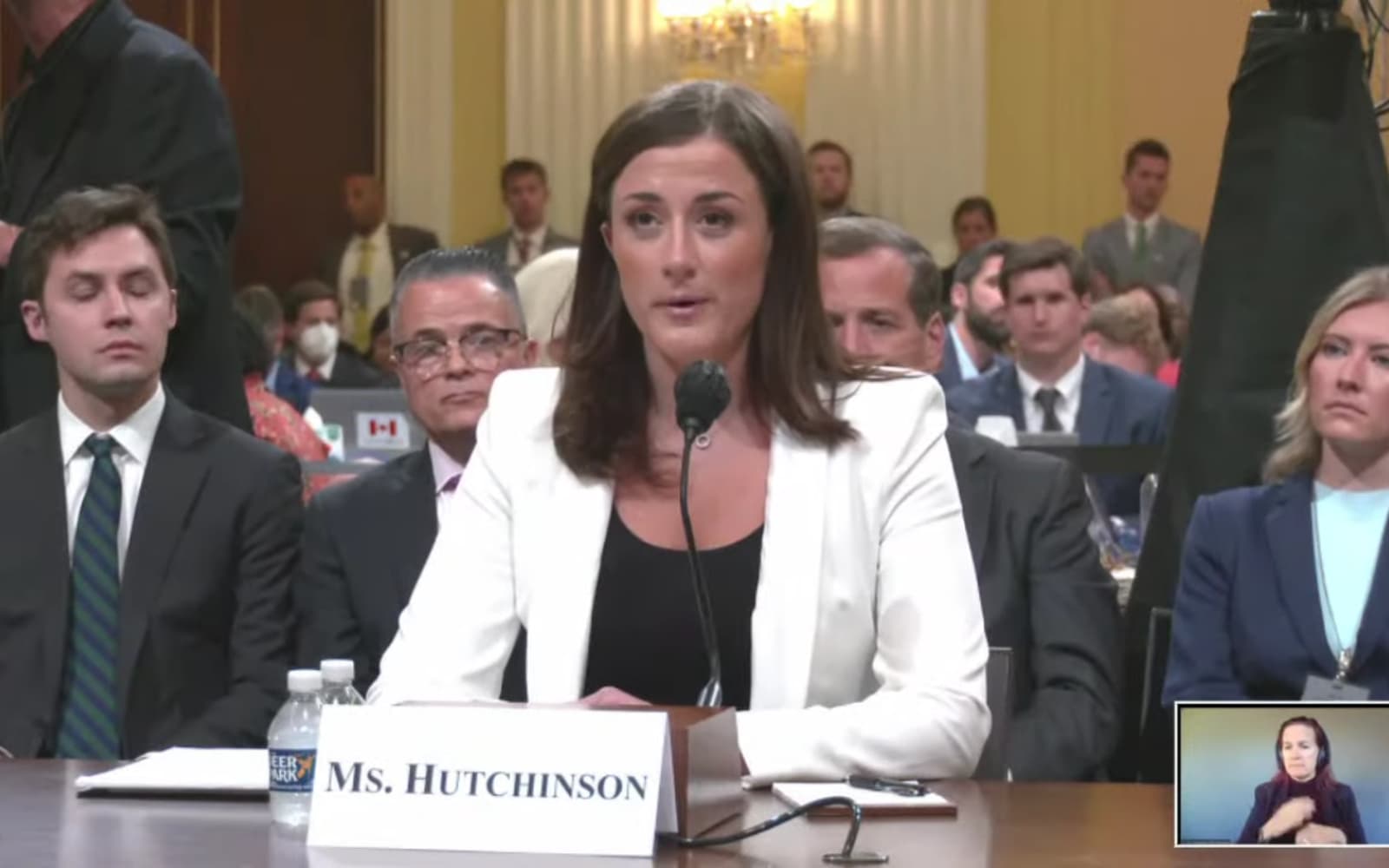
*ARCHIVE PHOTO: Cassidy Hutchinson testifying at the June 28, 2022, House January 6 committee hearing. Capture date(s): 2022-06-28. Photo: U.S. House January 6 Select Committee / Wikimedia Commons, Public domain (https://commons.wikimedia.org/wiki/Template:PD-USGov-Congress). Cropped/resized; social cards add typography and gradient. Not a photograph of the October 2026 event. No endorsement implied.*
*Prepared with AI assistance for NewsCubby.*
Sources, credits & editorial notes
- NBC News: Grand jury declines to indict Cassidy Hutchinson
- ABC News: DOJ fails to obtain Hutchinson indictment
- CNN: Hutchinson grand-jury presentation fails
- AP: Hutchinson indictment rejected
- Congress: June 28, 2022 Hutchinson hearing transcript
- Department of Justice: Charging
- Department of Justice: Trial
- Federal Rule of Criminal Procedure 6: The grand jury
- Federal Rule of Criminal Procedure 7: Indictment and information
- Photo: U.S. House January 6 Select Committee; Public domain