Entertainment
Henry Winkler: Part 4 of 5 - The Producer Behind MacGyver
While Happy Days was still on the air, Henry Winkler launched a production company. Years later, he was an executive producer of ABC's MacGyver.
What to know
- Winkler founded Fair Dinkum Productions in 1976, years before Happy Days ended in July 1984.
- Before MacGyver, his producing work included Who Are the DeBolts? And Where Did They Get Nineteen Kids?, Run, Don't Walk, All the Kids Do It, and A Family Again.
- MacGyver was created by Lee David Zlotoff. Winkler and John Rich were the executive producers, and the three sold the basis for the series to Paramount after Winkler's 11-year Happy Days run.
- After Richard Dean Anderson appeared on The Love Boat, Winkler got him to audition for the title role.
- MacGyver ran on ABC from 1985 to 1992, became a sleeper hit in its second season, entered Oxford Dictionaries as a verb in 2015, and returned that same year with Winkler attached to produce the CBS reboot.
Henry Winkler is usually introduced as the actor behind Fonzie, but one of the most durable parts of his career took shape off camera. In 1976, while Happy Days was still on the air, he started Fair Dinkum Productions and began building a second track as a producer. That work led from an Emmy-nominated documentary special and youth-oriented television projects to feature credits and, eventually, to MacGyver. The ABC series was created by Lee David Zlotoff, starred Richard Dean Anderson, and was executive produced by Winkler and John Rich. It became one of the clearest examples of how Winkler used his post-Happy Days years not only to keep working in television, but to help shape what viewers were watching.
Why did Henry Winkler start producing while still on Happy Days?
If the public image of Winkler in the late 1970s was closely tied to Happy Days, the reality of his workload was broader. He was not only an actor, but also a producer, director and author. That fuller identity was already taking shape while he was still playing Fonzie. In 1976, during his years on Happy Days, he started Fair Dinkum Productions. That date matters because it shows producing was not a later reinvention after his sitcom fame cooled. It was something he was building in parallel.
The move also fit the rhythm of his career at the time. During his decade on Happy Days, Winkler was not limited to one kind of television work. He was acting in films, appearing in television specials, and beginning to move behind the camera. The company gave him a formal home for that side of the business and linked him to two powerful outlets: Paramount Pictures for film and ABC for television rights. In other words, he was positioning himself not just as talent for hire, but as someone who could help originate, package and shepherd projects.
That distinction became even more important after Happy Days ended in July 1984, as the next sections show.
What did Fair Dinkum Productions make before MacGyver?
Before MacGyver arrived, Winkler had already put together a notable run of producing credits that showed range. In 1978, he was executive producer and host of the 50-minute television version of Who Are the DeBolts? And Where Did They Get Nineteen Kids?. It was nominated for a Primetime Emmy Award for Outstanding Informational Series or Special. That early credit is useful because it shows Winkler entering nonfiction television as both an on-camera presence and a producer.
He followed that with work aimed at younger audiences. In 1981, he was an executive producer of the ABC Afterschool Special Run, Don't Walk, based on the novel by Harriet May Savitz and featuring his Happy Days co-star Scott Baio. He also directed the 13th episode of the Happy Days spin-off Joanie Loves Chachi, again working with Baio and Erin Moran. In 1984, he directed and executive produced the CBS Schoolbreak Special All the Kids Do It, also starring Baio. That program won the 1985 Daytime Emmy for Outstanding Children's Special and brought Winkler a nomination for Outstanding Directing in Children's Programming.
A few years later, in 1988, he was the executive producer of the ABC Afterschool Special A Family Again, starring Jill Eikenberry and Michael Tucker. Taken together, these credits show a producer who was not waiting for a single signature project to define him. He was building experience across documentary work, issue-oriented programming, network specials and youth-focused material. By the time MacGyver was ready to come together, Winkler had already spent years learning how to work with networks, develop packages and move between creative roles.
How did producing help Winkler navigate the years after Happy Days?
The period immediately after Happy Days helps explain why Winkler's producer identity became so important. After the sitcom ended in 1984, he was typecast and could not get acting roles until 1991. He later said his agent would put him out there and people would say he was a really good actor, "But he was the Fonz." Producing offered a path that kept him working in the industry while casting directors still saw Fonzie.
Fair Dinkum Productions became the base for that work. The company name came from Australian English slang meaning something honest or authentic. The company also expanded through spin-offs that included Monument Pictures, the music publishing company Kindness of Strangers, and J-Z Productions. In 1987, Winkler signed a new feature film and development pact with Paramount Pictures. Those details show a producer operation that was growing rather than sitting still.
This was also the phase when his credits broadened into features and series work. He was executive producer for Rob Reiner's second film as director, The Sure Thing, released in 1985. MacGyver also sits within a larger producing resume that later included Dead Man's Gun, Sightings, So Weird and a revamped version of The Hollywood Squares. Instead of treating producing as a fallback, Winkler used it to build a viable second lane in the industry. MacGyver would become the best-known example of that lane, but it did not appear from nowhere.
How did MacGyver come together?
MacGyver did not begin as a solo Henry Winkler project. The series was created by Lee David Zlotoff. Richard Dean Anderson starred as the title character, and Winkler and John Rich were the executive producers. The development story is specific about how the show took shape.
At the time, Rich was working on the sitcom Mr. Sunshine for ABC, a show that was canceled quickly. Winkler had just finished his 11-year run on Happy Days and was looking for another project. Zlotoff was working as a producer on Remington Steele for NBC. The three got together, formed the basis for MacGyver and sold the idea to Paramount. ABC then became interested in the series. In short, Winkler did not create MacGyver, but he helped develop it and executive produced it.
That development story matters because it places MacGyver exactly at the crossroads of Winkler's first and second television lives. He was no longer only the star of a past ABC hit. He was part of the producing team that helped bring a new network series into existence. The leap from Happy Days to MacGyver was not a break from television so much as a change in function within it. He moved from carrying a character on screen to helping construct a new show's commercial and creative foundation behind the scenes.
Why did Richard Dean Anderson get the lead?
The casting of Richard Dean Anderson was one of Winkler's most important contributions to MacGyver. During pre-production, Winkler and Rich were looking for the right actor to play the lead. After Anderson appeared on the American television series The Love Boat, Winkler got him to audition for the part. That decision helped define the tone of the series as much as its title character did.
Rich felt the other actors who auditioned were leaning too hard into a more forceful style. When Anderson read for the role, Winkler and Rich thought he brought a more human touch to the character. Both believed he could become one of American television's new breakout stars. The audition became the moment when the producers found the balance they wanted for a hero who solved problems with intelligence and calm rather than brute force.
That approach matched the design of the series. MacGyver follows Angus MacGyver, a secret agent whose main asset is practical scientific knowledge and inventive use of ordinary items. The show became known for solutions made from materials at hand, often using everyday objects instead of high-tech weapons. The writers had consulting scientists vet the inventions so that the stories would retain a basis in scientific principles. In that context, Anderson's screen presence mattered. The character needed to seem approachable, quick-thinking and believable inside the show's unusual premise. Winkler's push to get him into the audition room ended up being central to the show's identity.
How big did MacGyver become on ABC?
MacGyver ran for seven seasons on ABC from 1985 to 1992, and it became both a ratings success and a show that gained a loyal following. The series was popular in the United States and around the world. That success was not instant. The show had a slow start in its first season before becoming a sleeper hit for ABC in its second.
Once it caught on, MacGyver settled into a durable network role. During its second season, it began a six-year run as the lead-in to ABC's Monday Night Football, the longest such run in history. That kind of placement says a great deal about how the network viewed the series. It was dependable enough to anchor a major part of the schedule. The show's production history also shows how it adapted to the realities of television economics. It was filmed in Los Angeles during seasons one, two and seven, and in Vancouver during seasons three through six, even though Los Angeles remained the setting throughout the run.
The final episode aired on ABC on April 25, 1992. The network later aired a previously unseen episode on May 21, 1992, though it had originally been intended to run before the finale. Even after the original series ended, MacGyver remained active as a franchise. By 1994, it had been released in more than 70 worldwide markets, and two television films aired on ABC that year. For a producer, that is the kind of lifespan that turns one successful series into a long-term credential.
How did MacGyver extend Winkler's producing legacy?
One sign of MacGyver's reach is that it moved beyond a show title and into everyday language. The series popularized the idea of MacGyverisms, the improvised inventions the character used to get out of trouble. That, in turn, led to the verb to MacGyver. The word entered the Oxford Dictionaries website in 2015 as a verb. By then, the series had long since outgrown its original ABC run.
That same year, Winkler's connection to the property became current again. In October 2015, the original series' executive producer Henry Winkler signed on to produce a reboot series for CBS with James Wan and R. Scott Gemmill. The reboot later ran from 2016 to 2021. For Winkler, that was a rare through line: he was present not only at the birth of the original network hit, but also at the point when television brought the concept back for a new generation.
MacGyver also sits inside a wider producing record that runs across several decades. Winkler was executive producer of the original series, which won the Genesis Award for Best TV Drama in 1991. He was also executive producer of Dead Man's Gun, which won the Bronze Wrangler in 1998, as well as Sightings and So Weird. In 2002, he partnered with Michael Levitt to revamp and update The Hollywood Squares for the fifth season of the 1998 reboot, and that version was nominated for a Daytime Emmy Award for Outstanding Game Show in 2003. Taken together, those credits show that MacGyver was not an isolated success. It was the most visible piece of a substantial behind-the-scenes career. In Part 5, the series turns back to Winkler in front of the camera and the 2018 Primetime Emmy he won for Barry.
This article is part 4 of NewsCubby's five-part Henry Winkler career series. For more, visit TV & Streaming, Movies, Entertainment, and find short videos on the Videos page.
Timeline
- **1976:** Winkler starts Fair Dinkum Productions.
- **1978:** He executive produces and hosts the television version of Who Are the DeBolts? And Where Did They Get Nineteen Kids?.
- **1981:** He is an executive producer of the ABC Afterschool Special Run, Don't Walk.
- **July 1984:** Happy Days ends.
- **1985:** MacGyver begins its ABC run.
- **1988:** Winkler executive produces the ABC Afterschool Special A Family Again.
- **1991:** The original MacGyver wins the Genesis Award for Best TV Drama.
- **Apr. 25, 1992:** MacGyver airs its final episode on ABC.
- **2015:** MacGyver enters the Oxford Dictionaries website as a verb.
- **Oct. 2015:** Winkler signs on to produce the CBS reboot.
Catch up on the series: Part 1: From Yale to the Fonz · Part 2: The Fonz's Jacket Goes to the Smithsonian · Part 3: Hank Zipzer and Championing Kids Who Learn Differently
*Want more? Explore today's headlines on NewsCubby and join My Day free to make NewsCubby part of your day.*
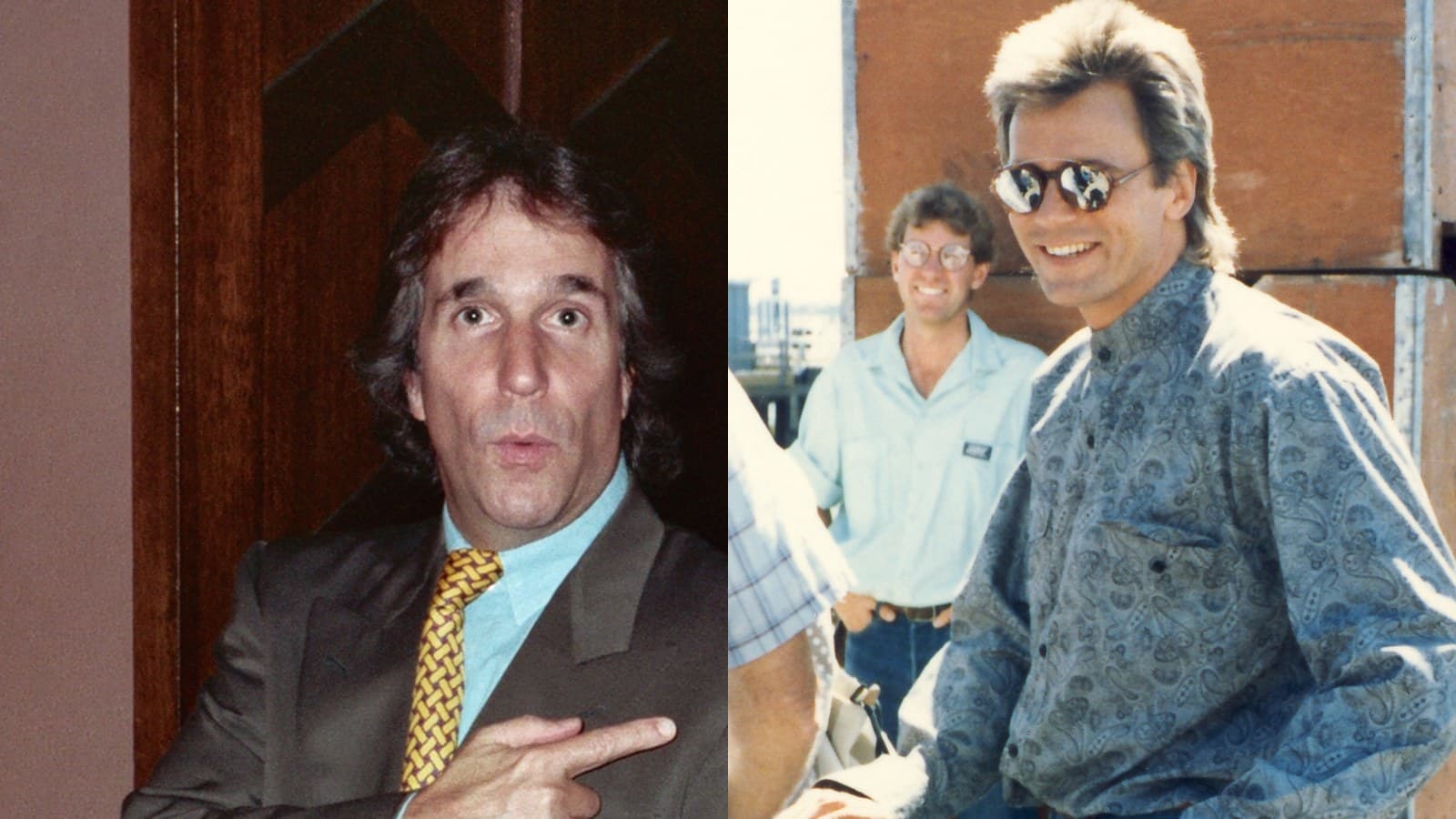
*ARCHIVE PHOTOS: Henry Winkler in Los Angeles in September 1990 (left) and Richard Dean Anderson on the set of MacGyver in Richmond, British Columbia, circa 1987 (right). Photos: Alan Light / Wikimedia Commons / CC BY 2.0 (left, cropped); Themightyquill / Wikimedia Commons / CC BY-SA 3.0 (right).*
*NewsCubby articles are produced with AI assistance and reviewed by humans.*
Reporting Sources
Photo & Video Credits
Credit: Alan Light / Wikimedia Commons (left); Themightyquill / Wikimedia Commons (right). License: CC BY-SA 3.0. Source: file page.