World
Iran strike options after midterms: What the Gulf warning means
A reported warning to Gulf governments raises new questions about military options, nuclear inspections and the cost of renewed fighting.
What to know
- The Wall Street Journal reported warnings to Gulf governments about a possible campaign after the November 3 elections; that specific warning remains the newspaper's reporting.
- Military preparation is not the same as a presidential order, an announced attack date or a completed strike.
- Britain called on October 27 for international inspectors to regain access to Iran's nuclear sites.
- CBS reported a new Central Command estimate of at least $47.1 billion in military costs through mid-October; it is not a comprehensive economic price tag.
Washington has warned several Arab Gulf governments to prepare for a possible renewed military campaign against Iran after the November 3 U.S. midterm elections, The Wall Street Journal reported. The reported warning adds a specific regional preparation angle to a conflict already threatening shipping, military readiness and nuclear diplomacy. It does not establish that President Donald Trump has ordered another attack.
The distinction is consequential for Americans trying to understand what could happen next. The Journal's account describes contingency preparations, while an official British statement at the United Nations on October 27 separately emphasized the unresolved problem of nuclear inspections. A new military cost estimate reported by CBS News also brings the financial stakes into sharper focus. These are related developments, but they are different kinds of evidence.
What is new about the reported Gulf warning?
The new element is the reported communication with governments whose territory and infrastructure could be affected by another confrontation. The Journal said messages were delivered through military and diplomatic channels and described preparations intended to give Washington options. NewsCubby has not independently confirmed those private communications. Other outlets repeating the Journal's account do not turn the same underlying report into several independent confirmations.
The White House response, reported alongside the account, declined to discuss sensitive military plans and said the president keeps his options open to prevent Iran from acquiring a nuclear weapon. That response does not publicly authenticate a target list or a launch timetable. Nor does it rule out further diplomacy. The story therefore concerns a reported warning and the choices facing the administration, rather than an announcement that a new campaign is underway.
For Gulf governments, advance warning would matter even without an imminent offensive. Protecting military personnel, ports and energy infrastructure requires preparation before a crisis peaks. A defensive move can reduce vulnerability while political leaders continue to consider their next step. It cannot, by itself, show which decision they will ultimately make.
Why are nuclear inspections still central?
At the Security Council on Tuesday, British Ambassador Sarah MacIntosh said Iran must allow International Atomic Energy Agency inspectors back into its nuclear sites. Her published statement said the agency had been unable to reach a safeguards conclusion about nuclear material and described verification as essential to restoring confidence in a peaceful program. Britain also reiterated its support for a diplomatic solution.
Those are the British government's stated concerns and policy positions. They do not amount to an independently verified finding that Iran has assembled a nuclear weapon. Safeguards work is about accounting for material and checking whether a state's declarations match what inspectors can establish. When access is missing, uncertainty about material is a problem in its own right; it should not be converted into a claim about an unseen weapon.
This creates a practical test for any proposed agreement: whether it produces access and verifiable information, rather than only assurances about intentions. A military operation and a functioning inspection arrangement serve different purposes. Damaging a facility would not automatically provide a reliable accounting of every relevant stockpile or restore the monitoring necessary to assess future activity.
Why would Gulf neighbors be concerned?
The Congressional Budget Office's September assessment describes a conflict that began with U.S. and Israeli strikes on February 28 and included Iranian attacks on regional bases and restrictions on commercial shipping. That history helps explain why governments outside Iran and Israel have a direct stake in the next decision. They face consequences involving security, transport and facilities on their own territory.
Regional preparations also have a different meaning from preparations within the United States. A country hosting American personnel has to consider protection for the people and infrastructure around a base, not merely the aircraft or ships involved in a campaign. Energy exporters must consider whether vessels can depart safely. Governments may therefore seek to avoid escalation while also taking precautions against it.
That tension is important when reading descriptions of readiness. Supporting protection against missiles does not necessarily establish support for a particular offensive. Publicly available evidence should distinguish those questions. It should also distinguish the duration planners hope for from the duration opponents' responses could produce. Calling a campaign brief describes an objective, not a guaranteed limit on its effects.
How could the Strait of Hormuz affect people elsewhere?
The International Energy Agency's February factsheet describes Hormuz as the narrow passage linking the Persian Gulf with the Gulf of Oman and the Arabian Sea. Its prewar baseline shows about 20 million barrels of crude oil and petroleum products a day passing through the strait during 2025. Those are historical flows, not a measurement of today's traffic.
The geography creates a bottleneck because several exporters depend heavily on the same route. The IEA identifies some bypass capacity through Saudi Arabia and the United Arab Emirates, but estimates it at a fraction of the oil normally moving through Hormuz. Natural gas has an additional constraint: liquefied gas exported from Qatar and the UAE cannot simply be redirected through an oil pipeline.
The relevance extends beyond countries receiving a particular tanker. The IEA explains that disruption affects pricing in a global market. American households need not buy a barrel directly from the Gulf to encounter consequences through fuel, delivery costs or businesses using petroleum products. That mechanism explains exposure; it does not predict a specific gasoline price or establish that prices rose today because of this report.
What does the new military cost estimate tell us?
CBS News reported late Tuesday that a Central Command estimate provided to lawmakers put the military cost at at least $47.1 billion through mid-October. NewsCubby has not independently obtained that estimate. The figure should remain identified as CBS's reporting of a military calculation, not presented as an audited total for every public and private consequence of the conflict.
The publicly available CBO analysis illustrates why comparisons require care. Its September 15 letter estimated roughly $38 billion in Defense Department costs through August 1, using government databases and public reports. It expressly warned that its different cost categories involved different methods, time periods and uncertainty, and should not simply be added together. It could not estimate the cost of repairing damaged bases.
A later estimate can be higher because more time has passed, because different items are included, or both. Subtracting one headline number from another would not automatically reveal a precise spending rate. Similarly, a replacement cost is not necessarily a bill paid in the same month that a weapon was used. Readers need the coverage period and definitions before treating competing figures as contradictory.
What does readiness mean beyond the dollar total?
CBO identified the expenditure of missile-defense interceptors as an important opportunity cost. A weapon used against one threat is unavailable for another until replaced. The analysis warned that reduced inventories could matter in a separate confrontation involving large missile arsenals. The issue is therefore both money and the time needed to rebuild usable stocks.
Operational spending and national readiness are connected, but not interchangeable. Authorizing funds does not mean factories can deliver finished equipment immediately. Nor does a claim about stockpiles establish that a particular base is defenseless. The useful questions concern which systems were consumed, what can be produced, and how commanders manage remaining supplies across competing responsibilities.
For the broader economy, CBO also traced higher energy costs through transportation and the prices of goods and services. Such estimates depend on assumptions about the conflict's intensity and duration. They provide context for the consequences of escalation rather than a forecast that every possible operation would produce the same inflation outcome.
What happens next?
The clearest developments would be an attributable decision from Washington, verified military activity, a concrete diplomatic arrangement or a change in inspection access. November 3 is the U.S. election date, not a publicly announced military deadline. Until an actual decision is established, a post-election scenario remains a scenario.
The questions can be followed separately: whether the reported warning is officially clarified; whether safeguards access changes; whether shipping conditions improve; and whether lawmakers receive a fuller cost accounting. Progress in one area would not settle all the others. A successful negotiation would require details, just as an announced operation would require evidence about what actually occurred and what followed it.
For now, the story advances beyond generalized threats by focusing on reported regional preparations and their practical stakes. Its limits remain visible: there is no newly announced American strike order in the evidence reviewed for this article, and a campaign described as limited would still carry risks beyond its opening phase.
*Want more? Explore today's headlines on NewsCubby and join My Day free to make NewsCubby part of your day.*
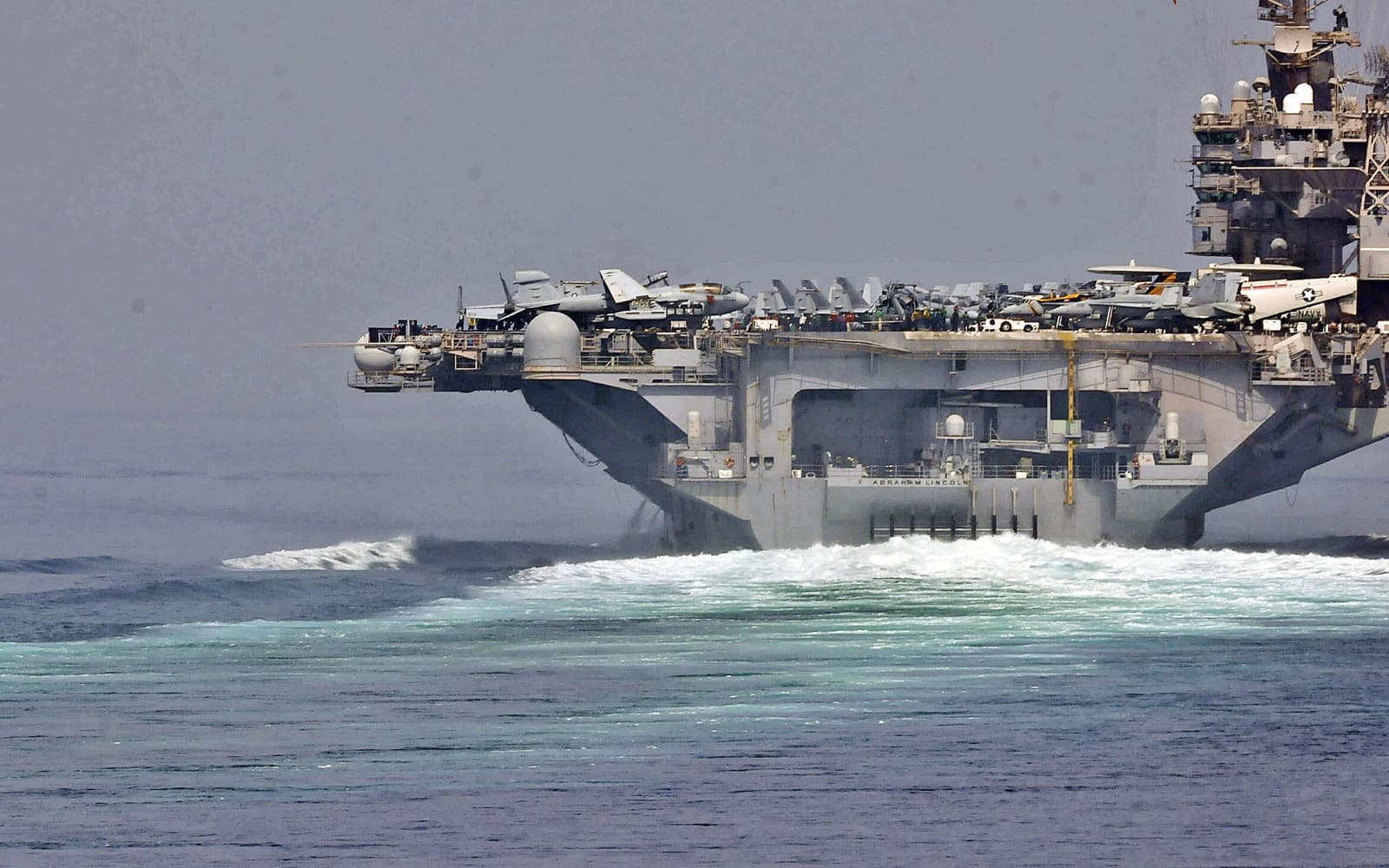
*ARCHIVE PHOTO: U.S. Navy ships transiting the Strait of Hormuz in May 2012; archive context, not a new military operation. Capture date: 2012-05-11. Photo: Alex R. Forster / U.S. Navy / Wikimedia Commons / Public domain (https://commons.wikimedia.org/wiki/File:Flickr_-_Official_U.S._Navy_Imagery_-_U.S._Navy_ships_transit_the_Strait_of_Hormuz..jpg). Resized/cropped; cards add typography and gradient. Adaptations retain the source license. No endorsement implied.*
*Prepared with AI assistance for NewsCubby.*
Sources, credits & editorial notes
- Wall Street Journal: Reported Gulf warnings about post-election Iran options
- Anadolu: Attributed account of the Wall Street Journal report
- CBS News: Reported Central Command Iran military cost estimate
- UK government: October 27 statement at the UN Security Council
- CBO: September 15 analysis of Iran combat-operation costs
- International Energy Agency: Hormuz geography, historical flows and bypass capacity
- Photo: Alex R. Forster / U.S. Navy; Public domain