World
Israel Election Exit Polls: Netanyahu's Likud Largest Party, but No Bloc Near a Majority
Channel 12 and Channel 13 exit polls put Likud first and Gadi Eisenkot's bloc slightly ahead of Netanyahu's camp, with record Arab party seats and both sides well short of 61.
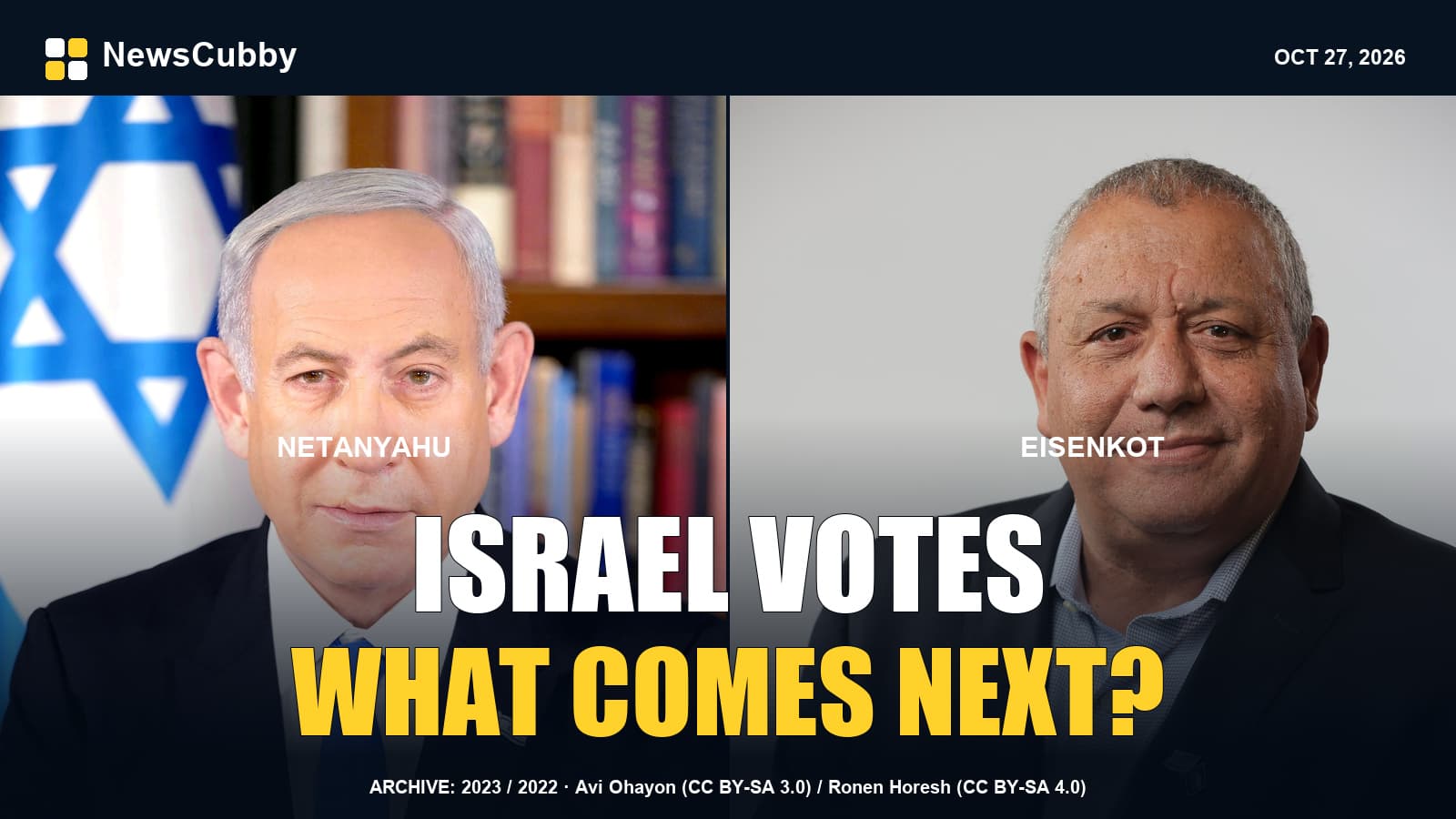
Israel's national election ended Tuesday without a clear winner, at least according to the first exit polls broadcast when voting stations closed at 10 p.m. Israel time, which was 4 p.m. ET. Prime Minister Benjamin Netanyahu's Likud is projected to be the largest single party in the 120-seat Knesset, but the bloc of parties opposed to him, led by former army chief Gadi Eisenkot, is projected to finish slightly ahead of Netanyahu's camp. Neither side comes close to the 61 seats needed to govern on its own.
Exit polls are projections, not results. The Central Elections Committee has begun counting, and the official tally will come in through the night and over the next several days. Here is what the broadcasters' numbers show, what they don't show, and what happens next.
The headline numbers, by broadcaster
**Channel 12 (N12).** In its first exit poll at 10:01 p.m. Israel time, Channel 12 projected Likud at 24 seats and Eisenkot's centrist Yashar party at 22, according to The Times of Israel's report on the Channel 12 exit poll. Former prime minister Naftali Bennett's B'Yachad (Together) party came third with 12 seats, followed by the Arab-led Joint List with 11. By bloc, Channel 12 projected 52 seats for the Jewish-led parties opposed to Netanyahu, 50 for the parties supporting him, and 18 for Arab-led parties, which the broadcaster described as a record for that sector.
**Channel 13.** Channel 13's first exit poll, also released at 10:01 p.m. Israel time, gave Likud 25 seats and Yashar 23, according to The Times of Israel's report on the Channel 13 exit poll. Channel 13 put B'Yachad third with 14 seats and the Joint List fourth with 10. Its bloc projection was 53 seats for the anti-Netanyahu camp, 50 for Netanyahu's right-wing and religious bloc, and 17 for Arab-led parties, again a record.
**Kan (public broadcaster).** At the time of writing, NewsCubby had not confirmed Kan's exit-poll seat projection from Kan itself or from a news report that cites it directly, so this article does not report a Kan number. We will add Kan's figures once they are confirmed.
Both of the exit polls we could confirm also agree on two small parties: the nonaligned Reservists, led by Yoaz Hendel, and Ofer Winter's right-wing People of Israel are projected to fall short of the 3.25% threshold needed to enter the Knesset.
Why "largest party" and "biggest bloc" point in different directions
Israeli elections are decided by coalition math, not by which party finishes first. Under the system, the president consults party leaders after the official results and gives the task of forming a government to the lawmaker seen as most likely to assemble 61 votes.
That is why the exit polls leave both leaders with an argument. Netanyahu leads the largest party in both projections. Eisenkot leads the larger of the two main blocs in both. As The Times of Israel noted, both men may claim victory and ask President Isaac Herzog for the first chance to build a coalition.
The arithmetic is hard for both. On the Channel 12 and Channel 13 projections, Netanyahu's bloc sits at 50 seats, 11 short of a majority. Eisenkot's bloc sits at 52 or 53, eight or nine short. The only way either number reaches 61 on these projections involves parties outside the two camps.
The Arab parties are the new variable
The most striking number in both exit polls is the projected Arab-led party total: 18 seats in Channel 12's poll and 17 in Channel 13's. Those parties, the Joint List and Ra'am, both oppose Netanyahu. Added to Eisenkot's bloc, they would put the anti-Netanyahu camp around 70 seats on paper.
But paper is not a coalition. Arab-led parties have generally not joined Israeli governing coalitions, and several parties in Eisenkot's camp have ruled out sitting in a government with Ra'am, according to The Times of Israel's pre-election poll roundup. Ra'am leader Mansour Abbas has said he is open to joining the anti-Netanyahu camp. Opposition sources quoted by The National described options ranging from a coalition that includes Ra'am, to a minority government with outside Arab party support, to a unity government that includes Likud.
Turnout was much higher than last time
Turnout appears to be a big part of the story. As of 8 p.m. Israel time (2 p.m. ET), national turnout stood at 74.3%, or 5,449,277 voters, according to the Central Elections Committee figures cited by the BBC's live coverage. That compares with 66.3% at the same hour in the 2022 election.
Before election day, Kan analysis had pointed in the same direction. Kan pollster Dudi Hasid's model, reported by Kan journalist Yaara Shapira and summarized by JFeed, found about 65% of Arab voters saying they intended to vote, compared with roughly 53% actual Arab turnout in the last election, and found stated intent among ultra-Orthodox voters lower than their turnout last time. Political sources told The National they expected "astronomical" Arab turnout. Those were forecasts and stated intentions, not measured results, but the exit polls' record Arab seat totals are consistent with them.
How the exit polls compare with the final pre-election polls
The exit polls differ from the last surveys published Friday, Oct. 23, before Israel's legal blackout on polls. In those, all three main broadcasters had Yashar ahead of Likud. According to Haaretz, Channel 12's final poll had Yashar at 23 and Likud at 21; Channel 13's had Yashar 22 and Likud 19; and Kan's had Yashar 22 and Likud 20. The bloc gaps were wider too: Channel 12 had the Eisenkot bloc ahead 56 to 50, Channel 13 had it ahead 54 to 50, and Kan had it ahead 52 to 50.
So Likud appears to have outperformed its final polls, while the opposition's bloc lead narrowed. Channel 13's exit poll, as summarized by The Times of Israel, described Likud's projected first-place finish as defying weeks of surveys that mostly showed it trailing. The Arab-led parties also appear to have run ahead of their pre-election range of 14 to 16 seats.
Exit polls can be wrong, and absentee ballots take days
Israeli exit polls are often revised during the night as more data arrives, and the official results frequently differ from them, as both Times of Israel reports noted. A shift of one or two seats can matter a great deal when parties are fighting over the threshold or when a bloc is a handful of seats from 61.
There is also a timing issue. According to the BBC, official results were expected to start appearing from 10 p.m. GMT (6 p.m. ET), but an estimated 600,000 absentee ballots, almost all from soldiers and making up around 10% of the vote, will not be fully counted until Thursday. Small parties near the 3.25% line will be watched especially closely until that count is done.
NewsCubby is not calling a winner. On the numbers available as of 4:15 p.m. ET, no party or bloc has a clear path to 61 seats.
The tone of the final days
The campaign ended on a sharp note. In the last stretch, Netanyahu posted an AI-generated image depicting a nuclear strike on Tel Aviv and warned of a second Holocaust if he were not re-elected, according to The Times of Israel; Eisenkot responded by calling the prime minister hysterical. Eisenkot had also told a rally that Netanyahu would do anything to stay in power. Netanyahu's campaign has framed him as the only leader able to keep Israel safe, an approach The Times of Israel's analysis described as a long-standing playbook. These are campaign claims from each side, and NewsCubby reports them as such.
The vote also took place against a tense security backdrop, with reports in Israeli and U.S. media about disagreements inside Israel's security establishment over possible military action involving Iran before the election. Those reports were disputed in part by the prime minister's office, and they are not confirmed by NewsCubby.
What happens next
- **The count.** The Central Elections Committee releases results through the night; absentee ballots are expected to be fully counted by Thursday.
- **Final certified results.** Once results are official, the parties' exact seat totals will be known, including which small parties crossed the threshold.
- **Consultations.** President Herzog meets with each party's representatives, who say whom they recommend to form the next government.
- **The mandate.** Herzog gives one lawmaker the first chance to form a coalition. That person has a set period, which can be extended, to reach 61 votes.
- **A possible repeat election.** If no one can form a government, Israel could head to another vote with Netanyahu staying on as caretaker prime minister. The country held five elections between 2019 and 2022 for that reason, as The Times of Israel noted.
Why it matters beyond Israel
Who governs Israel shapes the war in Gaza and its aftermath, the confrontation with Iran and its allies, relations with the United States, and the future of the West Bank. A Netanyahu-led government would likely continue his current direction; an Eisenkot-led government would depend on a coalition of parties that range from the right-wing Yisrael Beiteinu to the left-leaning Democrats, and possibly on Arab-led parties. A deadlock could mean months of caretaker government.
For now, the honest answer is the one the exit polls give: Likud is first, Netanyahu's opponents are slightly ahead as a group, the Arab-led parties had a record night on these projections, and nobody has a majority yet. NewsCubby will update as official results come in.
*ARCHIVE PHOTO: The Knesset, Israel's parliament, in Jerusalem. (Gary Todd / Wikimedia Commons, CC0)*
*NewsCubby articles are produced with AI assistance and reviewed by humans.*
*Want more? Explore today's headlines on NewsCubby and join My Day free to make NewsCubby part of your day.*