Politics
Appeals court tosses DOJ bid to set aside 20,000 California ballots; fight returns to district court Tuesday
A divided 9th Circuit panel said the Justice Department went to the appeals court too soon and did not rule on the merits. The dispute over ballots from people DOJ calls likely noncitizens goes back to Judge David O. Carter on Tuesday.
What to know
- The 9th Circuit dismissed the appeal in United States v. California (No. 26-7070) and denied the emergency motion as moot. It did not rule on the merits.
- Judges Mark Bennett and Gabriel Sanchez joined the unsigned order and each wrote separately. Judge Patrick Bumatay dissented.
- DOJ wants ballots from people on its list kept apart until their citizenship is checked. State and county officials say the list is unverified and includes U.S. citizens.
- Judge Carter, who had already scheduled a hearing for 1 p.m. PT (4 p.m. ET) Tuesday, Oct. 27, has said he will rule promptly.
A federal appeals court on Monday, Oct. 26, threw out the Justice Department's emergency bid to make Los Angeles County set aside mail ballots from more than 20,000 Californians the Trump administration says are likely noncitizens. The ruling means the ballots can be processed for now, eight days before the Nov. 3 midterm election.
A three-judge panel of the 9th U.S. Circuit Court of Appeals ruled 2-1 that it had no jurisdiction because the government went to the appeals court before the trial judge had a fair chance to rule. The panel did not decide whether the federal government's claims have merit. The case now goes back to U.S. District Judge David O. Carter in Los Angeles, who has a hearing set for Tuesday afternoon, according to the order, CBS News, the Los Angeles Times and the Associated Press.
What the court decided
The unsigned order said the United States did not give the district court an adequate opportunity to consider its request for a temporary restraining order. Because of that, the panel said, it could not treat the lower court's timing as a denial that can be appealed.
DOJ sued California, Secretary of State Shirley Weber and Los Angeles County Registrar-Recorder Dean Logan on Oct. 15 and later asked for a ruling by Election Day. After the case was reassigned to Carter on Oct. 21 and he set an Oct. 27 hearing, DOJ asked for a ruling by noon the next day, then appealed on Oct. 22, arguing the delay amounted to a denial.
The panel rejected that. It said the urgency DOJ described was largely of the government's own making: it waited to sue, was slow to grapple with how state law and California's size shape ballot processing, and was slow to say what relief it wanted. DOJ's lawyer also conceded at Sunday's argument that the district court was not about to lose jurisdiction, the order said.
The concurrences
Bennett, a Trump appointee, wrote that he would deny the request even if the court had jurisdiction. In his view, the Constitution's Elections Clause gives the power to set the mechanics of elections to states and Congress, not the executive branch. He added that the federal ban on noncitizen voting targets individual voters, not how states run elections, and that California has its own process for challenging eligibility.
Sanchez, a Biden appointee, said the Supreme Court's caution against changing election rules close to an election also weighs against relief. He cited county filings describing a software freeze through Nov. 6 on a system serving about 5.9 million voters.
The dissent
Bumatay, also a Trump appointee, wrote that the court did have jurisdiction and that the government was likely to win. He argued that the federal government has a sovereign interest in protecting federal elections and that federal law, through the Supremacy Clause, overrides California's practice of mixing the disputed ballots in with all the others.
He said the caution against late rule changes did not apply, because setting aside ballots already cast would not change the rules for voters or remove anyone from the rolls. He also cited this month's federal criminal cases.
What the list is, and what's disputed
DOJ gave officials the list on Oct. 13 and asked them to set aside those ballots until citizenship could be confirmed. In July, the Department of Homeland Security had told California it flagged as many as 190,832 possibly ineligible registrants, according to the court record.
Whether anyone on the current list is actually a noncitizen has not been proven in court. That claim comes from DOJ and the White House. State and county officials say the list is unreliable. A preliminary Los Angeles County review of 200 names found more than half of the registrations already canceled or inactive, many people listed a U.S. birthplace and most had no voting history, according to the attorney general's office and Votebeat. California has also declined to use the federal SAVE citizenship database, citing errors that flagged citizens, LAist reported.
About 7,035 of the records on the list have Los Angeles County addresses. Reuters, as published by NBC News, reported that DOJ had not said how many people on the list actually returned a ballot. NewsCubby earlier covered the original lawsuit and DOJ's 48-hour demand to counties.
The separate criminal cases
On Oct. 19, all four U.S. attorney's offices in California announced charges against 28 green-card holders in what DOJ called "Operation Protect the Vote." Prosecutors allege they falsely claimed citizenship to register, in many cases voted, and later lied on naturalization paperwork. DOJ says all 28 appear on the list of more than 20,000 names it gave California, a claim Reuters also reported. They are accused, not convicted, and are presumed innocent. The criminal cases are separate from Monday's ruling. We explained how the charges differ.
What each side said
California Attorney General Rob Bonta, in a statement, called the order an important early win for voters and for the state's authority over its elections. He said the Constitution gives that power to states and Congress, not the president, and that voter fraud is exceedingly rare. Gov. Gavin Newsom called the ruling a positive step and urged Californians to vote.
DOJ did not immediately respond to a request for comment, AP reported, and the U.S. Attorney's Office in Los Angeles declined to comment to the Times. In filings, the government argued that every ballot processed without being set aside dilutes citizens' votes. First Assistant U.S. Attorney Bill Essayli said Oct. 19 that California was mailing ballots to noncitizens and defying federal law.
President Donald Trump had not posted about the ruling on Truth Social as of Monday night. On Oct. 16, sharing a DOJ letter warning county officials that counting such ballots could expose them to criminal liability, he wrote on Truth Social: "They will all go to jail for a long period of time."
NewsCubby found no new statement Monday from Weber or Logan. Weber has previously called the lawsuit a reckless political stunt that could keep eligible people from voting, Reuters reported. In an Oct. 15 statement, Logan said DOJ had provided no evidence, source or method for the list, and that the county cannot hold ballots based on unverified claims or change the rules mid-election.
Justin Levitt, a Loyola Law School professor and former Biden White House adviser, told Votebeat the administration's election cases are not grounded in reality. Attorney General Todd Blanche has said, in another election case, that the president is not trying to take over state elections.
What we know
- The 9th Circuit dismissed DOJ's appeal 2-1 on jurisdictional grounds and did not reach the merits.
- Carter's hearing on DOJ's request is set for 1 p.m. PT (4 p.m. ET) Tuesday in Los Angeles, according to his scheduling order.
- The 28 people charged Oct. 19 are accused, not convicted.
What we don't know yet
- Whether anyone on DOJ's list is a noncitizen, or how many on it have returned ballots.
- Whether DOJ will seek further review. CBS reported the panel gave it until 7 p.m. Pacific Monday (10 p.m. ET) to ask the full 9th Circuit to reconsider. NewsCubby found no report of such a request as of publication.
- How Carter will rule.
What happens next
Carter will hear arguments at 1 p.m. PT (4 p.m. ET) Tuesday on whether to order the county to set the ballots aside. Whoever loses could return to the 9th Circuit, and possibly to the Supreme Court, before the Nov. 3 election. Our early vote tracker follows where ballots stand nationally.
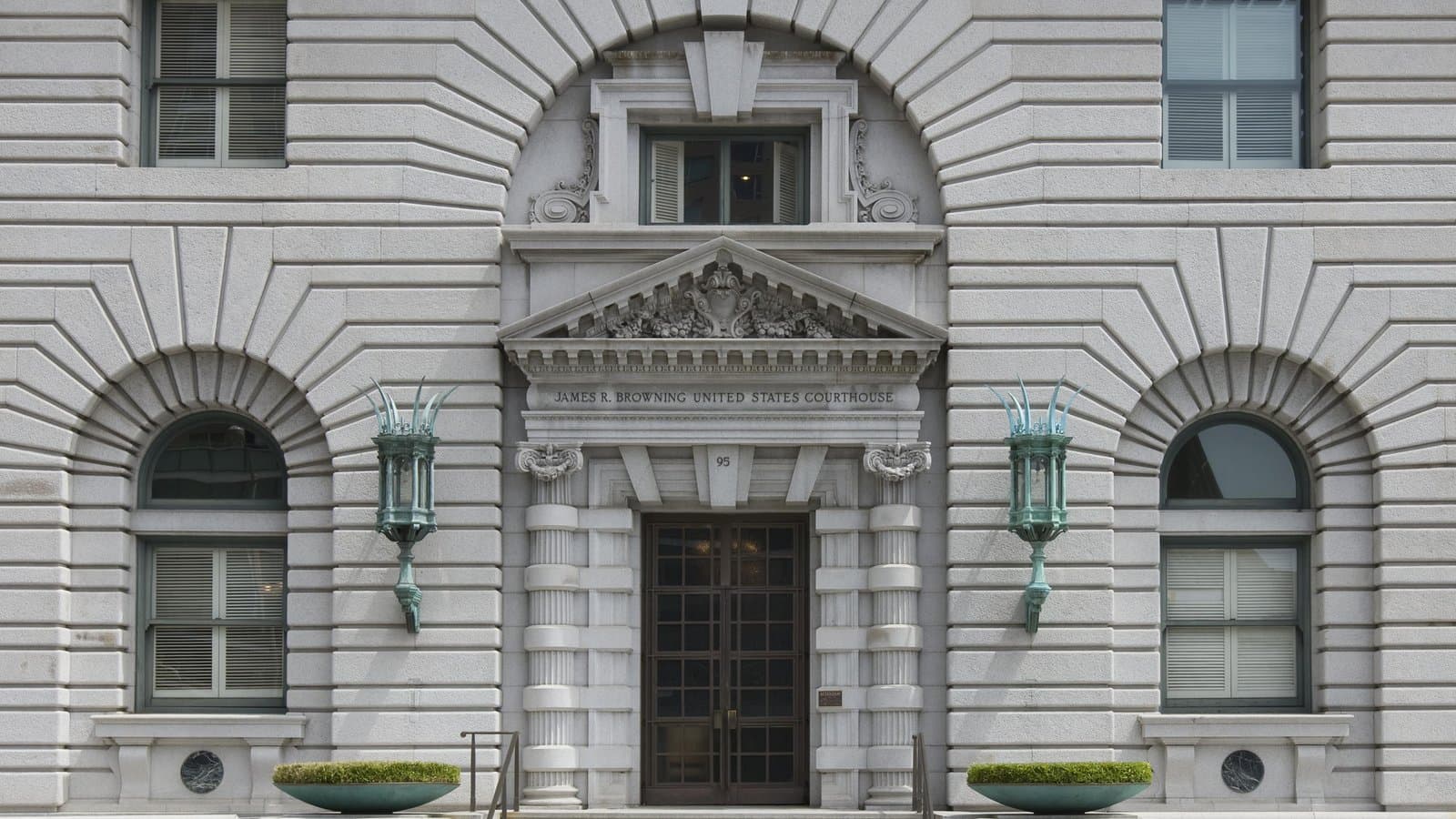
*Credits: reporting from the 9th Circuit's order, CBS News, the Associated Press, The Washington Post, the Los Angeles Times, Reuters, Votebeat, the California attorney general's office, Los Angeles County, the Justice Department, LAist and court records. Photo: Carol M. Highsmith / Library of Congress, public domain (archive photo). NewsCubby articles are produced with AI assistance and reviewed by humans.*
*Want more? Explore today's headlines on NewsCubby and join My Day free to make NewsCubby part of your day.*
Sources, credits & editorial notes
- 9th Circuit order, United States v. California, No. 26-7070, Oct. 26, 2026
- CBS News: Appeals court dismisses DOJ's request to force California to set aside ballots, Oct. 26, 2026
- Associated Press: Appeals court declines to block California from counting 20,000 disputed ballots, Oct. 26, 2026
- The Washington Post: California ballots targeted by Trump can be counted for now under court ruling, Oct. 26, 2026
- Los Angeles Times: 9th Circuit denies feds' appeal over 20,000 ballots; district court hearing to proceed, Oct. 26, 2026
- Reuters via NBC News: Trump administration loses push to block California votes from alleged noncitizens, Oct. 26, 2026
- Votebeat: Appeals court rejects Trump administration bid over California ballots, Oct. 26, 2026
- California Attorney General Rob Bonta: statement on 9th Circuit ruling, Oct. 26, 2026
- Los Angeles County: Statement from Dean Logan on DOJ lawsuit, Oct. 15, 2026
- Justice Department: Justice Department Charges 28 Foreign Nationals in California for Election Crimes, Oct. 19, 2026
- DOJ filing in U.S. v. California (C.D. Cal.), Oct. 21, 2026, listing Tuesday's 1 p.m. hearing (via Democracy Docket)
- LAist: California and the federal SAVE citizenship database
- Donald J. Trump on Truth Social, Oct. 16, 2026 (archive)
- Washington Examiner: Trump vows jail for California election officials counting ballots of noncitizens, Oct. 16, 2026
- NBC Los Angeles: Newsom and officials react to Trump administration case over LA County ballots, Oct. 26, 2026
- Photo: Carol M. Highsmith / Library of Congress, public domain, via Wikimedia Commons