Business
Tesla plans to wind down Cybertruck production in Texas
Elon Musk says Tesla will wind down Cybertruck production around mid-2027 to make room for more Cybercabs at its Austin-area factory.
What to know
- On November 6, Musk put the Texas wind-down around mid-2027. Tesla has yet to announce the last production day.
- Kelley Blue Book estimates 11,586 U.S. Cybertruck sales through September 2026, down 28% from a year earlier.
- Tesla says the Cybercab entered its Austin Robotaxi fleet in the third quarter.
- Owners can check for open safety recalls using their vehicle identification number.
Tesla plans to wind down Cybertruck production at its Texas factory around the middle of 2027, Chief Executive Elon Musk said Friday, November 6. The company wants to use the freed-up manufacturing capacity for its Cybercab, a two-seat vehicle built for its ride-hailing service. Tesla has yet to give a date for the last truck off the line or announce another plant that would build it. Reuters reported the plan, which Musk disclosed on X.
The announcement puts a timetable on a shift at the Austin-area plant. Tesla handed over the first Cybertrucks in November 2023. Three years later, Tesla's latest quarterly report lists both the pickup and the Cybercab in production in Texas, and the company says Cybercabs have already joined its Austin ride-hailing fleet. Musk's new plan concerns what the plant will build as that service expands. For truck shoppers and owners, the nearer-term questions involve inventory, warranty coverage and service.
What exactly did Tesla announce?
Musk said production would be winding down “around the middle of next year.” Tesla could make decisions about orders, available configurations and remaining inventory at different points as the line winds down. Friday's announcement gave no dates for any of those steps. The Texas factory is the only Tesla plant known to be equipped to make the truck's specialized parts, according to Reuters.
There is already a Cybercab manufacturing operation at the factory. In Tesla's third-quarter report, the company listed annual installed capacity of more than 125,000 vehicles on each of the two Texas lines. That figure describes what Tesla has installed the capacity to make. Its report gives no actual production total for either Texas line on that table. The amount of capacity available to the Cybercab after the wind-down will depend on how Tesla reconfigures the plant and how quickly it can build the vehicles at scale.
The timeline is approximate and still months away. A later update on order availability would matter immediately to shoppers. A revised capacity figure would tell investors how much of the factory Tesla expects to dedicate to the Cybercab. Friday's announcement gives the direction of the change, while those operational details remain open.
How did the Cybertruck get here?
Tesla unveiled the angular pickup in 2019. The stainless-steel exterior and sharp angles set it apart from the familiar shape of full-size pickups, and the launch demonstration drew attention when windows cracked after being struck with a metal ball, as The Associated Press recounts. The truck eventually went into customers' hands in November 2023, a milestone Tesla recorded in its annual filing with the Securities and Exchange Commission. The four-year gap between the unveiling and deliveries gave the truck a long period of public attention before it reached the road.
By fall 2026, the U.S. sales figures were moving in the opposite direction. Kelley Blue Book's third-quarter report estimates 4,323 Cybertruck sales from July through September, compared with 5,385 a year earlier, a decline of 19.7%. Its estimate for the first nine months of 2026 was 11,586, down from 16,097 in the same period of 2025. That is the 28% drop cited by Reuters.
The model was selling into a weaker electric-vehicle market overall. Kelley Blue Book estimates 262,649 U.S. battery-electric vehicle sales in the third quarter, down 39.5% from the same quarter a year earlier. The Cybertruck's third-quarter decline was smaller than that market-wide fall. Its nine-month tally still gives a clearer picture of the volume Tesla was attracting for this particular model than Tesla's own worldwide delivery table, which groups the truck together with other vehicles outside the Model 3 and Model Y.
Those measures also answer different questions about the factory. Kelley Blue Book estimates how many vehicles sold in the United States. Tesla's installed capacity is a manufacturing figure, and its global delivery totals use a different geography and vehicle grouping. A direct comparison between U.S. sales and Texas capacity would leave out exports, inventory and the timing between manufacturing and delivery. What the numbers establish is a decline in estimated U.S. demand over the measured period and a decision by Tesla to use more of the plant for a different vehicle.
What is Tesla building in its place?
The Cybercab is designed for paid rides. A privately owned truck can generate a vehicle sale when it is delivered. A Cybercab in a fleet has to keep carrying passengers over time to generate fare revenue. That puts practical questions about utilization, maintenance and the areas in which it can operate alongside the usual manufacturing questions about costs and production volume.
Tesla's second-quarter report said initial Cybercab production and engineering test drives on public roads took place during that quarter. Tesla says it started offering Robotaxi rides in Cybercabs in Austin on September 3. The factory announcement does not give a schedule for a larger Austin fleet or for the model's introduction elsewhere. It also gives no estimate of paid rides that the additional vehicles would be able to complete.
The day after the first Austin rides, NHTSA announced an audit into the basis for Tesla's self-certification that the Cybercab complies with federal vehicle safety standards. The agency said it would examine the process and technical data behind that certification. The audit's outcome is another development to watch as the company seeks to expand the service.
Those steps matter because building a vehicle, putting it into a fleet and offering rides across more areas each require a separate operational milestone. New manufacturing capacity can increase the number of vehicles available. The customer experience depends on where and when they can request a ride and whether vehicles are available when needed. For broader context on businesses trying to deploy autonomous equipment in public spaces, see NewsCubby's coverage of Chicago's delivery-robot lawsuits. That dispute concerns sidewalk robots and biometric privacy in a different jurisdiction.
What does the announcement mean for truck owners?
Musk's production announcement did not include a change to service or warranty terms. Tesla publishes its limited warranty for new Cybertrucks, and an individual truck's purchase documents specify the applicable terms. Parts availability, repair timing and resale prices will depend on factors beyond Friday's announcement. An owner who is considering a sale or a buyer looking at a used truck can get a firmer picture by checking its repair history, remaining coverage and any open recalls.
One recall illustrates why those records matter. In March 2025, Tesla recalled 46,096 model-year 2024 and 2025 Cybertrucks over a stainless-steel exterior trim panel that could detach and pose a road hazard, according to Tesla's filing with the National Highway Traffic Safety Administration. The campaign covers a specific defect and provides for a remedy without charge. Owners can enter the vehicle identification number in NHTSA's recall lookup to see whether their particular truck has an open safety recall.
For a shopper, that VIN check is more actionable than trying to predict whether the wind-down will make a given truck rarer or harder to resell. The purchase price, terms of the warranty and documented service on that vehicle can all be checked today. The same applies to the availability of a specific trim or configuration. A company production plan many months out is only one piece of the decision.
What to watch
The next signs will come from Tesla's ordering pages and subsequent company reports. An exact cutoff or a narrowing of available configurations would give buyers more concrete information. A change in the factory's published installed capacity would show how Tesla plans to divide its Texas manufacturing resources. For the Cybercab, deployment figures, the areas where paid rides are available and the number of vehicles actively serving passengers would show what the added capacity is delivering.
Investors will also be watching what Tesla says about factory investment and the economics of the fleet. NewsCubby's coverage of Friday's global stock selloff describes the broader scrutiny of spending on artificial intelligence. Tesla's decision puts a concrete manufacturing question alongside that debate. Its upcoming reports can show how many vehicles the plant is equipped to make and how much progress the company is making toward using them in a ride-hailing business.
Want more? Explore today's headlines on NewsCubby and join My Day free to make NewsCubby part of your day.
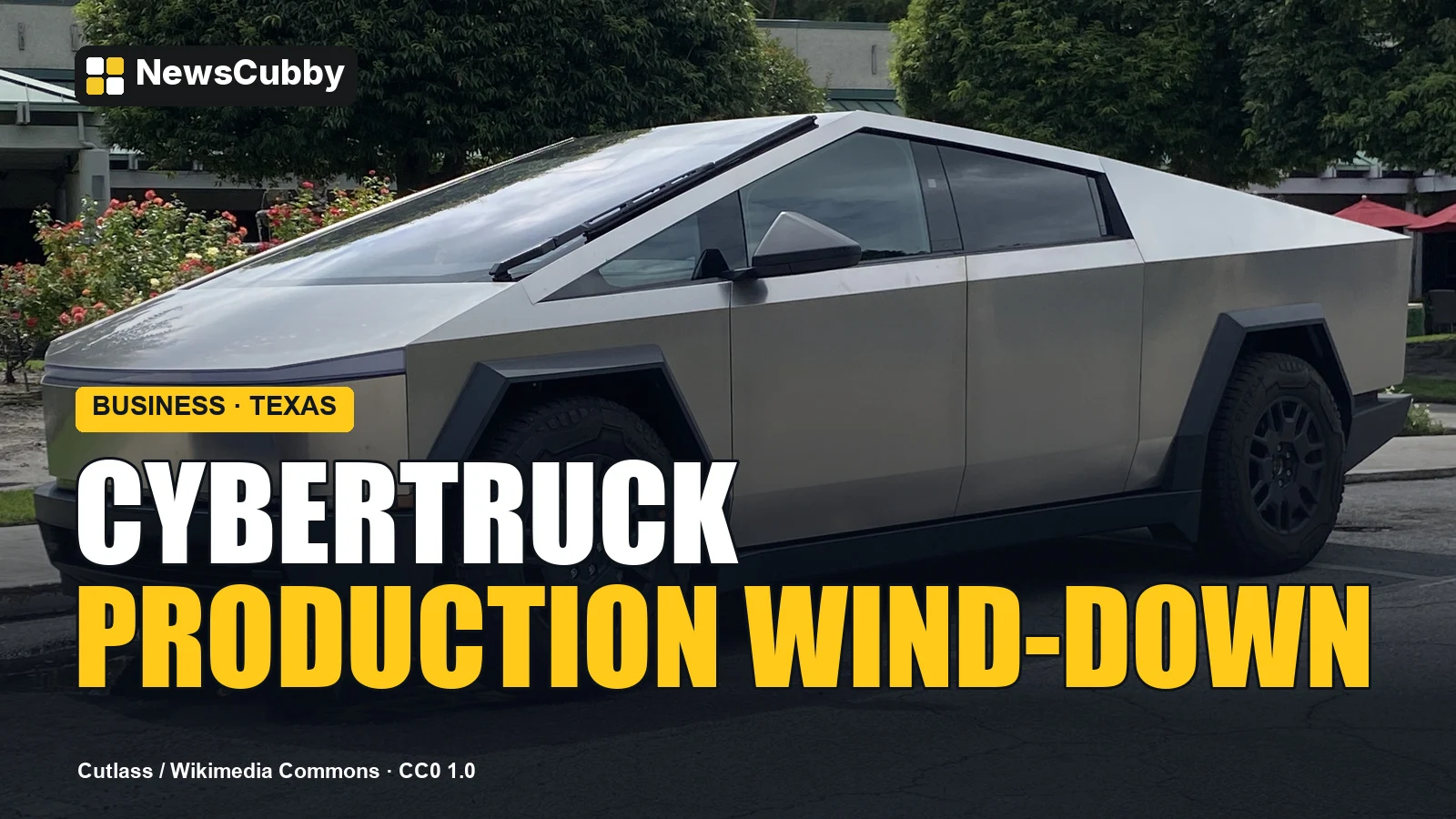
ARCHIVE PHOTO: A Tesla Cybertruck in Hilton Head Island, South Carolina, on July 27, 2024. Photo: Cutlass / Wikimedia Commons / CC0 1.0. The NewsCubby cover crops and resizes the image and adds a gradient, headline, credit and logo. Photo source.
NewsCubby articles are produced with AI assistance.
Reporting Sources
- Reuters reported the plan
- third-quarter report
- The Associated Press recounts
- annual filing with the Securities and Exchange Commission
- Kelley Blue Book's third-quarter report
- second-quarter report
- NHTSA announced an audit
- NewsCubby's coverage of Chicago's delivery-robot lawsuits
- limited warranty for new Cybertrucks
- Tesla's filing with the National Highway Traffic Safety Administration
- NHTSA's recall lookup
- NewsCubby's coverage of Friday's global stock selloff
- NewsCubby
- join My Day free
Photo & Video Credits
Credit: Cutlass / Wikimedia Commons. License: CC0 1.0 Universal. Source: file page.
Editorial notes
Sources
- Reuters — Texas wind-down and Cybercab capacity plan, November 6, 2026
- Associated Press — Cybertruck wind-down and history, November 6, 2026
- Tesla — Third-quarter 2026 update
- Tesla — Second-quarter 2026 update
- SEC — Tesla's 2023 annual report
- Kelley Blue Book — Third-quarter U.S. electric-vehicle sales report, updated October 13, 2026
- NHTSA — Recall 25V170 manufacturer filing
- NHTSA — Cybercab self-certification audit, September 4, 2026
- NHTSA — Recall lookup
- Tesla — Cybertruck New Vehicle Limited Warranty
Photo: Cutlass — Wikimedia Commons, CC0 1.0
Video image credits
truck-hilton-head — Cutlass. July 27, 2024. CC0 1.0.
https://commons.wikimedia.org/wiki/File:2024_Tesla_Cybertruck,_front_left,_07-27-2024.jpg
https://creativecommons.org/publicdomain/zero/1.0/
Gigafactory Texas Building 1 June 2022 — © 2022 Larry D. Moore. June 17, 2022. CC BY 4.0.
https://commons.wikimedia.org/wiki/File:Gigafactory_Texas_Building_1_June_2022.jpg
https://creativecommons.org/licenses/by/4.0/
Tesla Cybercab - San Francisco - June 2026 — 9yz. June 12, 2026. CC BY 4.0.
https://commons.wikimedia.org/wiki/File:Tesla_Cybercab_-_San_Francisco_-_June_2026.jpg
https://creativecommons.org/licenses/by/4.0/
Tesla Cybertruck March 2025 — Kidfly182. March 2025. CC BY 4.0.
https://commons.wikimedia.org/wiki/File:Tesla_Cybertruck_March_2025.jpg
https://creativecommons.org/licenses/by/4.0/
Front of the Tesla Cybercab — Steve Jurvetson. October 10, 2024. CC BY 2.0.
https://commons.wikimedia.org/wiki/File:Front_of_the_Tesla_Cybercab.jpg
https://creativecommons.org/licenses/by/2.0/
Video and cover changes include cropping, motion, resizing, gradient, wording, subtitles and logo.
Original NewsCubby graphic uses the Kelley Blue Book January–September 2026 sales figures cited in the article.