Politics
Trump orders DOJ to examine Democrats’ alleged threats
Trump’s directive follows Democrats’ midterm gains and raises a confrontation over congressional oversight, impeachment and federal prosecutions.
What to know
- President Donald Trump said on November 7 that he was directing the Justice Department to examine what he described as threats by Democrats against Republican officials and donors.
- Reuters reported that he provided no evidence for his assertion that the conduct was criminal. His announcement is not confirmation that prosecutors have opened a case.
- Democrats’ election victories put them in position to exercise congressional oversight in January. Impeachment, congressional inquiries and criminal prosecution are separate processes.
President Donald Trump said Saturday, November 7, that he was ordering the Justice Department to examine Democrats’ alleged threats against Republican officials and political supporters, escalating a confrontation over the investigations the incoming Congress could conduct into his administration.
The president’s announcement came four days after the midterm elections. His party lost control of both chambers, and Democrats have promised to scrutinize executive-branch conduct when the new Congress begins in January. Trump characterized their statements about impeachment and other consequences as criminal intimidation. Reuters reported that he offered no evidence establishing a crime.
The distinction between the president’s demand and prosecutors’ next decision is central. The Justice Department had not responded to Reuters’ request for comment in its November 7 report. Trump’s public instruction, by itself, does not establish that a criminal investigation has begun, identify an offense supported by evidence or announce charges against a named person.
What did Trump announce?
In his Truth Social statement, Trump accused Democratic leaders of threatening administration officials, donors and Republican supporters. He specifically referred to the attorney general and Michigan Democratic Sen. Elissa Slotkin. He argued that threatened impeachment and imprisonment amounted to extortion, and directed the department to examine the matter immediately.
The letters are part of a concrete records dispute. Reuters reported that lawmakers have released requests for documents on subjects including technology companies’ donations toward the White House ballroom. Such requests seek information about the relationship between private funding and a presidential construction project. Their contents and stated purpose are relevant to evaluating Trump’s accusation.
In a subsequent message, the president urged Republicans and donors to report alleged threats to the department or directly to him. That second request extended his appeal beyond administration officials to political supporters, making the potential reach of the directive another issue for any departmental response.
Why does the election result matter?
Control of congressional committees affects who sets hearing agendas, requests records and directs investigative work. Reuters reported that Democratic leaders intend to use their new majorities to conduct hearings and investigate administration actions. The practical change arrives with the next Congress, rather than through the election result alone.
NewsCubby’s explanation of Democrats winning control of Congress describes that transition. A congressional majority can create sustained demands for testimony and documents, but an election does not decide whether any particular allegation is true. Committee jurisdiction, records and testimony will shape the work that follows.
The current confrontation also comes during a change in executive personnel. Two senior Justice Department officials resigned on November 6. One departure affects the Miami-based federal prosecutor’s office, while the other affects the National Security Division in Washington. Their responsibilities span different investigations, making the next leadership arrangements important to the department’s broader work.
What is Congress allowed to investigate?
The Congressional Research Service’s Oversight Manual explains that Congress gathers information to legislate, examine how laws are administered and determine whether public programs need changes. Hearings, document requests and subpoenas are among its tools. Scrutiny of the Justice Department’s performance is part of that broader oversight function.
This authority has a constitutional foundation even though the Constitution does not set out a general investigations clause. The Supreme Court has recognized inquiry as an aid to Congress’s legislative work. Without information about how a department operates or spends money, lawmakers cannot effectively evaluate existing laws, propose replacements or decide future funding.
Oversight is not unlimited. The manual explains that compulsory inquiries generally must serve a legitimate legislative purpose. Congress cannot simply take over a criminal trial or conduct an unrestricted examination of private affairs unrelated to its duties. Questions about a committee’s jurisdiction, the scope of a subpoena and protected information can produce legal disputes.
That framework is more specific than either side’s broad political language. A request for government records is not automatically unlawful because its recipient objects to the investigation. Equally, describing an activity as oversight does not resolve every question about its legal scope. The actual request, authority and circumstances determine the dispute.
How is impeachment different from prosecution?
Trump’s statement repeatedly referred to impeachment. The Constitution assigns that process to Congress: the House has the power to impeach, and the Senate conducts the trial. The Senate’s official explanation says the House approves articles by a simple majority and conviction requires two-thirds of senators present.
Impeachment is a formal accusation concerning a federal officer’s conduct in office. A House vote does not itself remove the officer. Removal follows conviction in the Senate, which may also consider disqualification from future federal office. The Constitution separately recognizes the possibility of an ordinary criminal prosecution under applicable law.
The separation matters when officials or lawmakers speak about consequences. A proposed impeachment is not an indictment, and a congressional hearing does not produce a prison sentence. Criminal cases require executive-branch enforcement and judicial proceedings. A politician’s demand for imprisonment is not a substitute for those steps, whether the speaker is a president or a legislator.
These distinctions are already relevant to the separate impeachment dispute involving Defense Secretary Pete Hegseth. That dispute and Trump’s new directive involve different actors and decisions. A renewed threat to pursue articles does not establish that the House has adopted them or that the Senate would convict.
What standards apply to federal prosecutors?
The Justice Department’s published Principles of Federal Prosecution describe decisions that must be grounded in admissible evidence, the law and an assessment of whether a federal prosecution is warranted. Political affiliation, activities and beliefs are listed among the factors prosecutors must not use improperly in making charging decisions.
The manual also says investigative or prosecution decisions must not be timed to benefit or disadvantage a political party or candidate. The standards address both the basis of a case and the timing of official action. That makes the evidence supporting a decision, and the reason for taking a step at a particular time, important parts of accountability.
Separate Justice Manual provisions address communications with the White House. The posted chapter contains safeguards intended to preserve law-enforcement judgment from inappropriate influence while acknowledging the president’s constitutional responsibilities. It assigns primary responsibility for initiating and supervising investigations to department leaders, prosecutors and investigative agencies.
The communication rules are therefore relevant to the route any presidential request takes through the department. They describe who may communicate about particular cases and which officials carry investigative responsibility, providing a public benchmark against which a documented response can be assessed.
What has Slotkin said?
The dispute reaches back to Slotkin’s October remarks at the University of Chicago. Reuters reported that she favored investigating people who enabled Trump’s policies and wanted prospective administration employees to consider the possible consequences of their participation. Republican Sen. Mike Lee criticized the remarks as threats against young people interested in politics; Slotkin disputed his characterization.
In her November 7 response, Slotkin argued that officials who break the law or misuse public money should face accountability, while those who have not broken the law should have nothing to fear. That response places conduct and public resources at the center of her stated position.
The disagreement therefore includes competing descriptions of congressional scrutiny: Trump presents it as intimidation of innocent people, while Slotkin describes potential consequences for unlawful conduct. Neither description replaces evidence about a particular person. A fair assessment requires examining the conduct at issue, the actual statements and the legal process being used.
What should readers watch next?
The next substantive development is whether the Justice Department publicly responds or confirms any investigative action. If it does, the relevant details are the conduct being examined, the responsible office and the law invoked. A charge, if later filed, would remain an allegation to be tested through the courts.
On Capitol Hill, the meaningful steps will be formal committee decisions, records requests, hearing notices and any impeachment resolutions. The authority and scope of those actions will matter more than general promises of punishment. The central question is how each branch uses its established powers when the incoming Congress begins scrutinizing the administration.
Photo and video credits
These are archival photographs, not images of the November 7 announcement. All seven selected images are public-domain works or public-domain dedications. No endorsement is implied. Each was cropped, resized and given camera motion, captions, a readability gradient and NewsCubby branding as appropriate.
- 2 June 2025; official presidential portrait of Donald J. Trump Photo: Daniel Torok / White House. US government public domain. Exact source.jpg).
- 1997; west front of U.S. Capitol, Washington, D.C. Photo: Architect of the Capitol. US government public domain. Exact source.
- 27 February 2017; U.S. House chamber, U.S. Capitol, Washington, D.C. Photo: United States House of Representatives or Office of the Speaker of the House. Public domain, U.S. government. Exact source.
- U.S. Senate chamber, Washington, D.C.; archive, capture date not established Photo: United States Senate. U.S. government public domain. Exact source.
- Official DOJ portrait, not a resignation announcement photo Photo: U.S. Department of Justice. U.S. federal public domain. Exact source.
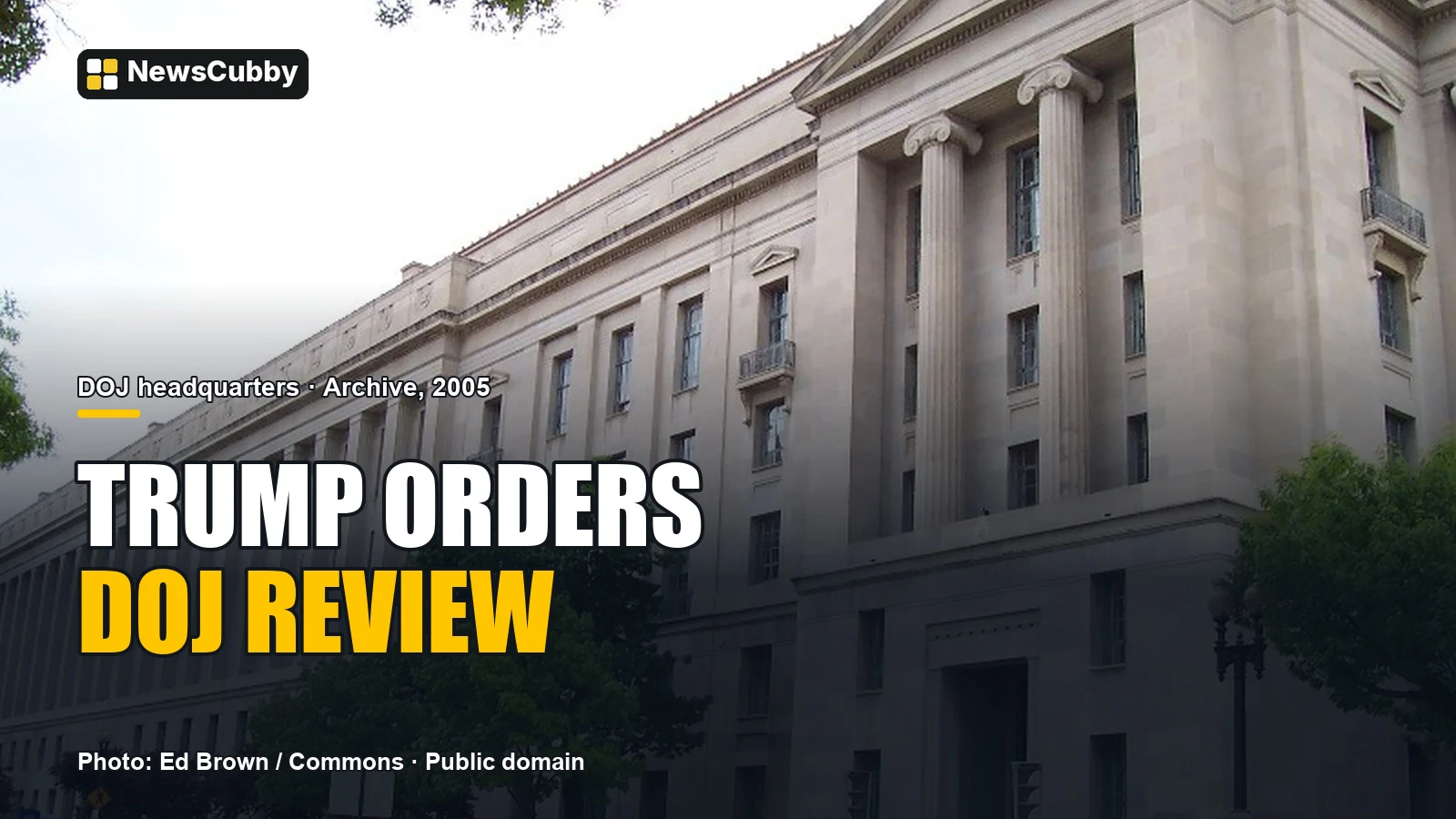
- 2005 DOJ headquarters archive, not current resignation-day footage Photo: Ed Brown (Edbrown05). Public domain by photographer dedication (PD-self). Exact source.
- Official Senate portrait, December 17, 2025; not the November 2026 remarks Photo: Rosa Pineda / U.S. Senate Photographic Studio. U.S. federal public domain. Exact source.
*Want more? Explore today's headlines on NewsCubby and join My Day free to make NewsCubby part of your day.*
*ARCHIVE PHOTO: U.S. Department of Justice headquarters in Washington, D.C., May 4, 2005. Photo: Ed Brown / Wikimedia Commons / public-domain dedication. Cropped with headline and branding; not an image of the November 7 directive.*
*NewsCubby articles are produced with AI assistance.*
Reporting Sources
- Reuters, November 7
- Reuters full syndication and Slotkin response
- CBS News, November 7 update on the directive
- Donald Trump’s original November 7 statement
- Searchable statement archive
- Congressional Research Service, Oversight Manual, updated March 27, 2026
- Constitution Annotated, congressional inquiry powers
- U.S. Senate, impeachment procedure
- Justice Manual, Principles of Federal Prosecution
- Justice Manual, congressional and White House relations
Photo & Video Credits
Credit: Ed Brown / Wikimedia Commons / public domain. License: Public-domain dedication. Source: file page.
Editorial notes
Sources
- Reuters, November 7: https://gvwire.com/2026/11/07/trump-orders-doj-to-look-into-democrats-for-threatening-people/
- Reuters full syndication and Slotkin response: https://www.marketscreener.com/news/trump-orders-doj-to-look-into-democrats-for-threatening-people-ce785fd2d180f22d
- CBS News, November 7 update on the directive: https://www.cbsnews.com/live-updates/midterm-election-results-2026-democrats-house-senate-trump/
- Donald Trump’s original November 7 statement: https://truthsocial.com/@realDonaldTrump/posts/117576401180733840
- Searchable statement archive: https://www.trumpstruth.org/
- Congressional Research Service, Oversight Manual, updated March 27, 2026: https://www.everycrsreport.com/reports/RL30240.html
- Constitution Annotated, congressional inquiry powers: https://www.law.cornell.edu/constitution-conan/article-1/section-8/clause-18/overview-of-investigation-and-oversight-power-of-congress
- U.S. Senate, impeachment procedure: https://www.senate.gov/about/powers-procedures/impeachment.htm
- Justice Manual, Principles of Federal Prosecution: https://www.justice.gov/jm/jm-9-27000-principles-federal-prosecution
- Justice Manual, congressional and White House relations: https://www.justice.gov/jm/jm-1-8000-congressional-relations