Politics
California ballot dispute: Ninth Circuit denies DOJ emergency bid
A 2-1 appeals panel refused to set aside mail ballots tied to a DOJ list of about 20,000 people; the department signaled a Supreme Court appeal.
What to know
- The Ninth Circuit voted 2-1 on Oct. 30 to deny the Justice Department an injunction pending appeal in case 26-7231. Judges Mark Bennett and Gabriel Sanchez formed the majority; Judge Patrick Bumatay dissented.
- The government wanted California and Los Angeles County to set aside mail ballots from people on its list and verify their citizenship before counting them.
- DOJ lawyers have signaled a Supreme Court appeal, AP reported. No Supreme Court filing had been reported as of Sunday night.
- An immigrant-rights group's analysis found more than 40% of the people on the list do not appear in California's voter file. DOJ says the analysis violated a court order.
- California counts mail ballots postmarked by Election Day and received within seven days after it.
California will count its mail ballots Tuesday under its existing rules after a federal appeals court refused the Justice Department's request to force the state to set aside ballots from more than 20,000 people the government says are likely noncitizens.
The 2-1 ruling by the U.S. Court of Appeals for the Ninth Circuit on Friday, Oct. 30, was the third loss in a week for the federal government in the case, and the fight over its list moved to new fronts over the weekend. On Sunday, the Justice Department defended the list's accuracy and asked a judge in Washington, D.C., to consider contempt proceedings against an immigrant-rights group that published an analysis critical of it, AP reported. Gov. Gavin Newsom, meanwhile, warned federal judges in California to scrutinize any request for warrants to seize ballots or election equipment.
What did the Ninth Circuit decide?
The panel held that the government "has not made the required showing that such extraordinary relief, during an ongoing election, is clearly required by law," NBC News reported. The majority agreed with the district court that "there is no feasible way to identify and segregate the ballots of specific individuals without potentially catastrophic effects on the entire system."
The order noted the practical problem at the heart of the request. Once a mail ballot is removed from its signed envelope, it can no longer be matched to the voter who cast it. California law allows counties to begin processing mail ballots 29 days before an election, the government's own filing noted, so many ballots had already been separated from their envelopes by the time the case reached the appeals court.
Bumatay dissented, arguing that the government's proposed procedure would protect the votes of citizens and allow eligibility to be verified before ballots were counted.
How did the case get here?
The dispute runs through three court decisions in five days:
- **Oct. 26:** A Ninth Circuit panel dismissed the government's first appeal because it had not given the district court adequate time to rule on its request. That panel called the emergency "at least in part, a self-constructed one," according to NBC News, because the government waited until close to the election.
- **Oct. 28:** U.S. District Judge David O. Carter of the Central District of California denied the government's request for a temporary restraining order. AP reported that he wrote such last-minute orders could "wreak havoc" on the state's election. California Attorney General Rob Bonta's office said a ruling that week found the list's methodology "vague" and that it "raised multiple questions regarding reliability."
- **Oct. 30:** The Ninth Circuit denied the government's emergency motion for an injunction pending appeal.
The United States sued Secretary of State Shirley N. Weber and Los Angeles County Registrar-Recorder Dean C. Logan on Oct. 15. It argued that the Constitution's Supremacy Clause bars California from knowingly sending mail ballots to likely noncitizens and counting those ballots, in violation of a federal criminal law, 18 U.S.C. § 611, that prohibits noncitizens from voting in federal elections.
Where did the 20,000-name list come from?
According to the government's court filing, the Department of Homeland Security told California in July that a preliminary review of state records had flagged possible noncitizen registrants. Two DHS agencies, U.S. Citizenship and Immigration Services and Homeland Security Investigations, then narrowed a preliminary list of more than 175,000 names to more than 20,000 people the government says are registered to vote in California, were sent a mail ballot and are "highly likely" to be noncitizens.
The government sent the list to state and county officials in mid-October, after ballots had been mailed, and asked them to confirm the citizenship of those listed within 48 hours or set aside their ballots. The officials refused, citing doubts about the list's reliability. On Oct. 19, federal prosecutors announced charges against 28 foreign nationals accused of illegally registering and voting; the government said every one of them was on the list.
What did the critics' analysis find?
In a separate case in Washington, D.C., Chief U.S. District Judge James Boasberg on Friday allowed the Coalition for Humane Immigrant Rights, known as CHIRLA, to examine the government's data. He barred the group from disclosing any names and limited its use of the data to arguments about whether it has legal standing to sue, AP reported.
On Saturday, the group's lawyers filed papers saying more than 40% of the people on the list do not appear in California's voter file. The analysis also identified 22 people on the list who were likely naturalized U.S. citizens and said thousands more citizens appeared to be on it.
The Justice Department responded Sunday that the analysis had nothing to do with standing and violated Boasberg's order. "The report's political grandstanding about alleged inaccuracies that purportedly impact California voters generally... has no relevance to whether the particular plaintiffs in this case have standing," the department wrote. It suggested Boasberg refer the matter to the department for a possible criminal contempt investigation.
Alberto Lammers, a spokesman for UCLA's Voting Rights Project, which filed the case and ran the analysis, said, "Plaintiffs' counsel and their experts fully complied with the Court's orders." No court has found contempt.
What did California officials say?
"Three legal victories in one week make clear that the Trump Administration has zero authority to interfere in California's elections," Bonta said in a statement Friday. He said state law already guards against noncitizen voting, which he called "exceptionally rare."
Newsom said the administration had "lost for the third time this week" and that the state would "deliver a free and fair election just as we've always done."
In its filing with the Ninth Circuit, Bonta's office cited the Purcell principle, a Supreme Court doctrine that discourages courts from changing election rules close to an election because of the risk of confusing voters and disrupting election administration.
What did Newsom warn about?
On Saturday, Oct. 31, Newsom wrote to the chief judges of California's four federal district courts, warning that federal agents might seek warrants to seize ballots, election records or voting equipment before results are certified. He urged extra scrutiny of any such request because of the potential disruption to counting and certification.
Newsom said he was not aware of any pending warrant application. He enclosed a UC Berkeley guide on evaluating warrant requests for election materials.
What other cases are pending?
In a related case in San Francisco, U.S. District Judge Trina L. Thompson on Friday night barred the Justice Department from demanding that election offices remove possible noncitizens from voter rolls, separate their ballots or threaten legal action. The department appealed on Sunday and noted that Thompson ruled before it could file its initial arguments. Thompson scheduled a hearing for Monday, AP reported.
The department has also issued subpoenas to California election offices and warned officials that knowingly allowing noncitizens to vote could bring criminal charges.
When will California's results be final?
California counts mail ballots that are postmarked on or before Election Day and received no later than seven days afterward, according to the secretary of state. That makes California one of the slower states to report final results, and close races can take days or weeks to call.
Official county guidance lists Dec. 3 as the deadline for counties to certify results and Dec. 11 for the secretary of state to certify the statewide results. Newsom's letter also cited Dec. 11.
What's next
Watch for any Supreme Court filing by the Justice Department, Monday's hearing before Thompson, and Boasberg's response to the contempt request. Background: NewsCubby's coverage of California election subpoenas and the special-master process, the order protecting California election workers from federal threats, the Alaska judge's dismissal of a separate DOJ ballot lawsuit and our guide to Tuesday's poll closing times.
*Want more? Explore today's headlines on NewsCubby and join My Day free to make NewsCubby part of your day.*
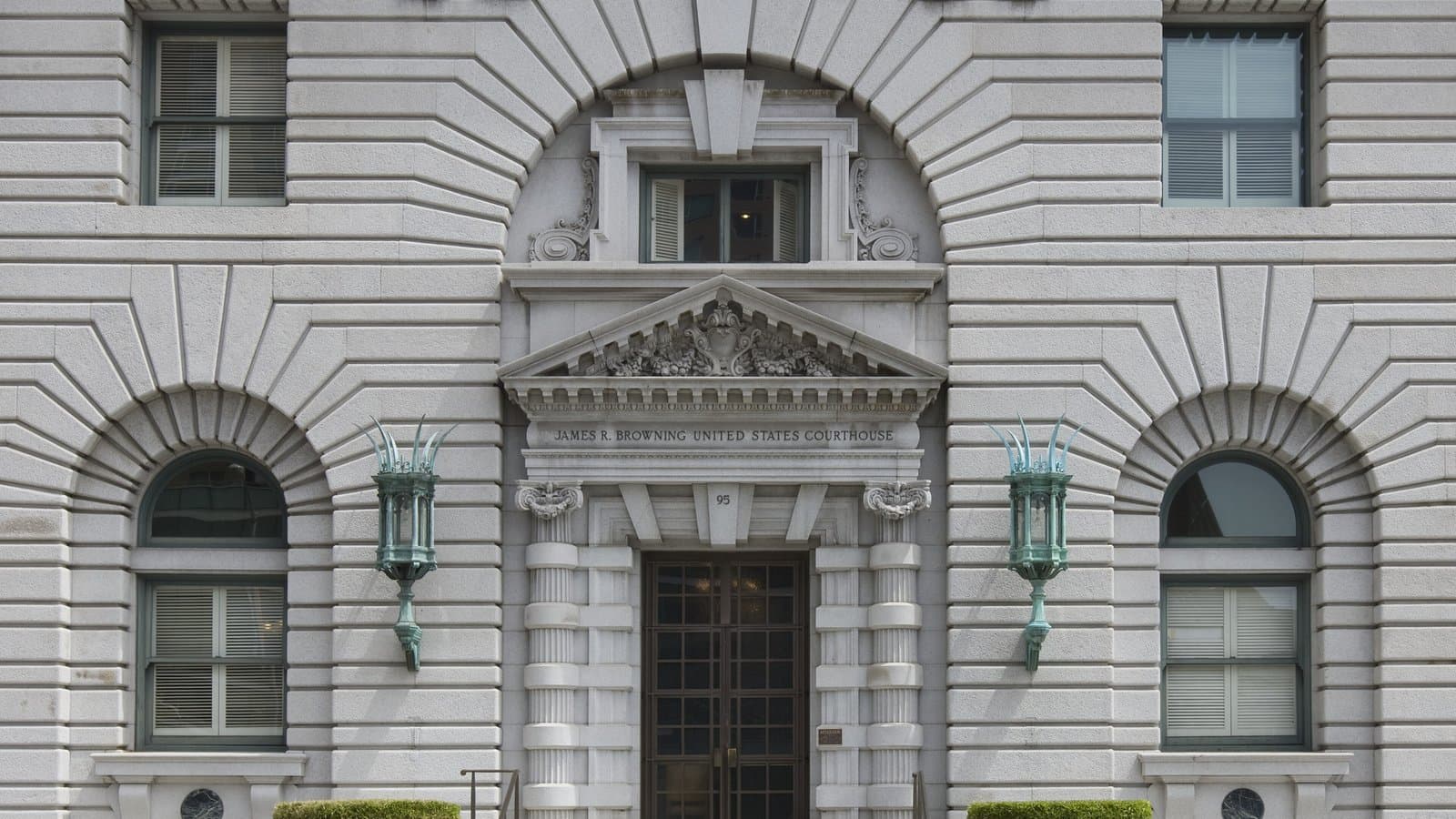
*ARCHIVE PHOTO: The entrance to the James R. Browning U.S. Court of Appeals Building in San Francisco, home of the Ninth Circuit, in 2009. Photo: Carol M. Highsmith / Library of Congress / Wikimedia Commons / Public domain.*
*NewsCubby articles are produced with AI assistance and reviewed by humans.*
Reporting Sources
- Ninth Circuit: Oct 30 order denying emergency injunction, No. 26-7231
- District Court: Oct 28 order denying TRO (Dkt. 149)
- AP: Oct 30 appeal ruling and signaled Supreme Court challenge
- AP at ABC News: Nov 1 dispute over list analysis and possible sanctions
- Governor of California: Oct 31 official warning letter to federal judges
- California Attorney General: official Oct 30 statement including Newsom response
- San Bernardino Registrar of Voters: official 2026 certification deadlines
- CBS/AP: Oct 30 ruling and procedural context
- NBC News, Appeals court again rejects DOJ's bid to segregate over 20,000 alleged noncitizen ballots in California
- Ninth Circuit: Oct. 26 order dismissing first appeal, United States v. California, No. 26-7070
- U.S. District Court, C.D. Cal.: United States' application for TRO and preliminary injunction (Dkt. 62)
- California Secretary of State, Vote by mail: postmark and receipt deadlines
Photo & Video Credits
Credit: Carol M. Highsmith / Library of Congress / Wikimedia Commons. License: Public domain. Source: file page.