Business
Is Skydance a Monopoly? Who Owns It, What It Owns and How Big It Is
Skydance now owns CBS, CNN, HBO, Paramount and Warner Bros. Here is who owns it, how big it really is, and why regulators did not call it a monopoly.
What to know
- What it is: Skydance is the company formed when Paramount Skydance bought Warner Bros. Discovery. The deal closed Oct. 6, 2026.
- The price: Warner Bros. Discovery shareholders got about $31.02 a share in cash. That's roughly $81 billion for the stock, or about $110 billion counting the debt Skydance took on, according to AP and Reuters.
- Who's in charge: David Ellison is chairman and CEO. Ynon Kreiz, the former head of Mattel, is co-CEO.
- Who controls it: The Ellison family and the investment firm RedBird Capital own 100% of the voting shares, according to the company.
- Did regulators approve it? Yes. The Justice Department found no likely harm to competition. Twelve states sued, then settled for promises about movie output, jobs and news independence. Europe and the U.K. approved it too.
If you turned on the TV this week, there's a good chance you watched something owned by Skydance. Maybe it was the evening news on CBS. Maybe it was CNN, a game on TNT, a cartoon on Nickelodeon or a show on HBO Max. Maybe it was all of them.
Five weeks ago, on Oct. 6, 2026, Paramount Skydance finished buying Warner Bros. Discovery. The combined company took a new name: Skydance. It trades on the New York Stock Exchange under the ticker SKYD.
That one deal put two of Hollywood's oldest movie studios, two big streaming services and two famous news networks under a single roof. So people are asking a fair question. At what point does owning this much turn into a monopoly?
The short answer: under U.S. law, it isn't one. Regulators looked hard and let the deal go through, with some strings attached. The longer answer is more interesting, and it explains a lot about how power works in the media business. Let's walk through it.
Where Skydance came from
Skydance started as one young man's film company.
David Ellison is the son of Larry Ellison, who co-founded the software giant Oracle and is one of the richest people on Earth. David is a pilot, and he named his company after "skydancing," the loops and rolls stunt pilots do in the air.
He formed the company in 2006. Its first movie, Flyboys, was a World War I flying picture he also acted in. It didn't do well.
The real start came a few years later. In 2009, Skydance signed a deal with Paramount Pictures to help pay for Paramount's movies. In August 2010, at age 27, David Ellison raised $350 million to do it, according to the Los Angeles Times. That was $150 million from investors, including his father, plus a $200 million line of credit from JPMorgan Chase.
Think of it like this. Making a big movie is expensive and risky. A studio that brings in a partner to cover part of the cost also gives that partner a share of the profit. Skydance became that partner for Paramount.
The first film under that deal was the Coen brothers' True Grit, which earned 10 Oscar nominations. Then came a long run of hits with Paramount, including several Mission: Impossible movies, Star Trek Into Darkness, World War Z and, later, Top Gun: Maverick.
So when Skydance went after Paramount years later, it wasn't a stranger. It had been Paramount's money partner for over a decade.
Who owned all of this before
To understand Skydance, you have to know about two older families of companies.
The Redstones and Paramount
Sumner Redstone ran National Amusements, a movie theater chain his family started. In 1987 he used it to buy Viacom, the company behind MTV and Nickelodeon. In 1994 Viacom bought Paramount Pictures. In 2000 it bought CBS.
The empire split in two in 2006, then got back together in 2019 as ViacomCBS. In 2022 it renamed itself Paramount Global.
Through all of those changes, the Redstone family stayed in control. Their company, National Amusements, held about 77% of the voting power in Paramount Global, according to Variety. After Sumner Redstone died in 2020, his daughter, Shari Redstone, ran the family's side.
Warner Bros.: sold, and sold again
Warner Bros. has a long history of changing hands. The four Warner brothers incorporated their studio in 1923. Much later it became part of Time Warner, which merged with AOL in 2001. AT&T bought it in 2018. In 2022 AT&T spun it off and combined it with Discovery, creating Warner Bros. Discovery.
The Justice Department pointed out this history itself when it reviewed the Skydance deal. It said Warner Bros. had been "a repeated acquisition target."
Deal 1: Skydance takes over Paramount (2024-2025)
In July 2024, Skydance agreed to buy Paramount. The plan had several moving parts, according to the companies' announcement:
- The Ellisons and RedBird paid $2.4 billion for National Amusements, the Redstone family company that controlled Paramount.
- Regular Paramount shareholders got $4.5 billion in cash or stock.
- Paramount got $1.5 billion in fresh cash to pay down debt.
- Skydance itself was folded into Paramount.
All in, it was about an $8 billion deal. Shari Redstone stepped away with about $1.75 billion in cash, Variety reported.
Because CBS owns local TV stations, and stations use public airwaves, the Federal Communications Commission had to sign off. The FCC approved it on July 24, 2025, by a 2-1 vote. Before that, Skydance promised in writing to put an ombudsman at CBS to review complaints of bias, and to end diversity, equity and inclusion programs, according to Variety and CNN.
The approval came weeks after Paramount paid $16 million to settle a lawsuit President Trump filed over how 60 Minutes edited an interview. FCC Commissioner Anna Gomez, the lone vote against the deal, called the process "cowardly capitulation."
The deal closed Aug. 7, 2025. The new company was called Paramount Skydance.
Deal 2: The fight for Warner Bros. (2025-2026)
Warner Bros. Discovery started weighing offers in 2025. Netflix won the first round. On Dec. 5, 2025, Netflix agreed to buy the Warner Bros. studios and HBO Max for $27.75 a share.
Paramount Skydance didn't give up. It went straight to Warner Bros. Discovery's shareholders with an all-cash offer for the whole company, including cable channels like CNN, and kept raising it.
On Feb. 26, 2026, Warner Bros. Discovery's board said Paramount's $31-a-share bid was better. Netflix chose not to match it, saying the deal was "no longer financially attractive." The next day Paramount signed the deal and paid Netflix a $2.8 billion breakup fee, according to Netflix's filing with the Securities and Exchange Commission.
Paramount also agreed to pay Warner Bros. Discovery shareholders a little extra for every quarter the deal ran past Sept. 30, 2026. It closed six days late. That's why the final payout was $31.0167 a share instead of an even $31.
Who owns Skydance now
This part confuses a lot of people, so here's the simple way to see it.
Skydance has two kinds of stock. Class A shares carry the votes. Class B shares are what regular investors buy on the stock market. They get a piece of the profits but almost no say in how the company is run.
The Ellison family and RedBird own all of the Class A stock. That means they control the company, even though lots of other people own Class B shares. The Ellisons hold the largest single stake, according to Skydance.
Buying Warner Bros. took $47 billion of new stock, sold at $12 a share. Here's who put up that money, based on the company's release and reporting from Bloomberg and the Los Angeles Times:
- The Ellison family: about $17 billion (a Bloomberg estimate from filings). Larry Ellison personally guaranteed the equity financing, according to Variety and the LA Times.
- Saudi Arabia's Public Investment Fund: $10 billion
- The Qatar Investment Authority: about $7 billion
- L'imad, an Abu Dhabi investment firm: about $7 billion
- RedBird Capital: about $4 billion
- South Korea's Shinsegae Group: about $1 billion
Banks, led by Bank of America, Citigroup and Apollo, lent the rest. The company now carries about $80 billion in debt, according to Variety.
That Middle East money raised its own questions. Normally, foreign investors can't own more than 25% of a company that holds U.S. broadcast licenses unless the FCC says it's in the public interest. On Sept. 17, 2026, FCC staff approved the request. Paramount said in a filing that the three Gulf funds would own about 38.5% of the combined company, Variety reported. The FCC said the funds can't have "any influence, direction, or control" over content or management.
Commissioner Gomez objected again, saying the agency let "some of the most repressive governments in the world" buy in without a full commission vote. The group Free Press had asked the FCC to put CBS and CNN in a separate, American-owned company. The FCC declined.
What Skydance owns
Here's the lineup, using the company's own descriptions:
- Movie studios: Paramount Pictures and Warner Bros. Pictures, plus New Line and DC Studios. That covers Mission: Impossible, Top Gun, Star Trek, Harry Potter, Batman, Superman and The Lord of the Rings films.
- Streaming: Paramount+, HBO Max and discovery+, plus the free service Pluto TV.
- Broadcast TV: the CBS network and the local CBS stations it owns.
- Cable channels: more than 50, including MTV, BET, Comedy Central, Nickelodeon, TNT, TBS, Cartoon Network, Discovery, HGTV, Food Network and TLC.
- News: CBS News and CNN.
- Sports: CBS Sports and TNT Sports, with rights to the NFL, March Madness, the NHL, Major League Baseball, NASCAR and UFC.
Skydance says it has nearly $70 billion in yearly revenue and spent more than $30 billion on content over the past year.
How big is it, really? The numbers
Size depends on what you measure. Here's where Skydance stands in each area, with the most recent numbers we could confirm.
TV viewing: No. 2, behind YouTube
Nielsen measures how much of all TV time in America goes to each company. In August 2026, the last month before the merger closed, Paramount had 6.8% and Warner Bros. Discovery had 5.3%. Put together, that's 12.1%.
That would make Skydance the second-biggest company on American TV screens. Skydance says the same thing in its November report to shareholders. First place belongs to YouTube, with 15.8%. Disney was at 9.3% and Netflix at 7.7%.
So roughly one out of every eight minutes Americans spend watching TV goes to something Skydance owns.
Streaming: big, but well behind Netflix
At the end of September, Paramount+ had 82.2 million subscribers. Paramount+, HBO and HBO Max together had 203 million, according to Skydance. That number counts someone who pays for both services twice, so the real number of households is lower.
For comparison, Netflix said it passed 325 million paid memberships in January 2026. Disney's last count, from September 2025, was 196 million for Disney+ and Hulu together. Disney has stopped reporting those numbers. Skydance says it will stop too, starting with its next report.
Movies: tied for first
In 2025, Americans and Canadians spent $9.05 billion at the box office. Disney took 27.5% of that and Warner Bros. took 21%, according to Comscore data reported by CNBC. Paramount had about 6.5%, according to the box office site The Numbers.
Add Warner Bros. and Paramount together and you get about 27.5%. That's a tie with Disney for the top spot. Box office shares jump around a lot from year to year, though, depending on which movies hit.
Local TV stations: about one in five homes
CBS owns local stations in big cities, like KCBS in Los Angeles. Those stations reach 21.8% of U.S. TV homes by the FCC's way of counting. That's about the same as ABC (20.7%), NBC (19.4%) and Fox (24.2%).
Warner Bros. Discovery didn't own any broadcast stations. So this deal didn't add a single local station to Skydance.
Cable news: third place
CNN is the famous name here, but it's not the ratings leader. From July through September 2026, CNN averaged about 608,000 viewers in prime time. Fox News averaged about 2.06 million and MS NOW about 933,000, according to Nielsen numbers reported by Adweek.
Kids TV: two big names under one roof
Nickelodeon and Cartoon Network used to be rivals. Now they share an owner. European regulators looked at this overlap specifically. They decided that streaming services full of kids' shows, like Netflix, Disney+ and YouTube, keep enough pressure on those channels. We couldn't find a reliable, current U.S. share number for kids TV, so we're not giving one.
So when does "big" become a monopoly?
Here's where the law comes in. Antitrust law is the set of rules that keeps companies from getting so powerful they can push customers, workers or competitors around. Think of it as a referee for business.
There are two main laws.
The Sherman Act (1890) is about monopolies. A monopoly is when one company controls so much of a market that it can raise prices or lower quality and customers have nowhere else to go. Picture a town with one gas station and no other for 100 miles. Courts have usually wanted to see a share well over half a market before calling something a monopoly. Skydance isn't close to that in any area above.
The Clayton Act (1914) is about mergers. It sets a lower bar. A merger is illegal if it "may" substantially lessen competition. You don't have to be a monopoly to break this law. You just have to make competition meaningfully weaker.
Step 1: Define the market
Before anyone can say a company is too big, they have to answer: too big in what? This is called market definition, and it's where most of the fighting happens.
If the market is "movies in theaters," Skydance is tied for first with about 27%. If the market is "everything people watch on a screen," YouTube and TikTok count, and Skydance looks smaller. The Justice Department, for example, said YouTube and TikTok don't count as true substitutes for streaming services like HBO Max, even though they compete for your time.
Step 2: Measure how crowded the market is
Regulators use a score called the HHI. The name is a mouthful (it stands for Herfindahl-Hirschman Index), but the idea is simple.
Take each company's market share, multiply it by itself, and add them up. If one company owns everything, the score is 10,000 (100 times 100). If 100 companies each have 1%, the score is 100. Higher means fewer, bigger players. Think of it as a "crowded room" test. A room with 100 people talking is competitive. A room where two people do all the talking is not.
Under the federal merger guidelines published in 2023, which the Justice Department and Federal Trade Commission still use, a market scoring above 1,800 is "highly concentrated." If a merger in that kind of market raises the score by more than 100 points, the government presumes it hurts competition.
We ran the numbers on the 2025 box office as an example. Before the merger, the score was about 1,683. After combining Warner Bros. and Paramount, it's about 1,956. That's a 273-point jump into "highly concentrated" territory.
That sounds like it should have sunk the deal. Here's why it didn't. A presumption is a starting point, not a final answer. The companies get to argue back. The Justice Department said relying on old market shares is shaky in a fast-changing business, and it cited a 1974 Supreme Court case, United States v. General Dynamics, that says the same thing. It also pointed to newer studios like A24, Neon and Amazon MGM that have had big hits.
Step 3: Look at the TV-station rules
The FCC has its own size limits for local TV. For decades, one company couldn't own stations reaching more than 39% of U.S. homes. Imagine a rule that one grocery chain can't serve more than 39% of the country's shoppers.
CBS is well under that limit at 21.8%. And it may not matter going forward. On Aug. 6, 2026, the FCC voted 2-1 to get rid of the 39% cap. Starting Jan. 11, 2027, the FCC will review big station deals one by one instead.
There are also local rules that limit how many top stations one company can own in the same city. Those didn't come into play, because Warner Bros. Discovery had no stations.
What the regulators decided
The Justice Department closed its review on June 12, 2026. After eight months and more than two million documents, it said the deal was "not likely" to harm competition in streaming, cable TV or movies. It said the combined company would be a stronger rival to the biggest streaming services. It also rejected arguments that the merger would hurt workers' pay.
Twelve states disagreed. On July 13, 2026, California Attorney General Rob Bonta and 11 other Democratic attorneys general sued to block the deal under the Clayton Act. The states were Arizona, Colorado, Connecticut, Massachusetts, Minnesota, Nevada, New Jersey, New Mexico, New York, Oregon and Washington. They argued it would raise prices, hurt movie theaters and cut jobs.
They settled on Sept. 21, 2026. The deal didn't force Skydance to sell anything up front. Instead, it set five years of court-enforced promises, according to the California attorney general's office:
- Release at least 30 movies a year, 20 of them wide releases, for two years, then 32 a year after that. If it misses, it has to sell Miramax and pay $30 million per missing movie to union health and retirement funds.
- Spend at least $1.5 billion more on U.S. film production over five years than it did in 2025.
- Put $47.5 million into a fund for workers who lose their jobs because of the merger.
- Negotiate cable deals for the old Paramount channels separately from the old Warner channels.
- Keep a free streaming service like Pluto TV running.
- Create a "News Editorial Independence Board" for CNN and CBS News.
- Accept an independent monitor.
"This settlement is not a vote of support for this merger," Bonta said. Connecticut Attorney General William Tong had pushed for selling off CNN and CBS News, and said he was "deeply disappointed" that didn't happen, according to Variety.
A federal judge in San Francisco, Araceli Martínez-Olguín, approved the settlement on Sept. 30. She wrote that there were "meaningful grounds for disappointment," but that wasn't enough to reject it. Six days later the deal closed.
Overseas, the European Commission approved the deal on July 22, 2026, on the condition that Paramount quit a European film-distribution partnership it shared with Universal. The U.K.'s Competition and Markets Authority cleared it on Aug. 6, and the British culture secretary decided not to step in after Skydance made binding promises about U.K. broadcasting and editorial independence. Skydance says competition regulators in nearly 70 places signed off.
What critics say
Opponents made three big arguments.
Fewer buyers means lower pay. Writers, actors and crew members sell their work to studios. When two big buyers become one, workers have fewer places to shop their work. "If Paramount succeeds in buying Warner Bros., the merged firm will be the largest buyer of original film and television programming in the United States," said Michele Mulroney, president of the Writers Guild of America West. The guild sued separately, then settled on Sept. 21. Skydance agreed to no writer layoffs at CBS News for five years and to pay $17.5 million into the guild's health fund. The guild said it still believes the merger will hurt writers.
Fewer movies in theaters. Theater owners and independent filmmakers worried a merged studio would release fewer films. That's the main reason the settlement locks in yearly movie counts.
Too much control over news. This is the part that worries people most, and it isn't really about market share. Groups like Free Press and Public Citizen argued that putting CBS News and CNN under one owner, with close ties to the Trump administration, is a risk to independent journalism. Sen. Cory Booker, D-N.J., asked the judge for an extra public-interest review. Sens. Elizabeth Warren, Bernie Sanders and Richard Blumenthal had written to the Justice Department in November 2025 asking for an independent review of any Warner Bros. sale.
Antitrust law isn't built to measure this kind of power well. It counts dollars and market share, not influence over what people believe.
What supporters say
Skydance argues it needed to get bigger to survive. Its main rivals aren't old studios anymore. They're tech giants like YouTube, Netflix and Amazon, with far deeper pockets. "Our ambition was to bring these two storied studios together and create a stronger competitor," David Ellison said when the deal closed.
The Justice Department largely agreed. It said Paramount and Warner Bros. came late to streaming and have fewer subscribers than the three biggest services, so putting them together creates a stronger challenger rather than a bully.
Some unions backed the final settlement, too. Teamsters President Sean O'Brien said it "protects American jobs." The Directors Guild called the commitments "important" and "enforceable."
How much influence each brand has
Market share is one thing. Influence is another. Here's what each major piece of Skydance brings.
- CBS: One of America's Big Four broadcast networks and, by Skydance's account, its "crown jewel." It airs NFL games, 60 Minutes and the CBS Evening News, and it reaches homes that don't pay for cable. Bari Weiss, whose news site The Free Press was bought by Skydance in 2025, is editor in chief of CBS News.
- CNN: The original 24-hour news channel. It's third in U.S. cable ratings, but it's one of the most recognized news brands in the world. Mark Thompson stays on as chairman and editor in chief, and Skydance says Weiss does not oversee CNN, according to TheWrap. Some longtime CNN staffers, including camera operators and fact-checkers, took buyouts this month, Variety reported.
- HBO: The prestige brand. Game of Thrones, The White Lotus and House of the Dragon came from here, and an HBO Harry Potter series premieres on Christmas Day.
- Paramount Pictures and Warner Bros.: Two of the oldest studios in Hollywood, with huge film libraries. Old movies keep earning money for decades through streaming and licensing.
- Nickelodeon and Cartoon Network: Kids' brands that turn into toys, theme park rides and sequels. SpongeBob alone has been on the air since 1999.
- MTV and BET: Big cultural names for music and for Black audiences.
- TNT Sports and CBS Sports: Live sports are one of the last things people still watch live on TV, so they matter a lot to advertisers. Skydance says its sports ad commitments are up more than 20% from last year.
- Pluto TV: A free, ad-supported streaming service with about 75 million monthly users. The settlement requires Skydance to keep a free option like it.
- Local CBS stations: Local news in big cities, like KCBS and KCAL in Los Angeles.
Has this happened before?
Yes, and that history is worth knowing.
In 1948, the Supreme Court ruled against Paramount and the other big studios in a case called United States v. Paramount Pictures. Back then, studios also owned the theaters, so they could decide which movies you got to see. The court made them separate. Those rules, known as the Paramount Decrees, lasted until a federal judge ended them in 2020.
From 1970 to 1995, the FCC also had "financial interest and syndication" rules that kept TV networks from owning most of the shows they aired. The Writers Guild says it wants something like that again, separating streaming services from the studios that supply them.
The bottom line
Skydance is not a monopoly under the legal tests U.S. courts use. It doesn't control most of any single market. It is No. 2 in American TV viewing, roughly tied for No. 1 at the box office, a distant No. 2 to Netflix in streaming, and third in cable news.
It is also one of the biggest concentrations of news and entertainment under one family's control in modern American history. Federal regulators said that's fine for competition. A dozen states said they had real concerns and settled for five years of promises. Critics say the law misses the bigger issue of who controls the news.
Both of those things can be true at once. Whether this deal turns out well for viewers and workers will show up in ticket prices, subscription bills, paychecks and newsrooms over the next few years.
What's next
- Prices: Skydance plans to sell HBO Max and Paramount+ together in a bundle starting in early 2027. It hasn't announced a price.
- Jobs: The company is aiming for at least $6 billion in yearly savings within three years. Buyouts are underway at CNN and CBS News.
- Movie promises: The first test of the 30-movie promise comes at the end of year one.
- News: How the new News Editorial Independence Board works in practice is still unclear.
- TV station deals: When the 39% cap goes away in January, expect more station buying across the industry.
Related NewsCubby coverage
- HBO Max and Paramount+ plan an early-2027 bundle. The price is still the missing piece.
- Microsoft and Skydance offer buyouts: What the new exit deals mean for workers
- Christiane Amanpour plans June 2027 CNN departure, with program changes beforehand
- You've Got Mail reboot: Jason Orley to direct for Warner Bros.
- Netflix cuts about 1,000 jobs, staff memo says
*Want more? Explore today's headlines on NewsCubby and join My Day free to make NewsCubby part of your day.*
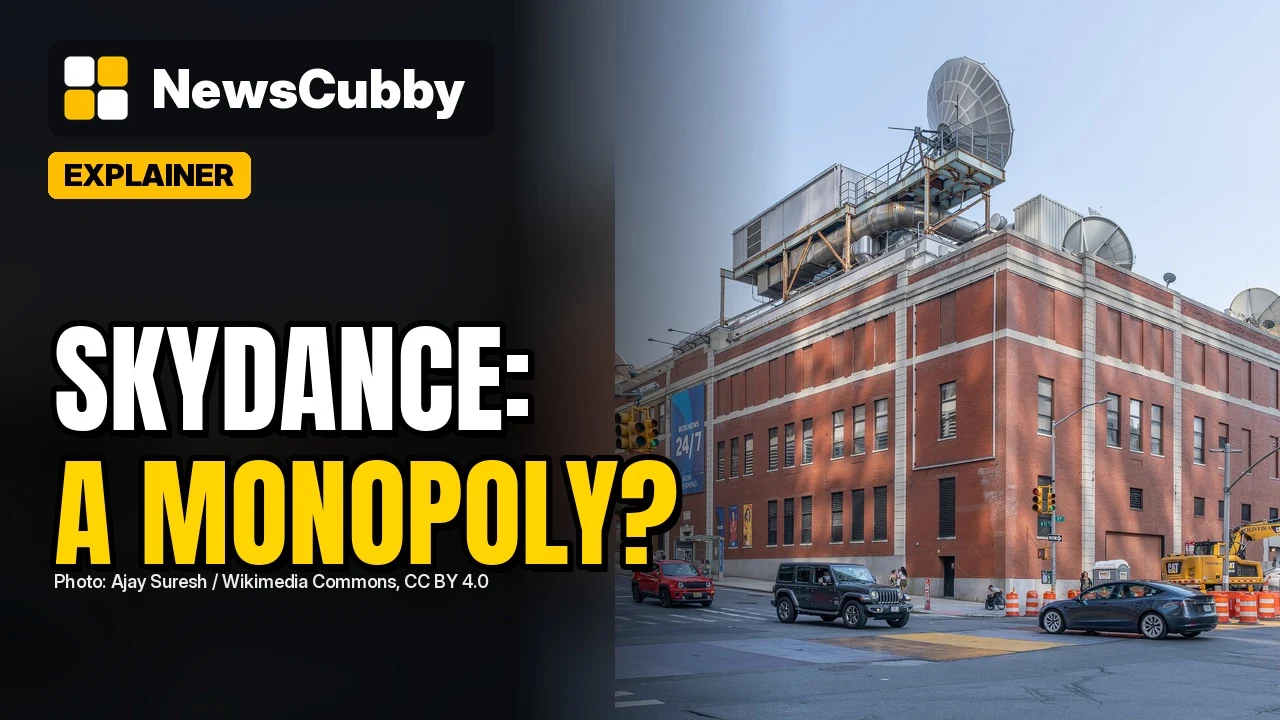
*ARCHIVE PHOTO: The CBS Broadcast Center in New York, home of CBS News, May 2026. Photo: Ajay Suresh / Wikimedia Commons / CC BY 4.0.*
*NewsCubby articles are produced with AI assistance and reviewed by humans.*
Reporting Sources
- Skydance: Paramount completes acquisition of Warner Bros. Discovery, Oct. 6, 2026
- Skydance Corp. Form 8-K, Oct. 6, 2026 (SEC)
- Skydance Q3 2026 shareholder letter, Nov. 9, 2026 (SEC Exhibit 99)
- Netflix Form 8-K, Feb. 27, 2026: end of WBD agreement and $2.8B fee (SEC)
- U.S. Justice Department Antitrust Division statement, June 12, 2026
- California Attorney General: settlement of Warner Bros./Paramount lawsuit, Sept. 21, 2026
- Writers Guild of America: settlement statement, Sept. 21, 2026
- U.K. Competition and Markets Authority: Paramount / Warner Bros. Discovery merger inquiry
- FCC: approval of Skydance/Paramount/CBS transaction, July 24, 2025
- Federal Register: FCC National Television Multiple Ownership Rule, Nov. 12, 2026
- Skydance and Paramount Global definitive agreement, July 7, 2024
- U.S. Justice Department and FTC: 2023 Merger Guidelines