Politics
Pentagon planning chief Brett Sylvia removed amid conflicting accounts
The Army lieutenant general left the J5 and retired after 11 months while public reporting offered different explanations for the change.
What to know
- Sylvia was removed from the Joint Staff post known as the J5 and retired from the Army, according to multiple reports.
- The government’s public record does not yet provide a completed finding explaining the change.
- Public reports disagree about the rationale, and no released government finding resolves those accounts.
- The J5 helps the chairman develop strategy, plans and policy advice, but it does not command forces or authorize an operation.
- The departure occurred as officials reviewed Iran options, yet no public evidence shows that Iran policy caused the personnel decision or that a new attack has been ordered.
Army Lt. Gen. Brett Sylvia has been removed as the Joint Staff’s director for strategy, plans and policy and has retired from the service, ending an 11-month tenure in one of the Pentagon’s most consequential planning jobs. What caused the departure remains disputed in public reporting, and the government has not released an on-record finding that resolves those accounts.
ABC News reported that Sylvia retired after being removed. One source cited lost confidence, while another said it was unclear whether Hegseth or Caine ordered the move. ABC also reported that the Joint Staff withdrew its first tribute, saying it did not reflect the full circumstances and citing an ongoing personnel process.
That account does not publicly identify the conduct under review, the evidence or the standard applied. Anonymous explanations remain claims unless an attributable statement or completed finding supports them.
What has the Pentagon actually confirmed?
CNN said Caine’s spokesperson confirmed Sylvia’s departure; no reason or successor was announced at the time. The report noted Iran planning but did not link it to his removal.
A confirmation of departure is different from an official explanation of cause. A spokesperson can verify that an officer left without validating every reported theory. The available public record does not resolve the dispute.
Why are the reported explanations still unsettled?
CBS reported an anonymous official’s unproven leak allegation.
The Atlantic, citing Defense Department officials, reported lost confidence and friction with Elbridge Colby. It also placed Sylvia within a broader turnover of senior officers. Those anonymous accounts remain unproven.
The sources reviewed for this article do not include a public response from Sylvia or a released investigative finding. The defensible conclusion is narrower: he was removed and retired, and the reason remains unresolved in the public record.
What does the J5 do?
The J5 is not simply an office that writes one war plan. The Joint Staff’s published mission says the directorate develops strategies, plans and policy recommendations for the chairman across national security issues. Its work is meant to incorporate combatant-command requirements, coordination with agencies and allies, and assessments of risk before the chairman gives military advice to civilian leaders.
That makes the office a bridge. Combatant commands develop and execute regional plans; civilian officials set policy; the chairman advises the president and defense secretary. J5 staff connect those layers so military options reflect political aims, alliance obligations, available forces and likely consequences.
The Joint Strategic Planning System instruction places strategic direction, contingency plans, global integration and readiness assessments inside a wider process. Institutional depth means one vacancy does not stop all planning. Leadership still matters because a director sets priorities, frames tradeoffs and presents recommendations to the chairman.
The office’s importance should not be exaggerated. The Joint Staff does not command combatant forces, and the J5 does not authorize an attack. Removing the director is not evidence that an operation has been approved. Nor does the vacancy erase work already done by military and civilian teams.
No successor had been publicly named in the reports reviewed. The official J5 page had listed Maj. Gen. Mark H. Slocum as vice director before Sylvia’s departure. A vice director can provide continuity, but NewsCubby found no public announcement assigning Slocum the director’s duties. Calling him the acting director without that confirmation would be premature.
Does the timing prove a connection to Iran planning?
No. The timing matters because the administration is reviewing military options involving Iran, but timing alone does not establish motive. None of the sources reviewed produced evidence that a disagreement over Iran caused Sylvia’s removal.
AP reported warnings to regional partners about possible post-election action and retaliation, while diplomats said President Donald Trump had not decided.
Military readiness, contingency planning and diplomatic warnings are not an attack order. NewsCubby’s October 28 explainer on reported Gulf warnings examines that distinction. A planning staff prepares alternatives so civilian leaders retain choices; the existence of an option says what forces could do, not what the president will do.
The wider regional context also contains disagreement inside allied governments. NewsCubby’s guide to Israel’s October 27 election documented public denials after reports of tension between political and military leaders over Iran. That episode is not evidence about Sylvia’s removal. It illustrates why staffing disputes and operational decisions must be evaluated through their own records.
A new J5 leader would inherit work spanning Central Command, European commitments, weapons inventories, regional partners and escalation risks. Changing leadership during such reviews may affect how options are organized or communicated. Public evidence does not yet show that the change altered any recommendation.
Why does continuity in the planning office matter?
The Joint Strategic Planning System distributes work across recurring assessments, guidance, contingency plans and advice to senior leaders. That structure gives the institution resilience when one officer leaves. Existing plans, staff expertise and coordination channels remain in place while leaders decide who will assume the post.
Leadership still shapes the questions a staff asks and the tradeoffs it highlights. A director decides which risks require attention, how competing regional demands are compared and how clearly disagreement is presented to the chairman. Continuity therefore depends on more than filling a name on an organization chart.
The practical indicators are whether an interim leader is formally identified, how long the vacancy lasts, whether planning timelines change and whether a permanent successor is nominated. Those measures will reveal more about operational continuity than speculation about informal arrangements.
What is known about Sylvia’s career?
Sylvia is a 1994 graduate of the U.S. Military Academy. The Army’s General Officer Management Office biography says he became a lieutenant general in December 2025 and began serving as J5 director that month. He previously served as the directorate’s vice director, giving him experience inside the office before leading it.
His other assignments included commanding the 101st Airborne Division and Fort Campbell from July 2023 to May 2025, along with senior roles in III Corps and the 1st Cavalry Division. The biography lists deployments connected to Iraq, Afghanistan, Europe and Bosnia, and decorations including the Distinguished Service Medal, six Bronze Star Medals—one for valor—and a Purple Heart.
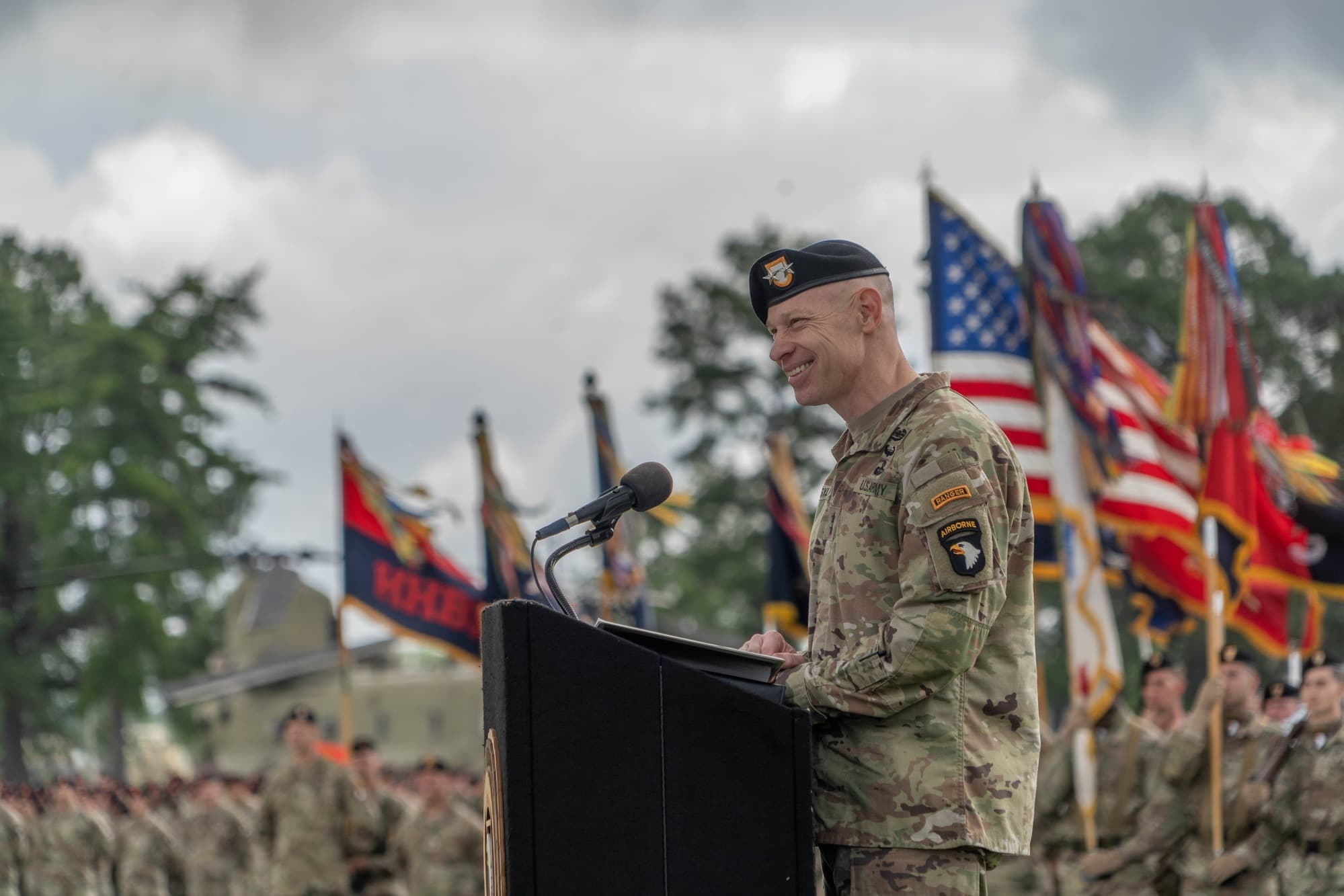
That record provides context, not a verdict about the removal. A long, decorated career does not by itself disprove a personnel allegation, and an unresolved allegation does not erase the career. The archive photograph accompanying this article shows Sylvia speaking as commander of the 101st Airborne Division in May 2025. It does not depict the 2026 removal or any alleged conduct.
What would clarify the story next?
The strongest new evidence would be an on-record Pentagon or Joint Staff explanation, a public finding from an authorized investigation, or a response from Sylvia or his representative. Officials can protect legitimately classified information while still identifying the status of a process, the interim chain of responsibility and whether any final determination has been made.
Operationally, the next questions are whether an acting J5 director is named, whether a permanent replacement is nominated and whether Congress receives information about the vacancy. Readers should also wait for an attributable Iran decision rather than infer one from staffing changes.
NewsCubby’s fact check of claims about an IRGC letter and the midterms showed why documents and exact wording matter when Iran, elections and anonymous claims intersect. The same rule applies here: separate what the government confirmed, what unnamed sources said and what remains unknown.
For now, the firm conclusion is limited. Sylvia is out of the J5 and has retired. Reports disagree over the rationale, no named replacement has been announced, and no Iran strike order can be inferred from the personnel move.
*Want more? Explore today's headlines on NewsCubby and join My Day free to make NewsCubby part of your day.*
*ARCHIVE PHOTO: Maj. Gen. Brett Sylvia speaks during the 101st Airborne Division change-of-command ceremony at Fort Campbell, Kentucky, on May 30, 2025. Photo: Staff Sgt. Kaden D. Pitt / U.S. Army / DVIDS. Public domain. This image predates and does not depict his October 2026 removal. Public domain — U.S. Army photograph, subject to DVIDS/DoD reuse limitations.*
*NewsCubby articles are produced with AI assistance and reviewed by humans.*
Sources, credits & editorial notes
- ABC News: Top general pushed out from Pentagon Joint Staff
- CBS News: Hegseth fires Pentagon chief planner
- CNN: Pentagon chief planner departs as Iran options are reviewed
- The Atlantic: Brett Sylvia and Pentagon leadership turnover
- Joint Chiefs of Staff: J5 Strategy, Plans and Policy mission
- Joint Chiefs of Staff: Joint Strategic Planning System instruction
- U.S. Army General Officer Management Office: Brett G. Sylvia biography
- Associated Press: Iran warnings and post-election military options
- DVIDS: copyright and reuse policy
- Photo: Staff Sgt. Kaden D. Pitt, U.S. Army / public domain