Politics
Dan Sullivan race: Times reports Peltola recruitment effort
New reporting links Peltola’s team to namesake recruitment in Alaska. The ballot dispute and questions about legality remain separate.
What to know
- The Times’ October 28 investigation reports that Peltola’s team worked with people attempting to recruit namesake and other potential spoiler candidates.
- The official ballot distinguishes incumbent Dan S. Sullivan, a Republican, from Daniel J. Sullivan Jr., who has no party label beside his name.
- Alaska courts restored the challenger’s candidacy after election officials disqualified him in June.
- The state is contesting a separate federal lawsuit seeking conditional intervention in certification. Recruitment claims do not establish how many voters, if any, were confused.
Mary Peltola’s campaign team participated in an effort to identify and recruit an Alaskan who shared Senator Dan Sullivan’s name, according to a New York Times investigation published October 28. The reporting adds evidence of campaign involvement to a ballot controversy that has already reached Alaska’s highest court and prompted a federal lawsuit.
The Times reports that senior campaign aides directed a staffer in summer 2025 to search for Alaska residents named Dan Sullivan. The staffer compiled names from voter records. A retired Petersburg teacher, Dan J. Sullivan, entered the Senate race the following spring, creating the prospect that voters could confuse him with Republican incumbent Dan S. Sullivan.
The investigation challenges the Peltola campaign’s earlier denials of involvement. But the reported recruitment effort, the challenger’s legal eligibility and the Justice Department’s proposed intervention in election certification are distinct questions. Evidence about how a candidate was recruited does not, by itself, establish a crime or determine how voters’ ballots should be counted.
What does the new reporting say about recruitment?
The investigation describes planning that began well before the namesake candidate filed. According to the Times, campaign aides wanted to locate another Dan Sullivan who could be persuaded to enter the Senate contest. The potential benefit was not simply another candidate’s presence: it was the possibility that the shared name would cost the incumbent votes.
The Times says its findings draw on interviews, text messages and documents prepared for a potential lawsuit against the campaign. It reports that Peltola’s team worked with people trying to recruit Sullivan and that the broader operation also sought other would-be spoilers to dilute the incumbent’s support.
That account goes beyond the previously public dispute over whether two similar names might confuse voters. It describes an effort to create an electoral advantage through candidate recruitment. The attribution matters: these are findings reported by the Times, rather than findings announced by a court in the proceedings reviewed for this article.
Who are the two Sullivans on Alaska’s Senate ballot?
The incumbent is Dan S. Sullivan, the Republican senator seeking reelection. The challenger is Daniel J. Sullivan Jr., a retired teacher from Petersburg. Democrat Mary Peltola and Republican Gerald L. Heikes are the other candidates on the four-person general-election ballot.
Alaska’s sample ballot identifies the senator as a registered Republican and the incumbent. It prints the challenger’s fuller name, including his different middle initial and the suffix Jr., without a party designation. Those differences are important to understanding the dispute: the names resemble each other, but the entries are not identical.
The challenger previously registered as a Republican and subsequently became undeclared. Alaska Beacon, in a report republished by Alaska Public Media, reported that the change appeared on his August absentee voting paperwork. The current ballot presentation, rather than an earlier description of his registration, is the relevant reference for explaining what November voters see.
What had the campaign and challenger said previously?
In June, the challenger told The Associated Press that running was his choice and rejected the sham-candidacy allegation. Alaska Democratic Party executive director Jenny-Marie Stryker denied party affiliation with either Sullivan. The Times’ new account says Peltola’s campaign repeatedly denied involvement in the namesake candidacy.
Those denials should remain in the record alongside the subsequent reporting. They establish what the participants said at the time; they do not independently resolve the evidence presented later. Likewise, a campaign connection involving a consultant is not automatically proof that every party organization or the candidate personally directed that consultant’s actions.
The distinction between the Peltola campaign, the Alaska Democratic Party and outside political committees is especially important. They are separate entities. The new investigation attributes activity to Peltola’s team. Reporting that finding accurately does not require assigning responsibility to an unidentified local party office.
What do the existing complaints and court records establish?
Before today’s investigation, Republicans had drawn attention to consultant Amber Lee’s assistance to the challenger and her separate work for a pro-Peltola political committee. A National Republican Senatorial Committee complaint alleged improper in-kind campaign contributions. Such a complaint identifies allegations and supporting material submitted by an interested party; it is not a ruling that a violation occurred.
On June 15, Alaska’s Division of Elections disqualified the challenger. Its determination cited concerns about misleading voters, among other matters. A superior court reversed the decision, and the Alaska Supreme Court affirmed the restoration of his candidacy on June 29, with further consideration of how his name should appear on the ballot.
Why is the Justice Department involved?
The Justice Department filed its federal lawsuit on October 22. Its requested relief is conditional: intervention in certification if the incumbent loses but would prevail under a calculation assigning the other Sullivan’s votes to him. The complaint seeks an investigation of possible voter confusion in that circumstance.
Alaska has asked the court to dismiss the case. In its response, the state argues that the federal government lacks the authority asserted in the lawsuit and that the ballot distinguishes the candidates. Alaska Public Media reported October 27 that the judge had expedited briefing. That procedural step is not a ruling that the government’s allegations are true or its requested remedy is lawful.
The Times investigation adds reporting about recruitment, but it does not itself decide the federal case. Whether a tactic was planned, whether it violated an applicable rule and whether a federal court can grant a particular remedy each require their own evidence and legal analysis.
Does a vote for the challenger automatically hurt the incumbent?
Alaska’s general election uses ranked-choice voting. Voters may rank candidates in order of preference. If no candidate wins a majority of first-choice votes, the lowest candidate is eliminated and ballots transfer to the next continuing candidate ranked on them. Counting proceeds in rounds under the state’s rules.
That means the challenger’s first-choice total cannot simply be labeled a count of votes taken from the senator. Some supporters may deliberately prefer the challenger. Others may rank the incumbent next, allowing their ballots to transfer if the challenger is eliminated. A ballot without another continuing preference can become inactive in later rounds.
These mechanics do not rule out confusion. They explain why evidence of a recruitment strategy is different from evidence of its effect. Establishing actual impact would require information about votes, rankings and voter intent, rather than assuming every supporter of one Sullivan intended to support the other.
What remains unresolved?
The evidence described by the Times puts the origins of the namesake candidacy under renewed scrutiny. Important questions include who authorized each recruitment step, what prospective candidates were told and how campaign participants reconcile the reported communications with earlier denials.
The Times also reports efforts involving other potential spoilers. That broader finding does not establish that every additional candidate on Alaska’s ballot was recruited by Peltola’s campaign, or that every recruitment attempt succeeded. Each person’s participation and the outcome of each approach must be supported individually.
What happens next?
Election Day is November 3. The next substantive court orders will determine what happens to the Justice Department’s requested intervention. The official ballot remains the source for how voters can identify the candidates.
Further disclosures may clarify the instructions, participants and communications behind the recruitment effort. Any subsequent campaign response must be evaluated against the specific findings, while any official enforcement action must be distinguished from an allegation or an unfiled potential lawsuit.
For voters, the immediate facts are that two distinct Sullivan candidates are on the ballot and that the Times now reports campaign involvement in attempts to recruit a namesake challenger. Whether those efforts changed anyone’s vote, violated a law or justify a particular court remedy remains a separate question.
Related reporting: earlier reporting on the certification lawsuit; the two-Sullivan ballot dispute; our early-voting tracker.
*Want more? Explore today's headlines on NewsCubby and join My Day free to make NewsCubby part of your day.*
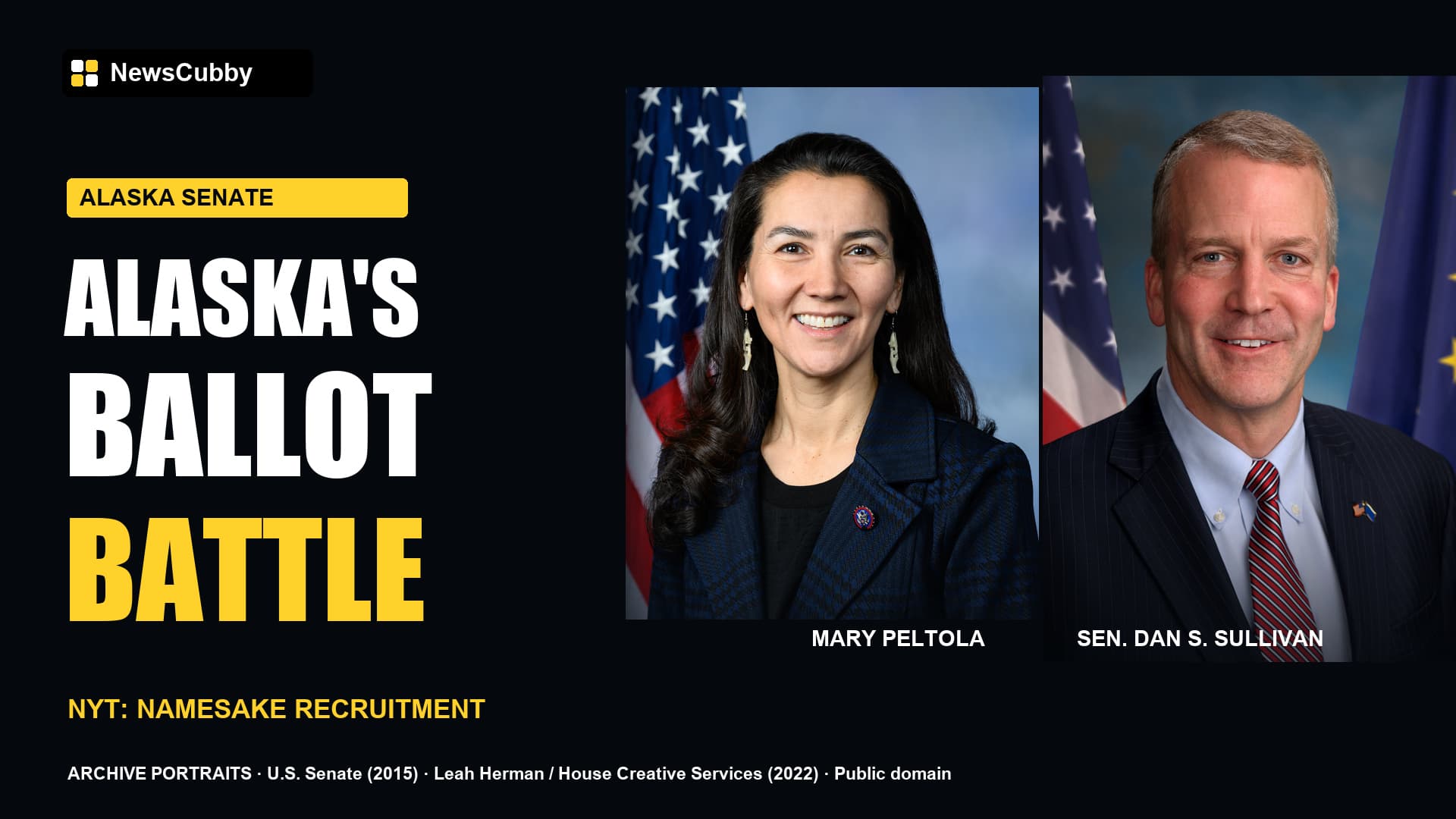
*ARCHIVE PORTRAITS: Mary Peltola, November 17, 2022 (Leah Herman / House Creative Services), and Senator Dan S. Sullivan, February 23, 2015 (United States Senate). Both public domain, U.S. government works via Wikimedia Commons. Cropped and combined with NewsCubby headline graphics; these are not photographs of the October 2026 reporting or of Daniel J. Sullivan Jr. No endorsement implied.*
*NewsCubby articles are produced with AI assistance and reviewed by humans.*
Sources, credits & editorial notes
- New York Times: Alaska ballot recruitment investigation
- Alaska Division of Elections: official general-election sample ballot
- Alaska Division of Elections: certified candidates
- AP: Challenger says candidacy was his choice
- Alaska Public Media: challenger switches to undeclared
- NRSC: FEC complaint alleging in-kind contribution violations
- Alaska Division of Elections: June 15 determination
- Alaska Supreme Court: June 29 order, S-19935
- US District Court: October 22 federal complaint
- US District Court: Alaska October 26 dismissal motion
- Alaska Public Media: state asks court to dismiss DOJ lawsuit
- Alaska Division of Elections: ranked-choice voting
- Photo: United States Senate; Public domain (archive portrait, 2015)
- Photo: Leah Herman / House Creative Services; Public domain (archive portrait, 2022)