Politics
DOJ says FBI and ICE staff will not serve as 2026 midterm poll monitors
A court filing narrows who may join the Justice Department’s November 3 monitoring teams, but the nationwide program continues and the NAACP’s challenge remains unresolved.
What to know
- The new commitment concerns election-monitor assignments; it is not a cancellation of the Justice Department’s nationwide program.
- The department’s own guidance distinguishes staff monitors from the narrower category of federal observers appointed under a court order.
- State and local officials administer polling places, and access rules for outside observers differ by jurisdiction.
- The NAACP’s challenge to the expanded program remains unresolved; the filing is a party statement, not a court ruling.
- The accessible public docket had not posted the late filing when NewsCubby checked Thursday morning, so the new details remain attributed to reporting about that document.
The Justice Department told a federal court that no FBI or Immigration and Customs Enforcement employee will serve as an election monitor in the November 3 midterms. Staff from the Bureau of Prisons, the Bureau of Alcohol, Tobacco, Firearms and Explosives, and the Drug Enforcement Administration may still participate as unarmed observers, and the wider nationwide monitoring plan remains in place.
How narrow is the new commitment?
Reuters and Associated Press separately reported the filing.
It does not answer every question about federal activity on Election Day. A monitor assignment is a defined role within the Civil Rights Division’s program. A criminal investigation, an emergency response or execution of a warrant would be a different activity. Earlier administration statements, summarized by the Associated Press, said immigration officers were not being sent to patrol voting sites but did not rule out action tied to a particular threat or warrant. The latest filing should therefore be read for what it covers, rather than as a promise about every possible federal operation.
It also does not end the monitoring program. The Justice Department has described a nationwide operation involving roughly 1,000 personnel. NewsCubby’s earlier explanation of the 1,000-monitor plan covers the announced scale, primary-season disputes and the initial litigation. The new development is a personnel boundary within that program.
The public RECAP docket for NAACP v. Blanche, No. 1:26-cv-03626 had not displayed the October 28 document when NewsCubby checked it Thursday morning. That access gap matters. This article does not present an unavailable declaration as if NewsCubby had read its full text; details unique to the late filing are attributed to the news organizations that reviewed it.
What does the Justice Department say election monitoring is for?
The Civil Rights Division’s official election-monitoring guide says the department sends attorneys and other staff to assess compliance with federal voting-rights laws. Those laws include the Voting Rights Act, the Help America Vote Act, the Americans with Disabilities Act and protections for military and overseas voters. Staff may watch election procedures and maintain contact with state and local officials.
That description is broader than investigating alleged fraud. The civil-rights mission includes whether eligible voters can enter a site, receive assistance when required, use accessible equipment and cast a ballot without discrimination. A monitor may record what happens and report it to the department, which can decide later whether follow-up is warranted. A monitor does not count ballots, certify results or replace the officials running the location.
The department has used staff monitoring for years. In an August 18 primary-election announcement, it said it had deployed more than 75 monitors across five states and more than 200 polling locations during the 2026 primary season. The same release said teams in Florida and Wyoming were checking compliance with federal law and promoting communication with election officials.
The dispute in 2026 is therefore not whether Justice Department personnel have ever watched elections. It concerns the size of the announced general-election effort, the mix of employees recruited for it, the program’s objectives and the conditions under which monitors may enter locally controlled voting sites.
How are DOJ staff monitors different from federal observers?
The department uses two related terms. Staff “monitors” are Justice Department personnel assigned by the Civil Rights Division. “Federal observers” are a specific group authorized through a federal court order under Section 3(a) of the Voting Rights Act. The Office of Personnel Management recruits, trains and supervises that observer group.
The Justice Department’s page on federal observers says court-authorized observers serve as neutral witnesses to election procedures in specified jurisdictions. The same page explains that the Civil Rights Division separately uses its own employees to monitor elections elsewhere.
The distinction has practical consequences. A court order may spell out access for a federal observer. A department employee sent as a staff monitor does not automatically receive the same authority merely because both roles involve watching an election. Local officials may ask for credentials, restrict the areas open to observers or decline access when state law does not permit it.
That is why calling every federal person at a voting site an “observer,” “monitor” or “agent” can obscure more than it clarifies. Readers should look at the person’s assigned role, the authority claimed for access and the rules that govern the particular polling place.
Who controls access inside a polling place?
State and local election authorities administer voting sites. The precise rules vary, so guidance from one state cannot simply be copied to another. The Justice Department itself has recognized the role of local permission. Its July announcement about monitoring Arizona’s primary said county officials issued credentials allowing federal staff to observe vote-casting procedures.
New York Attorney General Letitia James offered a state-specific explanation on October 27. Her office said federal monitors in New York may not demand identification from voters, challenge eligibility, direct poll workers, interfere with their duties, campaign or conduct political activity. The statement instructed local workers to refer an unannounced federal monitor to county election officials.
Those are New York instructions, not a national legal checklist. They illustrate the kind of boundaries a state may place around observation. Officials elsewhere may use different credentialing systems, distance rules or procedures for handling a visitor who claims a federal role.
For voters, the operational point is simple: election workers and designated local officials remain in charge of the site. If someone interferes with voting, a voter can alert a poll worker or local election office. That practical direction does not require a voter to decide on the spot whether a disputed action violates federal or state law.
What is the NAACP asking the court to do?
The NAACP, the Rev. Andre Miller, Nicholas Little and Daniella Pierre filed suit on October 16. Their complaint seeks to prevent the department from recruiting and deploying criminal prosecutors, law-enforcement agents and other criminal-enforcement personnel as election monitors. It also requests disclosure about selected jurisdictions, notice to local officials, consent, training and the federal statutes monitors are assigned to assess.
The plaintiffs invoke Section 11(b) of the Voting Rights Act, which addresses intimidation, threats and coercion connected to voting, and the Administrative Procedure Act. They allege that the scale and staffing of the 2026 program could deter voters, particularly people from communities with a history of intimidation at the polls.
Those are allegations, not judicial findings. The Justice Department rejects them. A spokesperson told Bloomberg Law that routine monitoring is meant to ensure compliance with federal law and that the suit rested on unwarranted fear. The court must evaluate the claims and requested relief; a filing from one side does not decide the merits.
The new personnel commitment may narrow the disagreement, but it does not necessarily eliminate it. The plaintiffs’ requested relief reaches beyond two named agencies and questions whether people whose ordinary jobs involve prosecution or enforcement should serve in the monitoring program at all.
The case is also separate from lawsuits about armed federal personnel near polls, demands for voter-registration data and litigation over ballot processing. NewsCubby’s report on the Ninth Circuit’s dismissal of a DOJ appeal involving California ballots concerns a different dispute and procedural record. Treating every election case as one combined controversy would blur the parties, the evidence and the decisions judges actually made.
What should voters expect on November 3?
Many people at a voting location may be there in legitimate but different roles: poll workers, local election officials, credentialed partisan or nonpartisan watchers, Justice Department monitors, attorneys and members of the public where observation is allowed. Their powers are not interchangeable.
A federal monitor’s presence does not transfer control of the site from election administrators. The department’s published materials describe monitors as watching procedures and communicating concerns, not directing voters or certifying the result. State rules determine where observers may stand and how they interact with workers.
The department had not published a complete final list of every monitored polling site when this article was prepared. That means voters should rely on their state or local election office for location-specific information. A national news report can explain the program, but it cannot tell a voter which credentials or access rules apply at every precinct.
Early voting is already underway in many states. NewsCubby’s early-vote tracker explains that totals released before Election Day measure participation, not completed results or a dependable forecast of the winner. The presence of monitors does not change that distinction.
What remains unresolved?
The court has not issued a final decision in the NAACP case. The late filing may affect arguments over whether an injunction is needed, but it is not itself an order. Further submissions could clarify whether the parties agree on any limits and what issues remain contested.
The final deployment map also remains incomplete in public. Counties and states have disclosed some notices from the department, while the complete list of sites and staffing has not been released. That leaves local officials to coordinate access as assignments are confirmed.
The next test is conduct. Election Day will show whether the department’s teams remain within the observer role described in its guidance and comply with the rules of the jurisdictions they enter.
*Want more? Explore today's headlines on NewsCubby and join My Day free to make NewsCubby part of your day.*
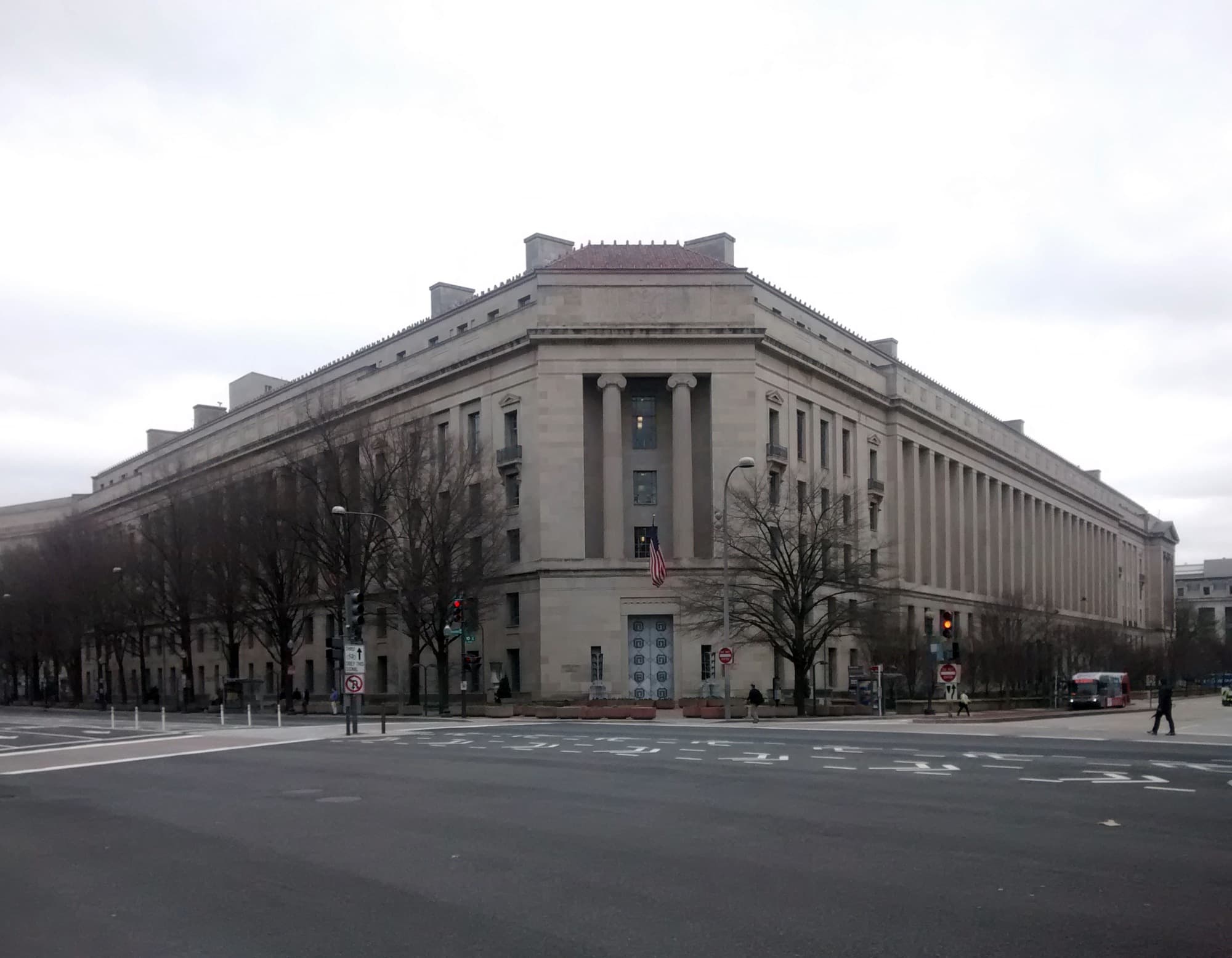
*ARCHIVE PHOTO — The Robert F. Kennedy Department of Justice Building in Washington, D.C., on April 4, 2014. Gunnar Klack / Wikimedia Commons, CC BY-SA 4.0; cropped or resized as needed. CC BY-SA 4.0.*
*NewsCubby articles are produced with AI assistance and reviewed by humans.*
Sources, credits & editorial notes
- Reuters: DOJ says FBI and ICE employees will not serve as midterm poll monitors
- Associated Press via The Independent: DOJ limits FBI and ICE monitoring roles
- CourtListener: NAACP v. Blanche public docket
- Bloomberg Law: NAACP challenges DOJ election-monitor program
- U.S. Justice Department: Federal election monitoring guide
- U.S. Justice Department: About federal observers and election monitoring
- U.S. Justice Department: Florida and Wyoming primary monitoring announcement
- U.S. Justice Department: Arizona primary monitoring announcement
- New York Attorney General: State rules for federal election monitors
- Associated Press: DOJ election-monitor plan and litigation background
- Associated Press: Administration statements on ICE activity at voting sites
- Democracy Docket: NAACP election-monitor interference challenge
- Photo: Gunnar Klack / CC BY-SA 4.0