Politics
Dolores Huerta dies at 96: What the farmworker organizer changed
The United Farm Workers co-founder turned a teacher’s outrage into contracts, voting campaigns and a durable organizing model while insisting that Filipino farmworkers’ role in the Delano strike be remembered.
What to know
- Huerta died on October 28, 2026, at age 96.
- She and Chávez founded the National Farm Workers Association in 1962. Filipino workers in the Agricultural Workers Organizing Committee began the Delano grape strike in 1965, and the groups later merged into the organization that became the United Farm Workers.
- Huerta helped direct the national grape boycott, negotiate contracts and win support for California’s 1975 Agricultural Labor Relations Act, which established collective-bargaining rights for farmworkers.
- “Sí, se puede” is often rendered as “Yes, we can,” though “Yes, it is possible” is a closer translation. Huerta created the phrase as a statement that organized people could overcome political resistance.
- Her later work through the Dolores Huerta Foundation linked labor rights with voting, women’s leadership, education and environmental justice.
Labor and civil-rights leader Dolores Huerta died Wednesday, October 28, at age 96, according to her foundation.
A family spokesperson told The Associated Press and Agence France-Presse that the cause was cancer. Her death closes a life that connected California farm fields to union bargaining tables, state lawmaking, voter-registration drives and national civil-rights campaigns.
The record is larger than any slogan. Huerta organized workers and consumers, negotiated contracts, lobbied for legislation and trained people to act for themselves. She also spent decades navigating institutions in which Mexican American women were rarely allowed to lead.
How did a teacher become an organizer?
Huerta was born Dolores Clara Fernández on April 10, 1930, in Dawson, New Mexico. The National Park Service says her father, Juan Fernández, worked as a farm laborer and miner, participated in union activity and was elected to the New Mexico legislature in 1938. After her parents divorced, Huerta moved with her mother, Alicia Chávez, and two brothers to Stockton, California.
Stockton’s multiracial working-class neighborhoods shaped her view of community. Her mother ran a hotel that welcomed low-income residents and modeled a form of practical generosity. Huerta earned a teaching credential and taught children from farmworker families. She later explained that seeing students arrive hungry and without adequate shoes persuaded her that organizing their parents could change more than classroom work alone.
She joined the Community Service Organization, where she registered voters, challenged discrimination and learned how local problems could become legislative campaigns. The U.S. Labor Department credits her early lobbying with measures affecting Spanish-language driver’s-license testing, aid for farmworker families and disability insurance. Those campaigns reveal an approach she would use repeatedly: begin with a concrete need, identify who has the authority to act, build public pressure and negotiate language that can be enforced.
That connection between daily hardship and civic power remains visible in current coverage of how election monitors affect voters’ rights. Huerta’s work did not treat voting as a ceremonial act. Registration, turnout and contact with public officials were tools for communities whose workplace demands were otherwise easy to ignore.
What did Huerta build with farmworkers?
In 1962, Huerta and Chávez left the Community Service Organization to form the National Farm Workers Association. The familiar shorthand that they “started the farmworker movement” leaves out essential people and chronology. On September 8, 1965, Filipino farmworkers organized through the Agricultural Workers Organizing Committee walked out of the vineyards in Delano. Leaders included Larry Itliong and Philip Vera Cruz. The National Farm Workers Association joined the strike later that month.
The two organizations merged in 1966 into the United Farm Workers Organizing Committee, which later became the United Farm Workers. Keeping that sequence clear does more than distribute credit fairly. It shows that the movement’s power came from cooperation across Filipino and Mexican American communities and from rank-and-file workers who were already taking risks before national attention arrived.
Huerta became a principal strategist. She directed boycott work on the East Coast, helped persuade consumers not to buy nonunion grapes and built alliances with unions, religious groups and civil-rights organizations. The boycott turned a purchase in a supermarket far from California into a choice about the conditions under which food was harvested. The long campaign helped produce collective-bargaining agreements in 1970.
As a negotiator, Huerta translated public support into contract terms. Reuters reported that UFW agreements delivered gains including job security, health care, retirement plans, rest periods, field toilets, clean drinking water and pesticide protections. No single agreement covered every worker or solved every abuse. The agreements showed that people excluded from federal labor protections could organize enough economic and political power to win enforceable changes.
That lesson matters when workers confront modern exit offers or restructuring. NewsCubby’s guide to what workers should know about corporate buyouts addresses a very different workplace, but the underlying question is familiar: what information, representation and bargaining power does an individual have when an institution sets the terms?
What changed because of the boycott and state law?
The 1970 contracts were milestones, but contracts expire and organizing gains can be reversed. Huerta also worked in Sacramento for a legal framework that would outlast a single bargaining round. California enacted the Agricultural Labor Relations Act in 1975, creating a state process for farmworkers to choose representation and bargain collectively.
The law did not end conflict in the fields. Enforcement, elections, retaliation claims and changes in agricultural employment continued to generate disputes. Its significance was structural: farmworkers gained a recognized route to organize under state law after being excluded from the National Labor Relations Act’s principal federal framework.
Huerta’s environmental advocacy grew from the same workplace reality. Pesticide exposure was not an abstract conservation issue for people required to enter treated fields or bring residues home on clothing. The Labor Department’s historical account describes her insistence that clean water, sanitation and protection from dangerous chemicals belonged in the definition of labor rights. Her work joined wage demands to health, family life and environmental justice.
The risks were personal. Huerta was arrested more than 20 times, according to Reuters and federal historical records. During a 1988 protest in San Francisco, police officers beat her with batons, breaking ribs and severely injuring her spleen. She recovered and returned to organizing. The incident became part of her public argument that nonviolent protest requires institutions to be accountable for the force they use.
Why did “Sí, se puede” endure?
Huerta coined “Sí, se puede” during an organizing campaign in Arizona in 1972, when critics argued that change there could not be won. The phrase is commonly translated as “Yes, we can,” and Barack Obama’s 2008 campaign popularized that English version. The National Archives renders it as “Yes, it is possible.” The original phrase rejected the claim that collective action was futile.
Huerta’s method depended on repeated, often unglamorous work: house meetings, voter registration, training, phone calls, boycotts, contract language and follow-up. A chant could focus people, but organization made the chant credible. That is why the phrase traveled beyond labor campaigns to immigration, women’s rights and electoral organizing.
President Bill Clinton awarded Huerta the Eleanor Roosevelt Award for Human Rights in 1998. President Barack Obama presented her with the Presidential Medal of Freedom in 2012. The White House citation described her as an advocate who strengthened communities and trained future leaders.
How did her work expand beyond the fields?
Huerta established the Dolores Huerta Foundation in 2002 to develop grassroots leaders in California’s Central Valley and beyond. Its work has included civic participation, education, health, environmental protection and support for women seeking public leadership. The foundation addresses those subjects together because the same residents can be workers, voters, tenants and caregivers.
She continued traveling, speaking and registering voters into her 90s. Her attention to who can participate connects to the practical questions in NewsCubby’s report on rallies that paired protest with voter outreach. A rally can attract attention, but registration rules, accessible information and sustained local work determine whether attention becomes civic power.
The foundation lists 14 children, 24 grandchildren, 23 great-grandchildren and seven great-great-grandchildren. It also announced a Peace and Justice Cultural Center planned for California’s Central Valley in 2027.
How should her 2026 disclosure be understood?
In a statement she published on March 18, 2026, Huerta said Chávez pressured her into sex once and forced her against her will another time during the 1960s, and that both encounters resulted in pregnancies. No court finding is cited in the sources reviewed for this article. Chávez died in 1993 and cannot respond.
Huerta said she had stayed silent to protect the movement and that its gains belonged to thousands.
What remains of Huerta’s organizing model?
Huerta’s most durable contribution may be a sequence rather than a single policy: listen to people closest to a problem, turn their experiences into shared demands, build alliances, create economic or political pressure, negotiate a concrete result and train others to continue. It is slower than a viral moment and less dependent on one famous leader.
Agricultural work has changed, and farmworkers still face low pay, heat, pesticide exposure, immigration vulnerability and obstacles to organizing. Historic victories do not establish current conditions, but they provide precedents showing how workers excluded from major legal protections acted together.
The record beneath the slogan includes the workers who called the first strike, the negotiators who wrote contract clauses, the volunteers who registered voters and the people omitted from early versions of the story. Huerta’s career shows how those roles combined in a sustained campaign.
What happens next?
The family has requested privacy. Further memorial arrangements remain for its official announcements.
Future memorials and histories can draw on a record that includes the Filipino-led start of the Delano strike, the women who sustained boycott networks, the contract gains, the environmental-health work and Huerta’s own statement about Chávez.
*Want more? Explore today's headlines on NewsCubby and join My Day free to make NewsCubby part of your day.*
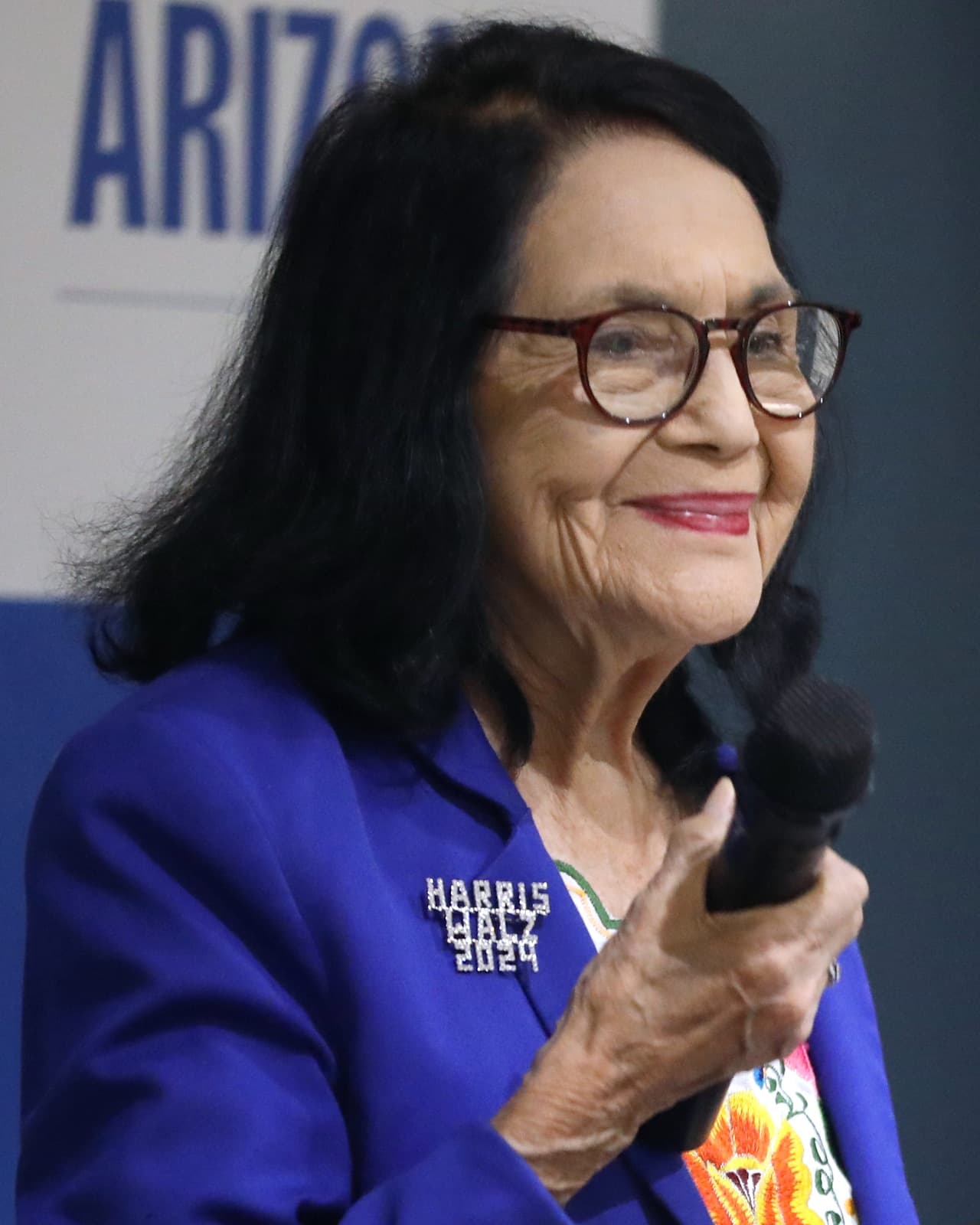
*ARCHIVE PHOTO: Dolores Huerta at a press conference at Teamsters Union Local 104 in Phoenix, Arizona, on August 28, 2024. Gage Skidmore / Wikimedia Commons, CC BY-SA 2.0. Cropped for NewsCubby; ShareAlike applies. No endorsement implied. CC BY-SA 2.0.*
*NewsCubby articles are produced with AI assistance and reviewed by humans.*
Sources, credits & editorial notes
- Dolores Huerta Foundation — In Memory of Dolores Huerta
- Associated Press — Dolores Huerta dies at 96
- Agence France-Presse — Pioneering U.S. labor leader Dolores Huerta dies at 96
- Reuters — Dolores Huerta, U.S. labor leader and force for human rights, dies at 96
- Dolores Huerta — statement published March 18, 2026
- National Park Service — Dolores Huerta biography
- National Park Service — Dolores Huerta and the farmworker movement
- U.S. Department of Labor Hall of Honor — Dolores Huerta
- National Archives — Dolores Huerta: Sí, se puede
- Obama White House Archives — Presidential Medal of Freedom ceremony
- Photo: Gage Skidmore / CC BY-SA 2.0