Science
Is the 'Mystery Asteroid' 1998 KY26 Heading for Earth? What NASA Data Shows
A tiny asteroid that speeds up in ways gravity alone can't explain has sparked a lost-Soviet-probe theory. It's about 188 million miles away, and NASA says nothing is about to hit us.
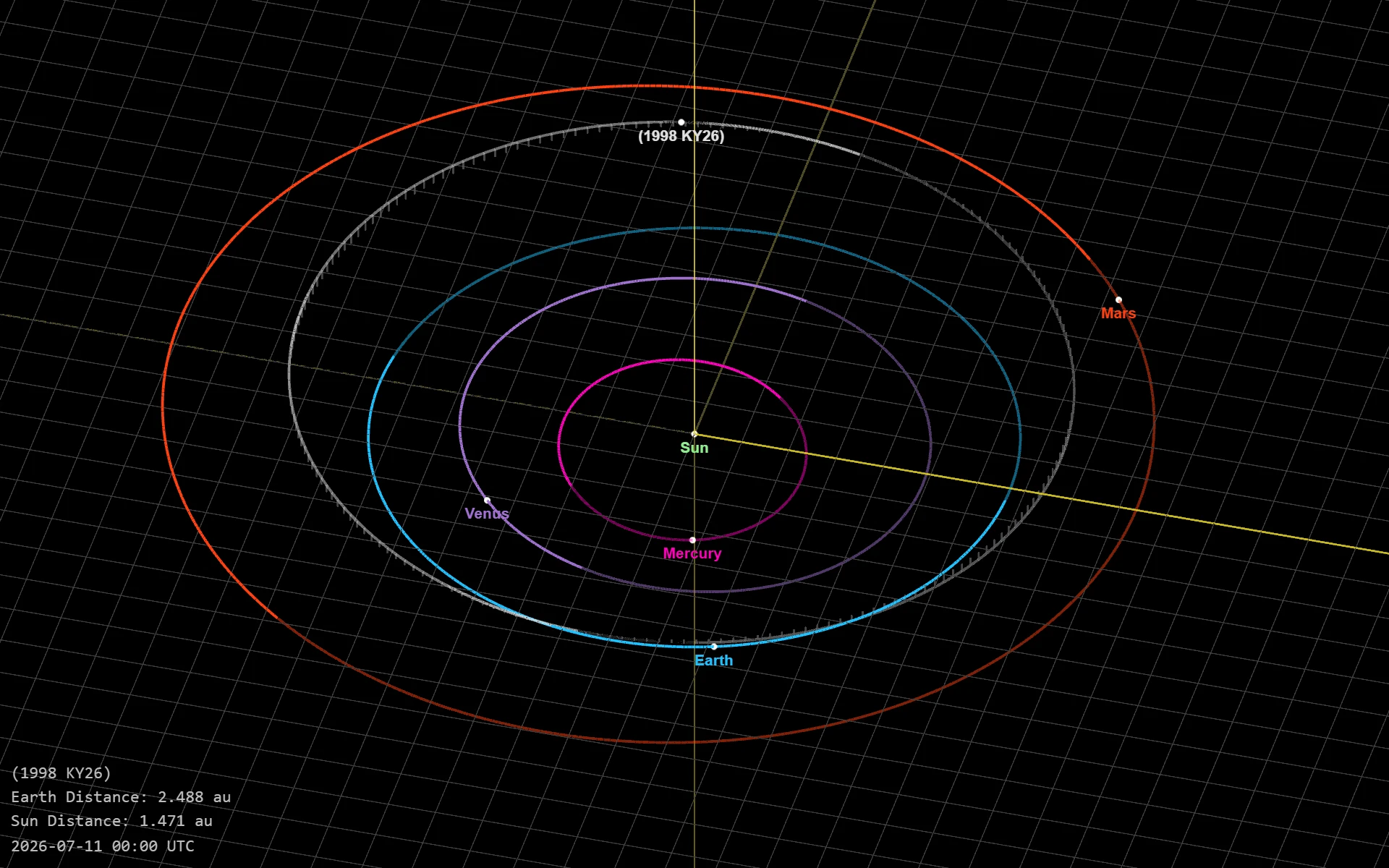
What to know
- **What it is:** 1998 KY26 is an Apollo-type near-Earth asteroid about 11 meters (36 feet) across that spins once every 5.35 minutes, according to NASA's Jet Propulsion Laboratory (JPL).
- **Where it is:** About 2.03 astronomical units from Earth on Nov. 13, 2026, or roughly 188 million miles (303 million km), per JPL's Horizons system.
- **Impact risk:** None listed. It does not appear on NASA's Sentry impact-monitoring list or on the European Space Agency's risk list, and NASA does not class it as potentially hazardous.
- **Next close approaches:** March 9, 2028, at about 35.6 million miles, and Sept. 20, 2028, at about 32.7 million miles. Its closest predicted pass through 2045 is May 24, 2039, at about 10 million miles, roughly 42 times the distance to the Moon.
- **Why it's in the news:** A new study says it is too warm to hide ice, weakening the "dark comet" idea, while Harvard's Avi Loeb has proposed it could be a lost Soviet spacecraft. That idea is unproven.
The "mystery asteroid" making headlines this week is 1998 KY26, a small near-Earth asteroid about 36 feet (11 meters) wide. It is not on a collision course with Earth. NASA's own orbit data puts it about 188 million miles away right now, and its next close approaches, in 2028, are tens of millions of miles out. What makes it a mystery is how it moves: it is speeding up slightly in a way gravity alone does not explain.
"First of all, nothing is about to hit us, to be very clear on this," NASA Administrator Jared Isaacman said Thursday, Nov. 12, on *Fox & Friends*. "I've not seen any evidence to suggest this is a threat to our planet or anything other than an asteroid."
Is 1998 KY26 coming toward Earth?
Only in the ordinary sense that its orbit brings it back near Earth every few years. JPL's Horizons data show the distance between Earth and KY26 is shrinking right now, at about 11 kilometers per second, as the two bodies move toward the 2028 encounters. But even the closer of those two 2028 passes keeps it roughly 137 times farther away than the Moon.
Here are the numbers from JPL's close-approach database:
| Date (UTC) | Distance from Earth | In lunar distances | |---|---|---| | June 1, 2024 (last close pass) | ~2.85 million miles (4.6 million km) | ~12 | | March 9, 2028 | ~35.6 million miles (57.2 million km) | ~149 | | Sept. 20, 2028 | ~32.7 million miles (52.6 million km) | ~137 | | May 24, 2039 | ~10.1 million miles (16.2 million km) | ~42 |
Even if an object this small did hit Earth someday, an 11-meter asteroid would be smaller than the roughly 18-meter rock that exploded over Chelyabinsk, Russia, in 2013. But no impact is predicted.
Why do scientists call it a mystery?
KY26 shows what astronomers call "nongravitational acceleration": a tiny extra push beyond the pull of the Sun and planets. JPL's current orbit solution includes non-gravitational terms to fit the observations.
One explanation was that KY26 is a "dark comet," an object that looks like an asteroid but quietly releases gas from buried ice. A new peer-reviewed study in the journal *Icarus* by Georgia Tech aerospace engineers Korbin Hansen and Masatoshi Hirabayashi tested that idea. They found even KY26's coldest regions average at least 212 Kelvin (about minus 61 C), far too warm for buried water ice, which needs to stay below about 145 K. Their calculated water-loss rates "preclude 1998 KY26 being a dark comet at present," they wrote.
That leaves more ordinary forces in play. Earlier research found sunlight striking KY26 and heat escaping its surface could produce the extra push. A separate 2026 study in *Astronomy & Astrophysics* found its light is consistent with a rocky asteroid that likely came from the inner asteroid belt.
Is it a lost Soviet spacecraft?
That's the most unusual theory, and it is **unproven**. Harvard astrophysicist Avi Loeb and researchers Adam Hibberd and Adam Crowl compared KY26 with Phobos 1, a Soviet Mars probe launched in July 1988 that stopped communicating later that year. They report that a simplified model of the spacecraft matched eight sets of brightness observations and could explain the extra push through sunlight pressing on its surfaces. The researchers themselves call the idea "strongly plausible but presently unproven," and it has not been confirmed by other scientists.
Isaacman said NASA continues to monitor KY26 but has "no reason to believe this is in any way remotely a threat to our planet or anything other than just an asteroid."
When will we know for sure?
Japan's Hayabusa2 spacecraft is on its way to KY26, with a rendezvous planned for July 2031. Its cameras should show for the first time what the object actually looks like up close.
Not the only space rock this week
Several small asteroids pass Earth safely every week. On Nov. 12, a car-size asteroid called 2026 VC11, about 15 feet wide, passed about 73,600 miles from Earth, closer than the Moon, according to NASA JPL's Asteroid Watch. It posed no danger and has nothing to do with KY26.
For more NASA news, see why astronauts are preparing to print blood vessels in space, how NASA is testing batteries for the lunar cold, and Christina Koch's new NASA engineering role.
*Want more? Explore today's headlines on NewsCubby and join My Day free to make NewsCubby part of your day.*
*NewsCubby articles are produced with AI assistance and reviewed by humans.*
Reporting Sources
- NASA JPL Small-Body Database, 1998 KY26 (orbit class, size 0.011 km, albedo 0.52, rotation 0.0892 h, not PHA,…
- NASA JPL SBDB Close-Approach Data API (2024, 2028, 2039 approaches)
- NASA JPL Horizons (Earth distance 2.027 au and range rate on Nov. 13, 2026)
- NASA CNEOS Sentry (1998 KY26 not listed)
- ESA NEOCC risk list, updated 04:49 UTC Nov. 13, 2026 (1998 KY26 not listed)
- NASA JPL Asteroid Watch, next five approaches (2026 VC11)
- Fox News, Greg Wehner, Nov. 12, 2026 — Isaacman quotes, Loeb/Hibberd/Crowl paper, Phobos 1
- ScienceAlert, Michelle Starr, Nov. 8, 2026 — Icarus study details, Hayabusa2 July 2031
- Hansen & Hirabayashi, *Icarus* (2026), DOI 10.1016/j.icarus.2026.117361
- NDTV, Nov. 2026 — 186 million miles context, Loeb idea not confirmed by others
Photo & Video Credits
Credit: Image: NASA/JPL-Caltech. License: Public domain. Source: file page.